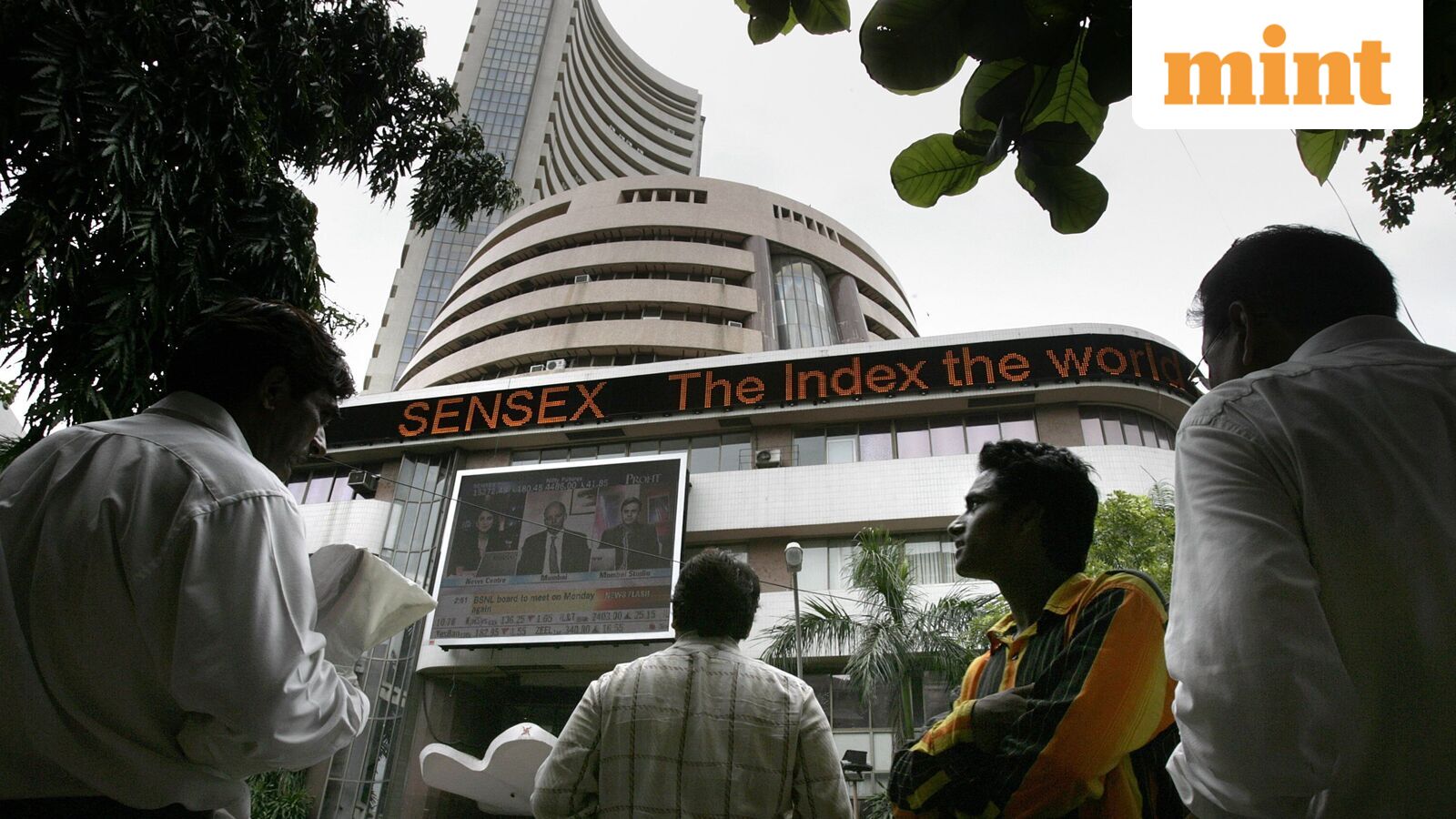
Indian stock market: The Indian stock market ended the holiday-shortened week on a positive note, posting modest gains in three of the four trading sessions.
Key benchmark Nifty reclaimed and held above the key psychological level of 24,000, reflecting resilience despite ongoing global volatility. For the week, the Sensex rose 0.39% to close at 77,100.47, while the Nifty added 0.18% to end at 24,056.
The steep fall in crude oil prices emerged as the key positive catalyst for domestic equities. With tanker traffic through the Strait of Hormuz returning to normal and geopolitical tensions in West Asia easing, Brent crude slipped back to near pre-conflict levels. The decline eased worries over imported inflation, India’s current account deficit, and pressure on corporate profit margins.
Investor sentiment was further buoyed by optimism over a potential India–US trade agreement, while the return of selective foreign institutional investor (FII) buying following intermittent outflows added to overall market confidence.
Stock Market Outlook next week
According to Ponmudi R, CEO – Enrich Money, the week ahead is likely to be shaped by developments on the geopolitical front, with investors closely monitoring tensions in the Middle East following the latest military exchanges involving US and Iranian forces.
Ponmudi further noted that while broader diplomatic efforts remain in place, the recent flare-up has reminded markets that geopolitical risks remain elevated. Any signs of renewed negotiations or de-escalation could help sustain the recent improvement in risk sentiment, while a further deterioration in relations may prompt a reassessment of global growth and energy market expectations.
“Crude oil prices will remain a critical market variable. The recent decline in energy prices has provided meaningful support to India’s macroeconomic outlook and helped underpin investor confidence. However, any disruption to the improving supply outlook or renewed concerns surrounding regional stability could quickly reverse the recent correction in crude prices and weigh on global equities.
The latest US inflation data, which rose above the 4% mark for the first time in three years, has reinforced expectations that the Federal Reserve may need to maintain a tighter monetary stance. As a result, movements in US Treasury yields and foreign capital flows are likely to remain important drivers of market sentiment in the week ahead,” he said.
On the domestic front, the progress of the southwest monsoon will remain a key area of focus for investors. Rainfall deficiencies in several agricultural regions have raised concerns over crop output, prompting the government to prepare contingency measures to mitigate potential disruptions to agricultural production. Any prolonged weakness in monsoon activity could affect rural demand, elevate food inflation pressures and influence broader economic sentiment, making monsoon developments an important factor for markets to monitor in the weeks ahead, Ponmudi added.
Top 5 triggers for the Indian stock market
1] India-US trade deal
India and the United States are on the verge of concluding a trade agreement, Commerce and Industry Minister Piyush Goyal said on Thursday, a day after concluding discussions with US Trade Representative Jamieson Greer. The proposed pact is widely viewed as a key step in strengthening bilateral economic ties.
Greer visited New Delhi for two days this week to lead the latest round of negotiations on the agreement, which has been under discussion for several months. The talks come amid diplomatic strains that have added complexity to the negotiations.
India is seeking a tariff rate lower than those applied to exports from other Asian economies, while the US is pressing for greater access for American products in the Indian market.
In February, the two countries reached a preliminary trade understanding that envisaged an 18% tariff on Indian goods in return for India reducing trade barriers and increasing imports of US products.
2] US-Iran war
The US carried out strikes on Iran on Friday in response to a drone attack on a cargo vessel in the Strait of Hormuz, an incident that US President Donald Trump said breached the ceasefire agreement.
Earlier on Thursday, the British military reported that a vessel off the coast of Oman had been struck by a projectile, further heightening tensions at a time when Washington and Tehran are engaged in delicate negotiations over an interim peace deal.
Separately, Trump warned of imposing a 100% tariff on imports from countries that levy digital services taxes on US. companies, explicitly naming European nations. In a social media post, he said such countries were considering “imminent” digital taxes and asserted that the proposed tariff would supersede any existing trade agreements.
3] Crude oil prices
Crude oil prices declined by more than 3% on Friday, heading for sharp weekly losses as oil tankers continued to transit the Strait of Hormuz, easing supply concerns a day after a cargo ship was struck near Oman.
Brent crude futures settled at $71.99 per barrel, down $3.27, or 4.34%, while U.S. West Texas Intermediate (WTI) crude ended at $69.23 per barrel, falling $2.69, or 3.74%.
On a weekly basis, Brent dropped 10.86% and WTI lost 9.62% compared with last Thursday’s close. Markets remained shut last Friday due to a public holiday.
4] FII outflows
After emerging as net buyers in the previous week, foreign institutional investors (FIIs) reverted to selling this week, offloading shares worth ₹2,080 crore in the Indian market, according to provisional exchange data.
Meanwhile, domestic institutional investors (DIIs) remained net buyers, investing ₹11,100 crore during the week.
For June so far, FIIs have recorded cumulative net sales of ₹45,130 crore, while DIIs have made net purchases worth ₹76,160 crore.
“Indian markets saw modest FII buying in the week ended 25 June, with provisional cash-market net FII inflows of roughly ₹380 crore on 25th June, while DIIs remained notable buyers supporting the rally. Given steady global cues, easing crude and a resilient domestic macro backdrop, expect a cautiously positive near-term outlook: range-bound upside with sectoral leadership from financials, tech and select cyclicals, but keep an eye on global risk sentiment and earnings cues for directional conviction,” said Vinit Bolinjkar – Head of Research- Ventura.
5] Rupee vs Dollar
The Indian rupee ended Thursday on a stronger note and also posted modest gains for the week, supported by declining crude oil prices, which lifted market sentiment, and signs of improving foreign portfolio inflows. However, investor caution persisted amid concerns that the US Federal Reserve could raise interest rates.
The rupee appreciated around 0.3% during the session to settle at 94.3950 against the US dollar. On a weekly basis, the currency was largely unchanged. Indian financial markets remain closed on Friday due to a local holiday. Although the rupee climbed to its highest level in over a month during early trade, it surrendered part of its gains later in the day as importers stepped up month-end dollar purchases and maturing non-deliverable forward (NDF) contracts also weighed on the currency.
Disclaimer: This story is for educational purposes only. Please consult with an investment advisor before making any investment decisions.
About The Author