The Indian Rupee (INR) trades strongly against the US Dollar (USD) on Thursday, extending the rally to near 94.28. The Indian currency gains significantly as a juggernaut mobilisation of foreign exchange in India through the Reserve Bank of India’s (RBI) Foreign Currency Non-Resident (FCNR) (B) deposits window has increased FX reserves.
According to a Reuters report, India attracted a much larger-than-expected $136.38 billion through special foreign-currency mobilisation schemes, the RBI said on Wednesday, empowering the Indian central bank to contain more pressure.
In the last several months, the RBI was seen intervening in spot and Non-Deliverable Forward (NDF) markets to support the Indian currency against excessive one-sided volatile moves amid geopolitical uncertainty.
In addition to a significant inflow of foreign funds through the RBI’s special foreign exchange window, weakness in the US Dollar has also pressured USD/INR.
Soft US private labor data hurts US Dollar
The US Dollar Index (DXY), which gauges the Greenback’s value against six major currencies, fell sharply on Wednesday and has extended its decline on Thursday to near 99.28 so far in the Asian session.
The Greenback came under pressure after the US ADP reported that the private sector created 38K fresh jobs in August, fewer than 47K estimate and the prior release of 46K. This has set a weak stage for the Nonfarm Payrolls (NFP) data for August, which will be published on Friday.
Investors will closely track the US NFP data as it is expected to influence market expectations for the Federal Reserve’s (Fed) monetary policy outlook.
On Wednesday, New York Fed Bank President John Williams expressed confidence that the labor market is “stable and solid”, and inflation expectations are “contained”.
India growth surprise narrows room for RBI to stay dovish
Analysts at Societe Generale highlight that India’s “reported 2Q26 real GDP growth of 7.8%, 80bp above the RBI’s forecast,” suggests aggregate demand is absorbing “tighter financial and adverse external conditions more comfortably than previously assumed.” They stress that the upside surprise was “reasonably broad-based,” noting that real GVA “expanded 8.2%, services grew 10.0%, manufacturing 9.2% and gross fixed capital formation 11.9%, while private consumption rose 7.1%.”
Societe Generale adds that this “supercharged growth comes on the back of a massive upward revision to the 1Q26 real GDP and real GVA growth by 0.80 percentage points each,” which in their view “reduces the downside growth cost of additional monetary tightening and suggests that the economy is operating with less spare capacity than embedded in the RBI’s current FY27 growth projection of 6.7%.”
At the same time, the bank cautions that the principal downside risks to this assessment would be “a sharp reversal in food and energy prices, a material weakening in domestic activity, or evidence that the exceptional GDP print overstates underlying demand momentum (which we believe is likely the case).”
Technical Analysis: USD/INR extends distance with 20-day EMA on the downside
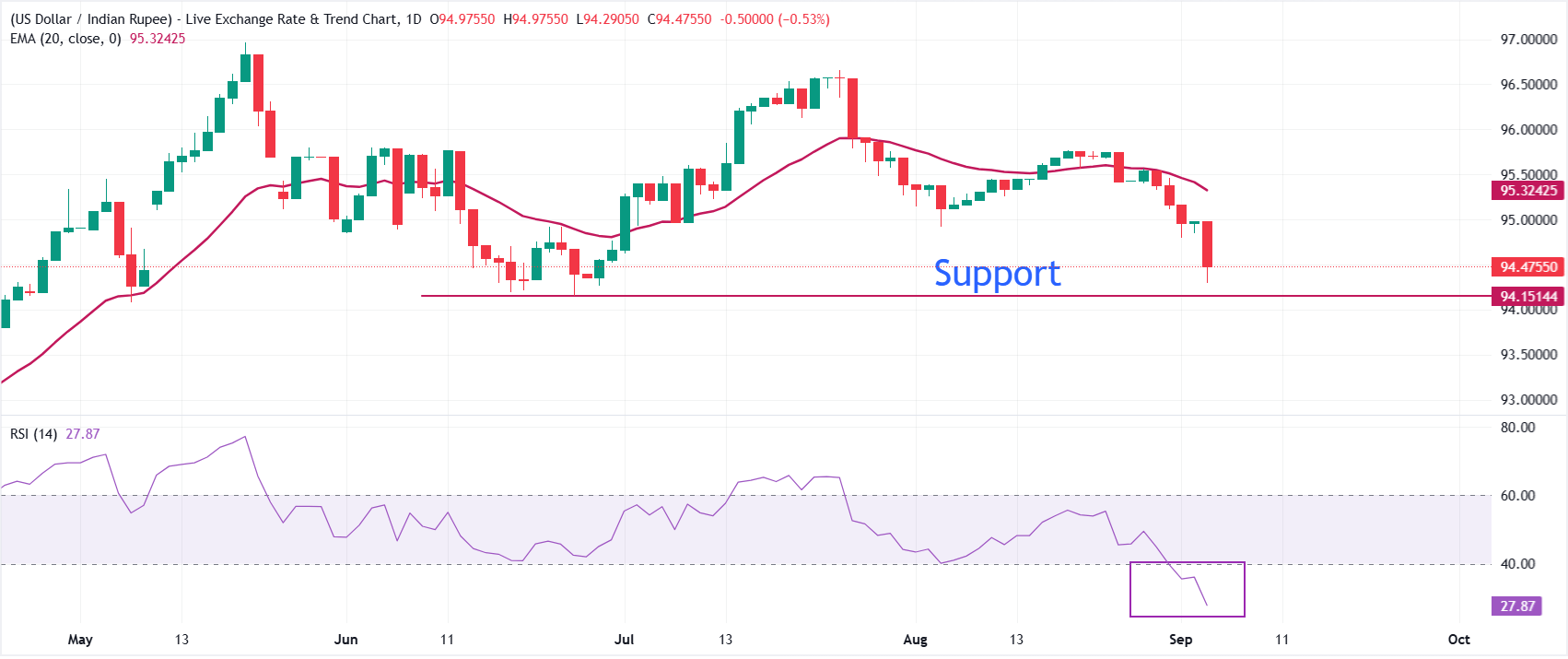
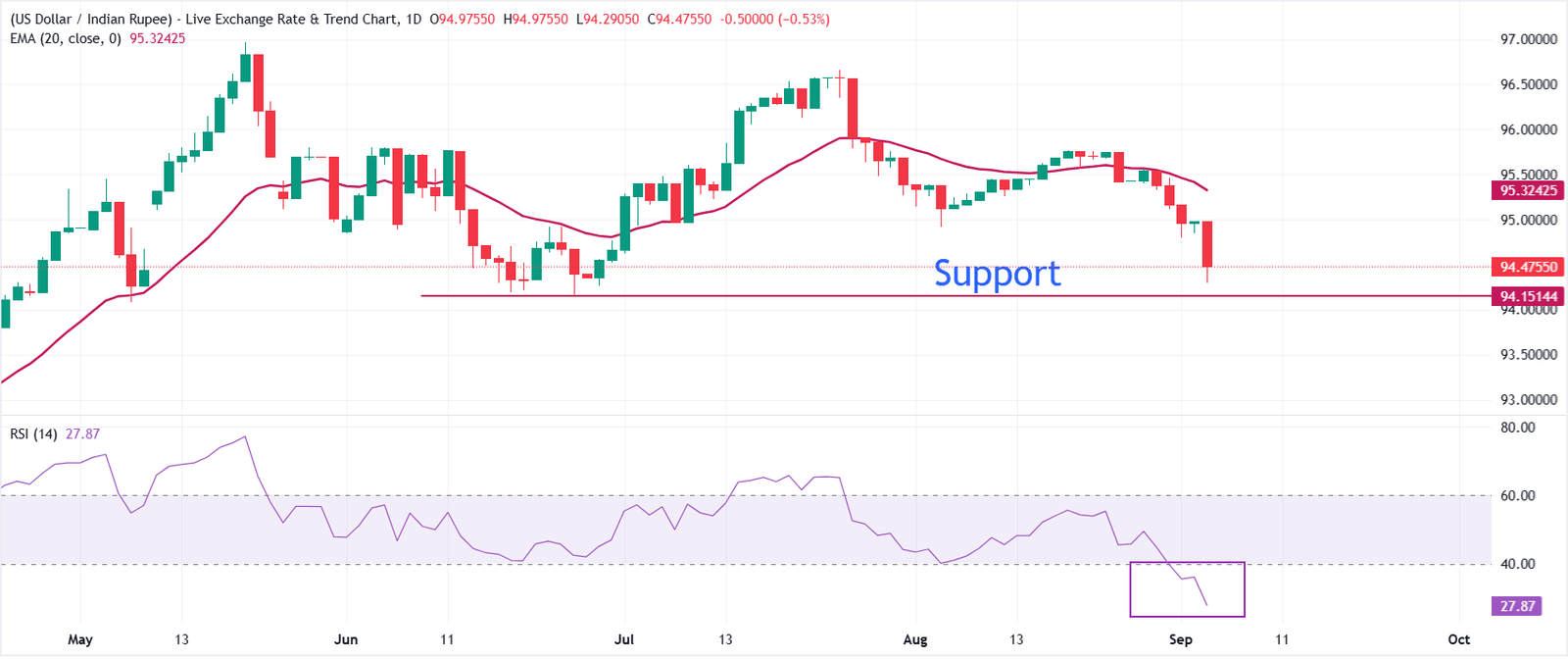
In the daily chart, USD/INR trades at 94.48, keeping a bearish near-term bias as spot holds below the 20-period exponential moving average (EMA) at 95.32.
The bearish structure is reinforced by price trading under this key trend reference, while the Relative Strength Index (14) at 27.96 slips into oversold territory, hinting that while selling pressure dominates, the downside could start to lose momentum if sub-95 levels persist.
On the topside, initial resistance is provided by the 20-day EMA at 95.32, and a daily close back above this barrier would be needed to ease immediate downside pressure and signal room for a corrective bounce. Looking down, the pair is expected to find support near the June 25 low at 94.16.
(The technical analysis of this story was written with the help of an AI tool. Know more.)
Williams flags strong economy behind higher yields, keeps Fed focused on 2% inflation
Fed’s Williams delivers a slightly above-baseline tone, with a 6/10 FXS Speechtracker score versus a 5.9/10 historical average, emphasizing that rising yields reflect a strong economy and robust outlook rather than worsening inflation expectations. The focus on tariffs and Middle East conflict as key drivers of above-target inflation, alongside contained expectations and a trend toward lower inflation, signals confidence in the disinflation process but underscores that achieving 2% remains “job number one.” Overall, the combination of solid labor market conditions and strong investment demand pushing yields higher points to a still-resilient backdrop for the Dollar and risk assets, even as geopolitical risks are acknowledged.
The FXS Fed Sentiment Index slipped by 1.42 points to 127.44, indicating a modest pullback in perceived hawkishness despite remaining firmly above the neutral 100 mark. This configuration suggests that, while the Fed stance is still clearly in hawkish territory, the speech nudges expectations slightly toward a more balanced policy outlook, consistent with the marginally higher but near-baseline FXS Speechtracker score.
About The Author