Hello, this is Priyanka Salve, writing to you from Singapore.
Welcome to the latest edition of “Inside India“— your one-stop destination for stories and developments from the world’s fastest-growing large economy.
India is home to the world’s most prolific filmmaking industry. This week, industry executives told me that generative AI adoption is accelerating as producers seek to meet rising content demand in the country’s $32 billion media and entertainment sector while navigating tighter budgets.
Read on!
Any thoughts on today’s newsletter?Share themwith the team.
The big story
While Hollywood continues to work out how best to use AI and debates its effect on jobs, filmmakers in India — the world’s most prolific movie production industry — have taken the next step.
In October last year, JioStar, a joint venture between Indian billionaire Mukesh Ambani-owned Reliance Industries and Walt Disney, launched a 100-episode series that used generative AI to produce a retelling of the Indian mythological epic “Mahabharat.”
The series, “Mahabharat: Ek Dharmayudh,” garnered 6.5 million views on its launch day, with its performance exceeding 2.1 times the platform average, JioStar’s Senior Vice President of GenAI Content and Technology Stephan Bugaj told CNBC by email.
Bugaj added that the series was never meant to be “a one-off experiment” for the platform and is the first step in exploring how AI can “expand the boundaries of storytelling.”
And they aren’t the only ones.
Indian production houseAbundantia Entertainment is preparing for the theatrical launch of “Chiranjeevi Hanuman – The Eternal,” based on the mythology around an Indian deity and described as India’s first AI-generated feature film by local media.
“Made in India: the Titan story,” a series streaming on Amazon’s MX Player, has used over 100 AI shots to recreate Mumbai of the 1970s, said Prasad Gori, an AI artist who has worked on the project with his partners Anurag Tiwari and Sagar Chogale.
There has been a boom in AI-related production work in the last eight months, Gori said, adding that he now gets 10-15 offers for such jobs every week. Three years ago, he had to chase production firms for work.
India’s media and entertainment market was valued at $32 billion in 2025 and is growing at 9%, a faster rate than the broader economy, according to a report by consultancy firm Ernst & Young in March.
Generative AI tools can create films and content on a grand scale at much lower cost than traditional methods, but the real benefit is that it cuts down production timelines, according to Neil Shah, vice president of research at Counterpoint Research.
“There is a huge demand for content in India,” Shah said in a telephone interview, adding that it makes “time to market” a crucial element for success.
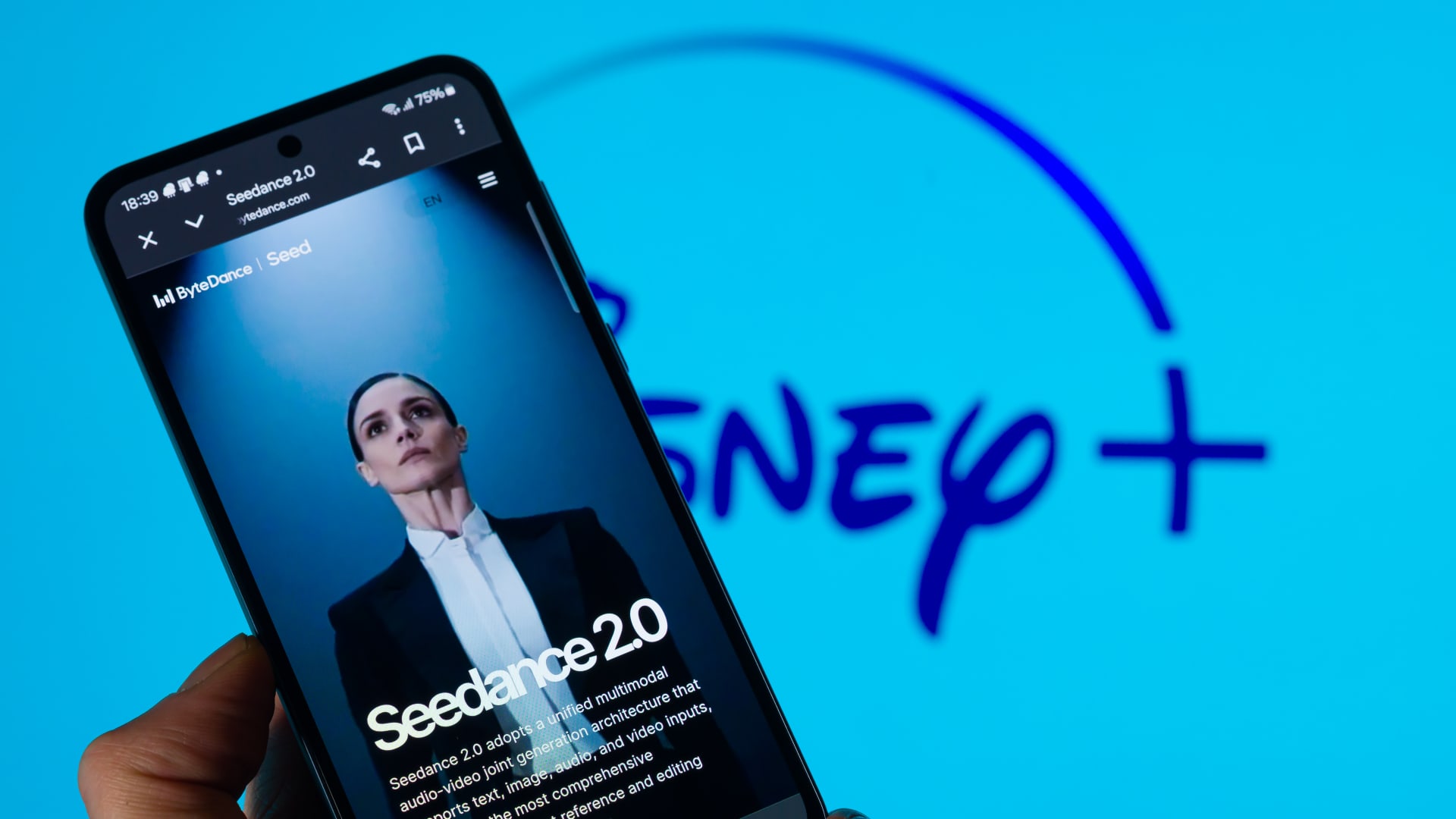
The homepages of the Chinese AI video generation model Seedance 2.0 appear on a mobile phone, with Disney visible in the background in this photo illustration in Brussels, Belgium, on February 16, 2026. (Photo by Jonathan Raa/NurPhoto via Getty Images)
Jonathan Raa | Nurphoto | Getty Images
Lowering barriers
AI offers filmmakers quick turnaround times and unlocks creativity at a low cost.
Manesh Muthu Swamy, co-founder and chief creative officer of Indian content production firm FirstAI Consultancy, told CNBC that his team found a novel approach to making an animation project using AI.
First, the team shot content using human actors, then used AI to create animated characters based on those actors’ facial expressions, Swamy said, explaining that the technology isn’t yet able to produce expressions well.
Creating such an animation from scratch would have cost a few million dollars with traditional tools, and over six months to a year to produce, but with AI, it can be done with a few hundred dollars and within weeks, he said.
Across movie studios, television networks and content production firms, AI creators CNBC spoke to mentioned using a wide variety of generative AI tools, with Midjourney, Adobe Firefly, Kling, MiniMax, Seedance and Google’s AI Studio being frequently mentioned.
Platforms like Higgsfield are also popular as they allow creators to work with multiple generative AI tools.
The technology is also lowering barriers for new entrants.
Sudharshan Srinivasan, who works as an executive producer in the Tamil film industry, has spent years hoping to direct his own feature film. Like many outsiders, he is finding it difficult to break into an industry where access to financing, stars, and distribution often depends on relationships built over decades.
AI has given him a new route.
“AI has made filmmaking simple for small teams who are struggling to find producers or investors,” Srinivasan told CNBC, adding that if he does not find a backer for his film in the next two years, he plans to produce it using AI and release it on a digital platform.
Need to know
India’s central bank cuts growth outlook, raises inflation forecast
India’s central bank on Friday held interest rates at 5.25% but raised its inflation projection for the financial year ending March 2027 by 50 basis points to 5.1%, while tempering the economy’s growth forecast to 6.6% for the year, down from 6.9% projected earlier.
India scraps tax on overseas bond investors in bid to attract foreign capital and shore up the rupee
The government on Friday announced that it hasexempted foreign investorsand the Bank for International Settlements — a global financial institution owned by central banks— from income tax on any interest or capital gains. The exemption will take effect from April 1, 2026, as per the government’s release.
India’s growth story faces its toughest test yet in Modi’s third term
India’s growing reputation as an anti-artificial intelligence trade, combined with theeconomic strain of the prolonged conflictin the Middle East on the Indian economy, is leading to a record exodus of foreign investors from the country.
Coming up
June 12: India CPI inflation data for May.
June 13-18: Prime Minister Narendra Modi to visit France and Slovakia.
About The Author