- The Japanese Yen struggles to capitalize on modest intraday gains amid reduced BoJ rate hike bets.
- Expectations that the Fed will cut interest rates this year weigh on the USD and might cap USD/JPY.
- Trade jitters keep investors on edge and should contribute to limiting losses for the safe-haven JPY.
The Japanese Yen (JPY) attracts some intraday sellers following an Asian session uptick and for now, seems to have stalled its sharp recovery move from a two-week low touched against the US Dollar (USD) on Wednesday. Japan’s Producer Price Index (PPI) released earlier this Thursday hinted that inflation pressures might be cooling off. This, along with concerns that rising trade tensions would add to woes for Japan’s economy, might force the Bank of Japan (BoJ) to forgo raising interest rates this year, which, in turn, acts as a headwind for the JPY.
However, persistent uncertainties surrounding US President Donald Trump’s trade policies could offer some support to the safe-haven JPY. Moreover, the USD bulls seem reluctant amid prospects for more interest rate cuts by the Federal Reserve (Fed) this year, bolstered by FOMC Minutes on Wednesday. This might further contribute to the USD/JPY pair’s goodish intraday bounce of around 50 pips from the 100-day Simple Moving Average (SMA). Traders now look to the US Weekly Jobless Claims and Fed speaks for a fresh impetus.
Japanese Yen bulls turn caution as trade tensions temper BoJ rate hike bets
- US President Donald Trump issued a new round of trade letters, outlining individual tariff rates ranging from 20% to 50% for eight countries starting August 1. A notable aspect of the 20 letters sent so far was Trump’s direct threat to increase tariffs if any countermeasures are taken.
- Moreover, Trump announced 50% tariffs on copper and has also threatened to impose levies of up to 200% on foreign drugs, fueling concerns about the economic fallout from trade tensions. This assists the safe-haven Japanese Yen to attract buyers for the second straight day on Thursday.
- Japan hopes to arrange meetings between its chief negotiator Ryosei Akazawa and US Treasury Secretary Scott Bessent during his visit to the World Expo on July 19. Japan also aims to secure a call prior to the meeting, and possibly a meeting between Prime Minister Shigeru Ishiba and Bessent.
- Minutes from the June 17–18 FOMC meeting released on Wednesday indicated that policymakers anticipate that rate cuts would be appropriate later this year and that any price shock from tariffs could be temporary or modest. This is seen weighing on the US Dollar and the USD/JPY pair.
- A report released by the Bank of Japan on Thursday revealed that Japan’s Producer Price Index (PPI) fell 0.2% in June and rose by 2.9% compared to the same time period last year. The readings were in line with estimates, though the annual rate marked a deceleration from May’s 3.3%.
- Moreover, data released earlier this week showed that the growth in Japan’s nominal wages decelerated for the third straight month in May 2025, and inflation-adjusted real wages posted the steepest decline in 20 months. This backs the case for the BoJ caution in the near term.
- Recent media polls raised doubts about whether the ruling coalition of the Liberal Democratic Party (LDP) and Komeito will be able to secure enough seats to maintain their majority at the House of Councillors election on July 20. This adds a layer of uncertainty and could cap the JPY.
- Traders now look forward to the release of the US Weekly Initial Jobless Claims, due later during the North American session. Apart from this, speeches from Fed officials will be scrutinized for cues about the future rate-cut path, which should drive the USD and the USD/JPY pair.
USD/JPY rebounds from 100-hour SMA pivotal support near 145.75 area
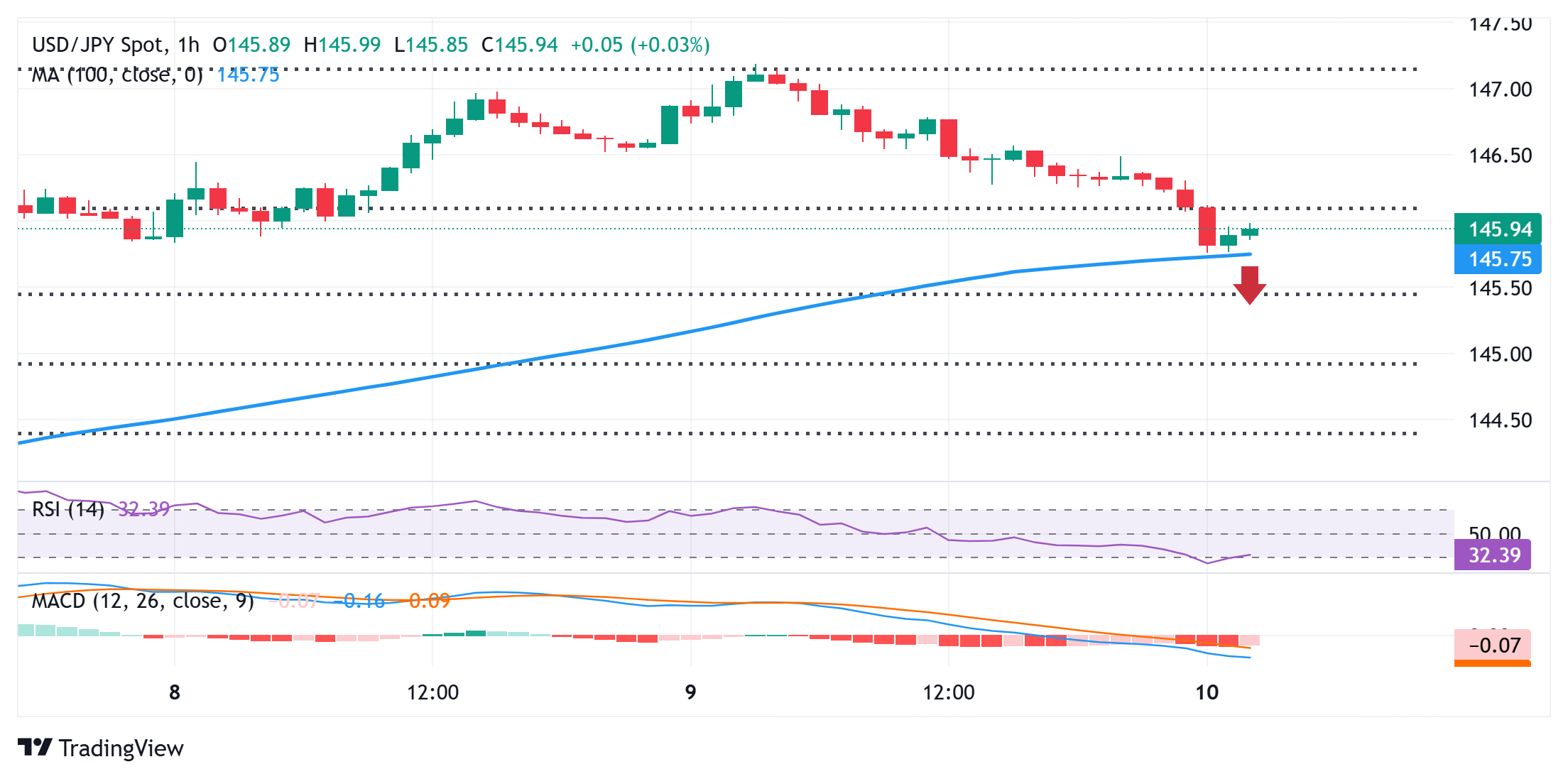
From a technical perspective, intraday breakdown below the 23.6% Fibonacci retracement level of the recent move up from the monthly swing low could be seen as a key trigger for the USD/JPY bears. The subsequent fall, however, finds some support near the 145.75 region, representing the 100-hour Simple Moving Average (SMA). The said area should now act as a pivotal point, below which spot prices could extend the fall towards the 38.2% Fibo. retracement level, around the 145.50-145.45 area. Some follow-through selling could eventually drag the pair to the next relevant support near the 145.00 psychological mark, or the 50% retracement level.
On the flip side, any recovery beyond the 146.00 mark might now confront resistance near the 146.25-146.30 area ahead of the 146.55 region. A sustained strength beyond the latter will suggest that the corrective pullback has run its course and allow the USD/JPY pair to reclaim the 147.00 round figure. The momentum could extend further towards the 147.60-147.65 intermediate hurdle en route to the 148.00 mark, or the June monthly swing high.
Bank of Japan FAQs
The Bank of Japan (BoJ) is the Japanese central bank, which sets monetary policy in the country. Its mandate is to issue banknotes and carry out currency and monetary control to ensure price stability, which means an inflation target of around 2%.
The Bank of Japan embarked in an ultra-loose monetary policy in 2013 in order to stimulate the economy and fuel inflation amid a low-inflationary environment. The bank’s policy is based on Quantitative and Qualitative Easing (QQE), or printing notes to buy assets such as government or corporate bonds to provide liquidity. In 2016, the bank doubled down on its strategy and further loosened policy by first introducing negative interest rates and then directly controlling the yield of its 10-year government bonds. In March 2024, the BoJ lifted interest rates, effectively retreating from the ultra-loose monetary policy stance.
The Bank’s massive stimulus caused the Yen to depreciate against its main currency peers. This process exacerbated in 2022 and 2023 due to an increasing policy divergence between the Bank of Japan and other main central banks, which opted to increase interest rates sharply to fight decades-high levels of inflation. The BoJ’s policy led to a widening differential with other currencies, dragging down the value of the Yen. This trend partly reversed in 2024, when the BoJ decided to abandon its ultra-loose policy stance.
A weaker Yen and the spike in global energy prices led to an increase in Japanese inflation, which exceeded the BoJ’s 2% target. The prospect of rising salaries in the country – a key element fuelling inflation – also contributed to the move.
About The Author