The Japanese Yen (JPY) attracts some sellers on Friday and erodes a part of the previous day’s gains to an over one-week high against the US Dollar (USD). Data released during the Asian session pointed to signs of cooling private consumption in Japan, which, along with Japan’s new Prime Minister Sanae Takaichi’s pro-stimulus stance, could allow the Bank of Japan (BoJ) to resist policy tightening. This, in turn, is seen as a key factor undermining the JPY, though a combination of factors could help limit deeper losses.
Minutes of the BoJ’s September policy meeting, released on Wednesday, kept hopes alive for an imminent rate hike. Moreover, speculations that Japanese authorities might intervene to stem further weakness in the domestic currency might hold back the JPY bears from placing aggressive bets. Meanwhile, the USD might struggle to attract buyers amid concern about a prolonged US government shutdown and bets for more rate cuts by the US Federal Reserve (Fed). This, in turn, might contribute to capping the USD/JPY pair.
Japanese Yen remains on the back foot as weaker data adds to BoJ uncertainty
- Data released earlier this Friday showed that Japan’s household spending rose 1.8% from a year earlier in September, compared to 2.5% expected and 2.3% growth recorded in the previous month. On a seasonally adjusted, month-on-month basis, spending fell 0.7%, pointing to signs of cooling private consumption.
- Meanwhile, Japan’s new Prime Minister Sanae Takaichi is reportedly looking to finalize an economic stimulus package of around $65 billion to address inflation and growth by late November and pass a supplementary budget to fund it. Moreover, the Bank of Japan remains reluctant to commit to further rate hikes.
- Minutes of the BoJ’s September 18-19 meeting highlighted a cautious rate-hike path as policymakers weighed inflation dynamics and trade risks. Board members, however, said that the central bank may be able to return to a stance of raising interest rates, as the BoJ’s 2% price stability target has been more or less achieved.
- Japan’s Vice Finance Minister for International Affairs and top foreign exchange official, Atsushi Mimura, said on Wednesday that the recent JPY moves deviate from the fundamentals. Mimura added that JPY long positions have been shrinking amid speculations about Japan’s macroeconomic policies, especially fiscal policy.
- The US Dollar is seen consolidating the previous day’s losses as concerns about economic risks stemming from a prolonged US government shutdown keep bulls on the sidelines. Furthermore, a resolution appears no closer after Democrats signaled that they were prepared to block GOP plans to force a vote on Friday.
- Traders have been scaling back their expectations for more easing by the US Federal Reserve and now see around a 69% chance of a rate cut in December in the wake of hawkish comments from a slew of influential FOMC members. This limits the USD losses and assists the USD/JPY pair to attract some dip-buyers.
- Traders now look to the preliminary release of the University of Michigan US Consumer Sentiment Index, as the longest US government shutdown in history has caused a blackout of official data. This, along with Fed speak, might influence the USD and produce short-term trading opportunities heading into the weekend.
USD/JPY seems vulnerable while below the 154.45 pivotal resistance
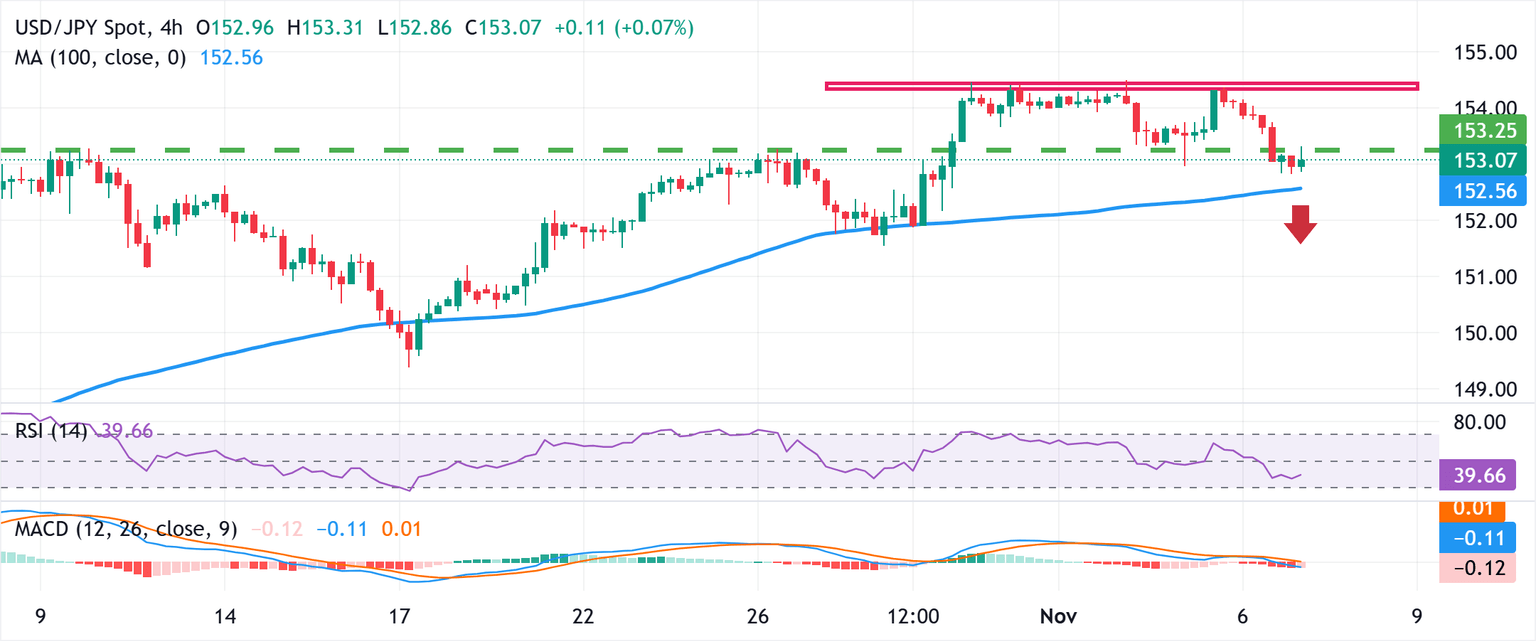
The recent repeated failures in the vicinity of mid-154.00s and the overnight breakdown below the 153.30-153.25 resistance-turned-support back the case for a further depreciation for the USD/JPY pair. However, positive oscillators on the daily chart suggest that any further decline is more likely to find decent support near the 152.15-152.10 region. Some follow-through selling below the 152.00 mark will be seen as a fresh trigger for bearish traders and pave the way for an extension of the recent pullback from the highest level since February, touched earlier this week.
On the flip side, a recovery back above the 153.25-153.30 horizontal resistance might now confront a hurdle near the 153.65 area. A sustained strength beyond the latter should allow the USD/JPY pair to reclaim the 154.00 mark and climb further towards retesting the 154.45 supply zone. The latter should now act as a key pivotal point, above which spot prices could climb to the 155.00 psychological mark en route to the 155.60-155.65 barrier and the 156.00 round figure.
Bank of Japan FAQs
The Bank of Japan (BoJ) is the Japanese central bank, which sets monetary policy in the country. Its mandate is to issue banknotes and carry out currency and monetary control to ensure price stability, which means an inflation target of around 2%.
The Bank of Japan embarked in an ultra-loose monetary policy in 2013 in order to stimulate the economy and fuel inflation amid a low-inflationary environment. The bank’s policy is based on Quantitative and Qualitative Easing (QQE), or printing notes to buy assets such as government or corporate bonds to provide liquidity. In 2016, the bank doubled down on its strategy and further loosened policy by first introducing negative interest rates and then directly controlling the yield of its 10-year government bonds. In March 2024, the BoJ lifted interest rates, effectively retreating from the ultra-loose monetary policy stance.
The Bank’s massive stimulus caused the Yen to depreciate against its main currency peers. This process exacerbated in 2022 and 2023 due to an increasing policy divergence between the Bank of Japan and other main central banks, which opted to increase interest rates sharply to fight decades-high levels of inflation. The BoJ’s policy led to a widening differential with other currencies, dragging down the value of the Yen. This trend partly reversed in 2024, when the BoJ decided to abandon its ultra-loose policy stance.
A weaker Yen and the spike in global energy prices led to an increase in Japanese inflation, which exceeded the BoJ’s 2% target. The prospect of rising salaries in the country – a key element fuelling inflation – also contributed to the move.
About The Author