- The Japanese Yen attracts some dip-buyers and stalls its pullback from a multi-month low against the USD.
- Hopes for a US-Japan trade deal and rising bets for more BoJ rate hikes in 2025 continue to underpin the JPY.
- A positive turnaround in the global risk sentiment keeps a lid on any meaningful gains for the safe-haven JPY.
The Japanese Yen (JPY) trims a part of Asian session losses, though it remains depressed against its American counterpart amid the risk-on impulse. Trump administration officials hinted at a potential de-escalation of the ongoing tariff dispute with China and fueled optimism about a trade deal. Adding to this Trump stepped back from his threats to dismiss Federal Reserve (Fed) Chair Jerome Powell, which, along with easing geopolitical tensions, boosts investors’ confidence and undermines demand for the safe-haven JPY.
The JPY bears, however, seem reluctant to place aggressive bets amid the growing optimism that the US and Japan are moving closer to an interim arrangement on trade. Moreover, traders have been pricing in the possibility that the Bank of Japan (BoJ) will continue raising interest rates in 2025, which contributes to limiting deeper JPY losses. The USD, on the other hand, struggles to preserve modest intraday gains amid the weakening confidence in the US economy and Fed rate cut bets, which, in turn, caps the USD/JPY pair.
Japanese Yen is pressured by receding safe-haven demand; bullish potential seems intact
- The global risk sentiment gets a strong boost after US Treasury Secretary Scott Bessent said at a private investor summit that the tit-for-tat tariff war between the US and China would de-escalate soon. Later, White House spokeswoman Karoline Leavitt told reporters that the Trump administration is setting the stage for a deal. This, in turn, contributes to improving investors’ appetite for riskier assets and driving flows away from perceived safe-haven assets, including the Japanese Yen.
- Meanwhile, US President Donald Trump ruled out the possibility of taking the unprecedented step of firing Federal Reserve Chair Jerome Powell before the expiry of his term in May 2026. This, in turn, triggers a goodish US Dollar recovery from a three-year low, which assists the USD/JPY pair to attract some follow-through buyers during the Asian session on Wednesday. The USD move up, however, runs out of steam amid the prospects for more aggressive policy easing by the Fed.
- According to the CME Group’s FedWatch Tool, traders are pricing in the possibility that the Fed will lower borrowing costs by 25 basis points in June and deliver at least three rate cuts by the end of this year. This marks a big divergence in comparison to a rising consensus that the Bank of Japan will continue hiking interest rates in 2025. Apart from this, the hope that Japan might strike a trade deal with the US helps limit the JPY losses and prompt some intraday selling around the USD/JPY pair.
- In fact, the new US ambassador to Japan said last Friday that he is optimistic about a deal in the ongoing US-Japan tariff negotiations. However, Japan’s Economic Revitalization Minister Ryosei Akazawa said that any agreement would likely take some time as it’s difficult to say how long it will take to bridge the gap between the two sides. This might keep a lid on any optimism in the market and warrants some caution before placing aggressive bullish bets around the USD/JPY pair.
- Meanwhile, the preliminary Purchasing Managers’ Index (PMI) released earlier this Wednesday showed that Japanese manufacturing activity has shrunk for the tenth consecutive month in April. The au Jibun Bank manufacturing PMI came in at 48.5 in April, slightly higher compared to 48.4 in the previous month. In contrast, Japanese services activity rebounded and the au Jibun Bank Services PMI rose to 52.2 during the reported month compared to a neutral reading of 50.0 in March.
- Wednesday’s economic docket also features the release of flash global PMIs, which might provide a fresh insight into the global economic health. Apart from this, trade-related developments would play a key role in influencing the broader market risk sentiment and driving demand for the safe-haven JPY.
USD/JPY needs to find acceptance above the 143.00 mark to support prospects for further gains
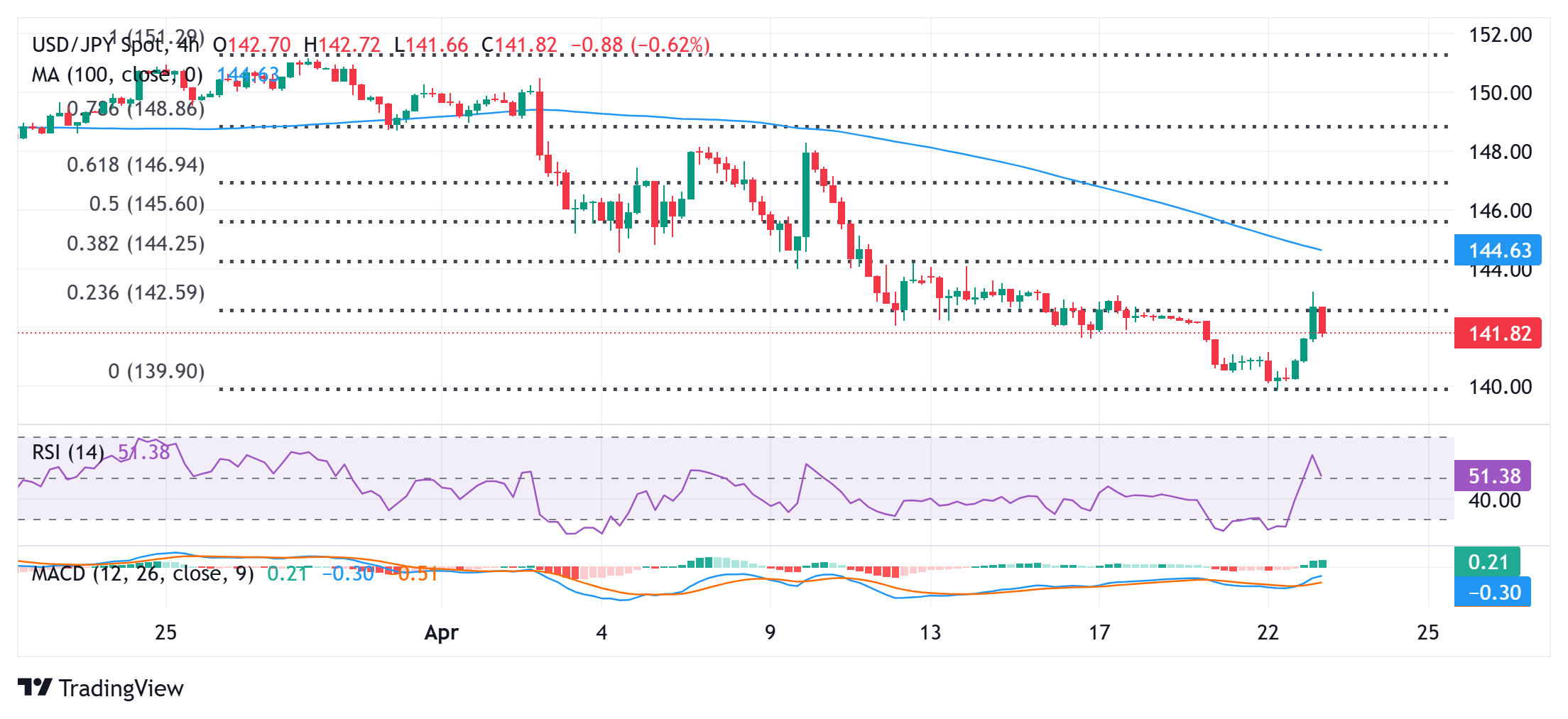
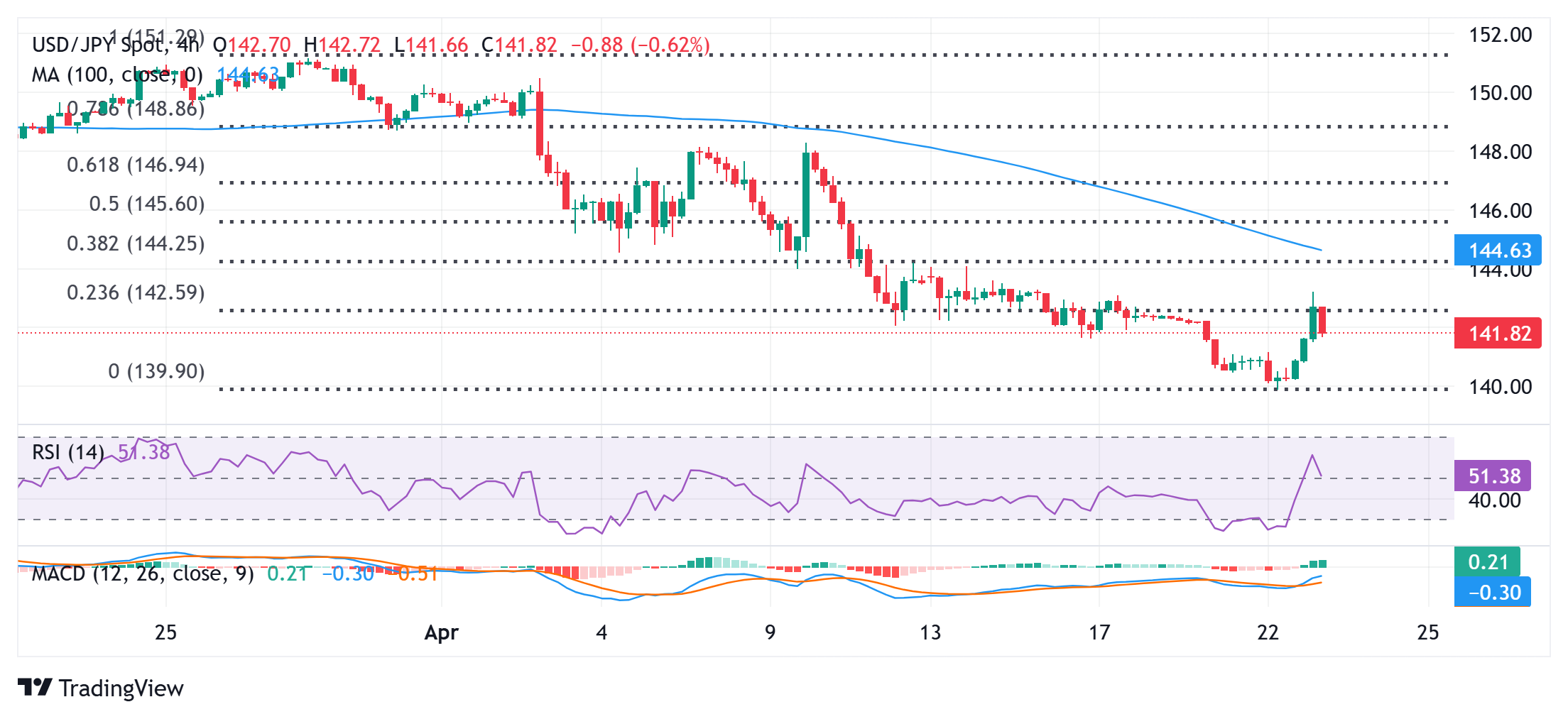
From a technical perspective, the USD/JPY pair showed some resilience below the 140.00 psychological mark on Tuesday and the subsequent short-covering rally warrants some caution for bearish traders. The recovery momentum, however, struggles to find acceptance above the 143.00 mark or the 23.6% Fibonacci retracement level of the March-April downfall. This, in turn, should now act as a key pivotal point, above which spot prices might aim to surpass the Asian session peak, around the 143.20 area, and climb further towards reclaiming the 144.00 mark. The momentum could extend further towards the 144.25-144.30 region or the 38.2% Fibo. level.
On the flip side, weakness below the 141.45 zone, or the Asian session low, now seems to find decent support near the 141.00 mark. A convincing break below the latter, however, will suggest that the recent downtrend is still far from being over and make the USD/JPY pair vulnerable to retesting sub-140.00 levels, with some intermediate support near the 140.45 region. The subsequent downfall would expose the 2024 swing low, around the 139.60-139.55 area.
Tariffs FAQs
Tariffs are customs duties levied on certain merchandise imports or a category of products. Tariffs are designed to help local producers and manufacturers be more competitive in the market by providing a price advantage over similar goods that can be imported. Tariffs are widely used as tools of protectionism, along with trade barriers and import quotas.
Although tariffs and taxes both generate government revenue to fund public goods and services, they have several distinctions. Tariffs are prepaid at the port of entry, while taxes are paid at the time of purchase. Taxes are imposed on individual taxpayers and businesses, while tariffs are paid by importers.
There are two schools of thought among economists regarding the usage of tariffs. While some argue that tariffs are necessary to protect domestic industries and address trade imbalances, others see them as a harmful tool that could potentially drive prices higher over the long term and lead to a damaging trade war by encouraging tit-for-tat tariffs.
During the run-up to the presidential election in November 2024, Donald Trump made it clear that he intends to use tariffs to support the US economy and American producers. In 2024, Mexico, China and Canada accounted for 42% of total US imports. In this period, Mexico stood out as the top exporter with $466.6 billion, according to the US Census Bureau. Hence, Trump wants to focus on these three nations when imposing tariffs. He also plans to use the revenue generated through tariffs to lower personal income taxes.
About The Author