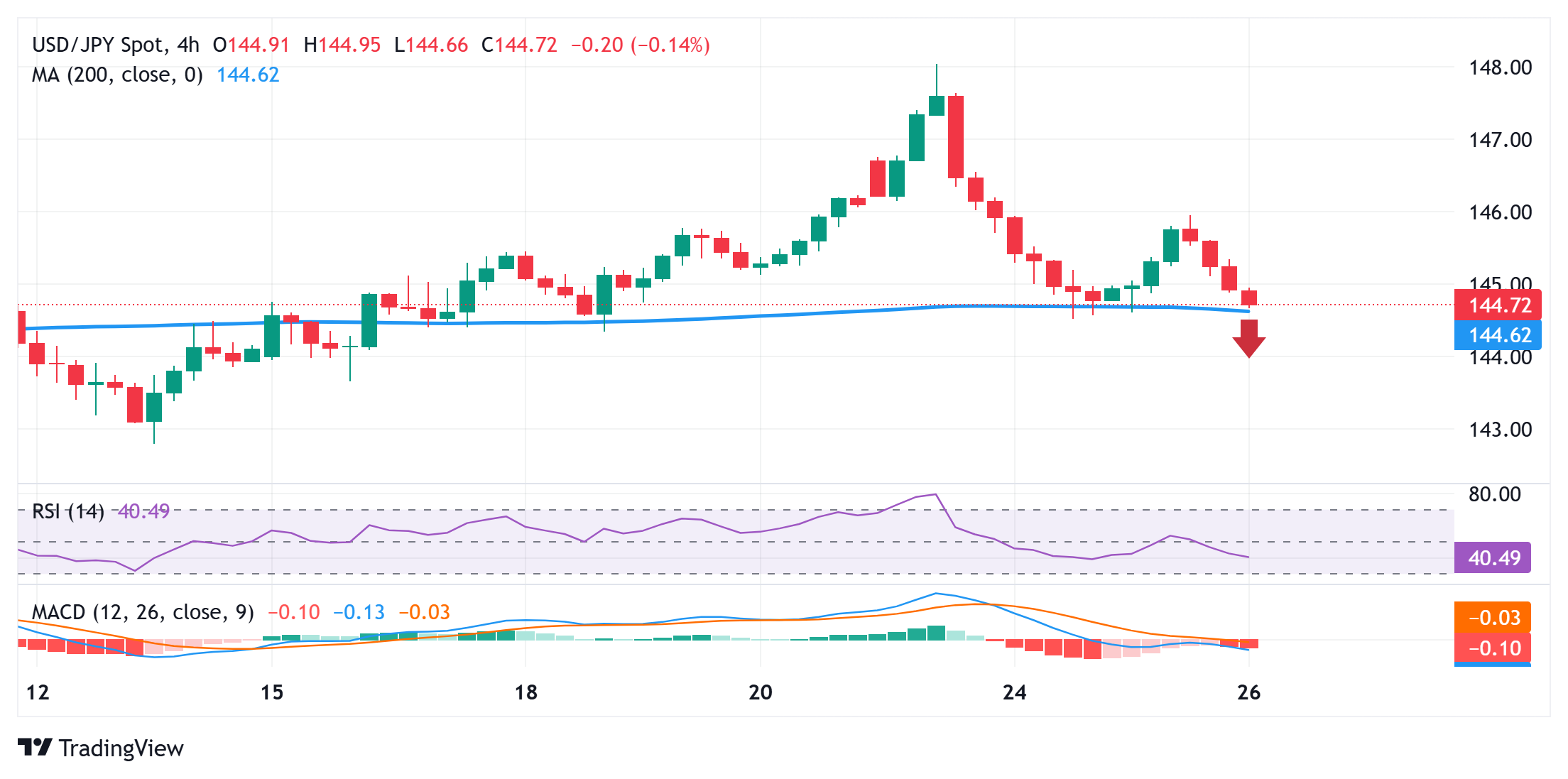
- The Japanese Yen attracts fresh buyers following the previous day’s modest decline.
- The USD slumps to over a three-year low and exerts additional pressure on USD/JPY.
- Traders now look forward to key inflation figures from Japan and the US on Friday.
The Japanese Yen (JPY) sticks to its positive bias against a broadly weaker US Dollar (USD) on Thursday and trades near the top end of the weekly range heading into the European session. The Bank of Japan (BoJ) – although has been hesitant to raise interest rates – is still expected to stay on the path of monetary policy normalization as inflation persistently exceeds its target. This marks a significant divergence in comparison to the Federal Reserve’s (Fed) latest projections of two rate cuts before the year-end, which contributes to the JPY’s outperformance against its American counterpart.
Meanwhile, US President Donald Trump’s fresh attack on Fed Chair Jerome Powell fuels concerns about the potential erosion of the central bank’s independence. This overshadows the latest optimism over the Israel-Iran truce and undermines the global risk sentiment, further benefiting the JPY’s safe-haven status. The USD, on the other hand, sank to its lowest level since March 2022 on the back of the Trump-Powell standoff and Fed rate cut bets. This turns out to be another factor that drags the USD/JPY pair back closer to the mid-144.00s and backs the case for a further depreciating move.
Japanese Yen seems poised to appreciate further amid the divergent BoJ-Fed expectations
- The Bank of Japan signaled a cautious approach to unwinding its long-standing ultra-loose policy and decided to slow the pace of reduction in its bond purchases from fiscal 2026. However, the incoming data from Japan points to a consistent rise in inflationary pressures and keeps hopes alive for more rate hikes by the BoJ.
- In fact, Japan’s core inflation has remained well above the BoJ’s 2% target for well over three years and rose to a more than two-year high in May. Moreover, Japan’s Corporate Services Producer Price Index – a leading indicator of consumer price inflation – has been trending above the 3% YoY rate for several consecutive months.
- Meanwhile, Federal Reserve Chair Jerome Powell, testifying before Congress, acknowledged that recent inflation readings had been more moderate, but he warned that new tariffs could change that. Powell added that he expects policymakers to stay on hold until they have a better handle on the impact of tariffs on consumer prices.
- Powell’s position on interest rates is increasingly at odds with US President Donald Trump, who ramped up his criticism of the central bank chief and floated the idea of firing him. When asked if he is interviewing candidates to replace Powell, Trump said he has three or four people in mind as contenders for the top Fed job.
- Nevertheless, traders are still betting that the Fed will lower rates by at least 50 basis points before the end of the year and are also pricing in a roughly 20% chance of a rate reduction in July. This, in turn, drags the US Dollar to over a three-year low and the USD/JPY pair closer to the weekly trough during the Asian session.
- A ceasefire between Israel and Iran appears to be holding for now, which might continue to underpin the global risk sentiment and cap traditional safe-haven assets, including the Japanese Yen. Traders now look to the release of the final Q1 GDP, though the focus will be on key inflation figures from Japan and the US on Friday.
USD/JPY could accelerate the downfall once the 200-SMA support on H4 is broken decisively
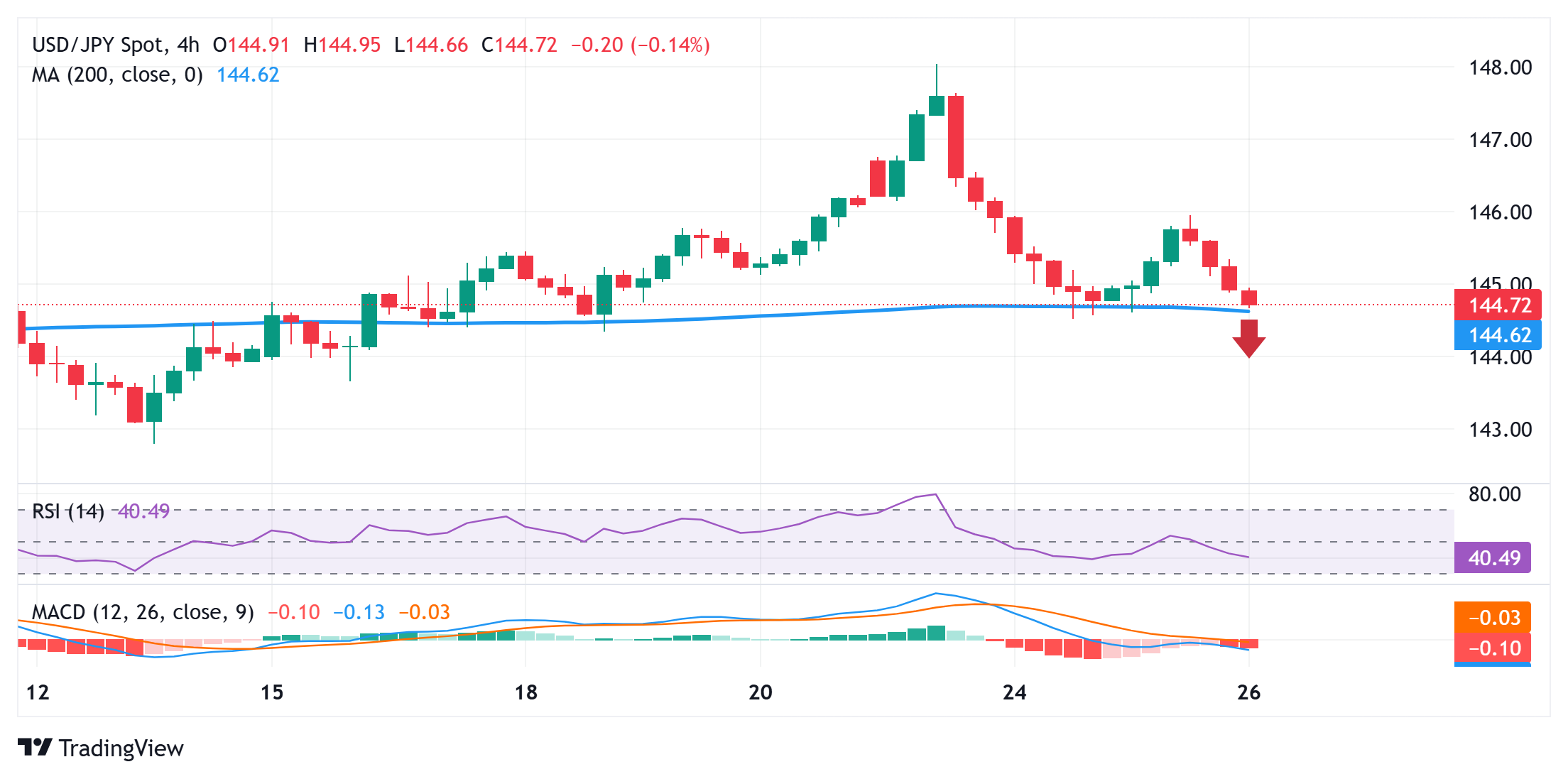
The overnight failure ahead of the 146.00 mark and a subsequent break below the 200-period Simple Moving Average (SMA) on the 4-hour chart, currently around the 144.70-144.65 region, will be seen as a key trigger for the USD/JPY bears. Given that oscillators on hourly/daily charts have just started gaining negative traction, spot prices might then accelerate the fall towards the 144.00 round figure en route to the 143.70-143.65 region before eventually dropping to test sub-143.00 levels.
On the flip side, any attempted recovery back above the 145.00 psychological mark is more likely to attract fresh sellers near the 145.25-145.35 static barrier and remain capped near the 146.00 mark. The latter should act as a pivotal point, which if cleared could shift the near-term bias in favor of bulls and lift the USD/JPY pair to the 146.65-146.70 region en route to the 147.00 round figure. The momentum could extend further towards the 147.45-147.50 hurdle before the pair makes a fresh attempt to conquer the 148.00 mark.
Bank of Japan FAQs
The Bank of Japan (BoJ) is the Japanese central bank, which sets monetary policy in the country. Its mandate is to issue banknotes and carry out currency and monetary control to ensure price stability, which means an inflation target of around 2%.
The Bank of Japan embarked in an ultra-loose monetary policy in 2013 in order to stimulate the economy and fuel inflation amid a low-inflationary environment. The bank’s policy is based on Quantitative and Qualitative Easing (QQE), or printing notes to buy assets such as government or corporate bonds to provide liquidity. In 2016, the bank doubled down on its strategy and further loosened policy by first introducing negative interest rates and then directly controlling the yield of its 10-year government bonds. In March 2024, the BoJ lifted interest rates, effectively retreating from the ultra-loose monetary policy stance.
The Bank’s massive stimulus caused the Yen to depreciate against its main currency peers. This process exacerbated in 2022 and 2023 due to an increasing policy divergence between the Bank of Japan and other main central banks, which opted to increase interest rates sharply to fight decades-high levels of inflation. The BoJ’s policy led to a widening differential with other currencies, dragging down the value of the Yen. This trend partly reversed in 2024, when the BoJ decided to abandon its ultra-loose policy stance.
A weaker Yen and the spike in global energy prices led to an increase in Japanese inflation, which exceeded the BoJ’s 2% target. The prospect of rising salaries in the country – a key element fuelling inflation – also contributed to the move.
About The Author