- The Japanese Yen weakens slightly amid receding safe-haven demand.
- Expectations that the BoJ will hike rates again should limit JPY losses.
- The USD hangs near a one-week low and might cap the USD/JPY pair.
The Japanese Yen (JPY) edges lower against its American counterpart during the Asian session on Wednesday as the Israel-Iran ceasefire optimism continues to act as a headwind for traditional safe-haven assets. Moreover, the Summary of Opinions from the Bank of Japan’s (BoJ) June meeting showed that some policymakers called for keeping interest rates steady for the time being due to uncertainty over the impact of US tariffs on Japan’s economy. This turns out to be another factor undermining the JPY.
Any meaningful JPY depreciation, however, still seems elusive amid the growing acceptance that the BoJ will hike interest rates again. The bets were reaffirmed by Japan’s Services Producer Price Index (PPI), which rose for the third straight month and remained above the 3% YoY rate in May. This marks a significant divergence in comparison to expectations that the Federal Reserve (Fed) would lower borrowing costs further, which keeps the US Dollar (USD) depressed and should benefit the JPY.
Japanese Yen drifts lower as easing Middle East tensions dents safe-haven demand
- The Bank of Japan published the Summary of Opinions from the June monetary policy meeting earlier this Wednesday, which revealed that several board members warned of the expected hit to Japan’s fragile economy from sweeping US tariffs. Some policymakers said that consumer inflation was moving at higher-than-expected levels, partly due to surging prices of the staple rice.
- In fact, data released last week showed that Japan’s annual National Consumer Price Index (CPI) rose by 3.5% YoY in May and remained above the BoJ’s 2% target. Further details revealed that the National core CPI – excluding volatile fresh food prices – shot to the highest level since January 2023, while a core gauge that excludes both fresh food and energy prices climbed 3.3% YoY in May.
- Adding to this, Japan’s Services Producer Price Index, released earlier this Wednesday, increased 3.3% YoY in May, slightly lower than the previous month’s upwardly revised reading of 3.4%. The Services PPI is a key gauge of domestic inflation pressures and back-to-back readings above the 3% mark keep alive market expectations for further interest rate hikes by the central bank.
- Moreover, BoJ board member Naoki Tamura said on Wednesday that inflation rose more than expected back in May and he fog surrounding US tariffs is clearing somewhat, though it is difficult to predict the outlook. Tamura added that the Japanese central bank may need to act decisively if upside price risks heighten further.
- Meanwhile, Federal Reserve Chair Jerome Powell, in his prepared remarks for the Semiannual Monetary Policy Report to Congress, said that the central bank expects inflation to start rising soon and is in no rush to ease borrowing costs. Powell’s remarks come after his colleagues recently suggested a rate cut at the July policy meeting, though it does little to impress the US Dollar bulls.
- The Israel-Iran ceasefire came into effect on Tuesday and appeared to hold for now, despite an Israeli attack on Tehran and an Iranian missile strike. Both Iran and Israel have claimed victory in the war and warned they were ready to renew hostilities if the other attacks. This keeps geopolitical risks in play and benefits the safe-haven Japanese Yen amid the divergent BoJ-Fed expectations.
USD/JPY looks to build on strength beyond 200-hour SMA; not out of the woods yet
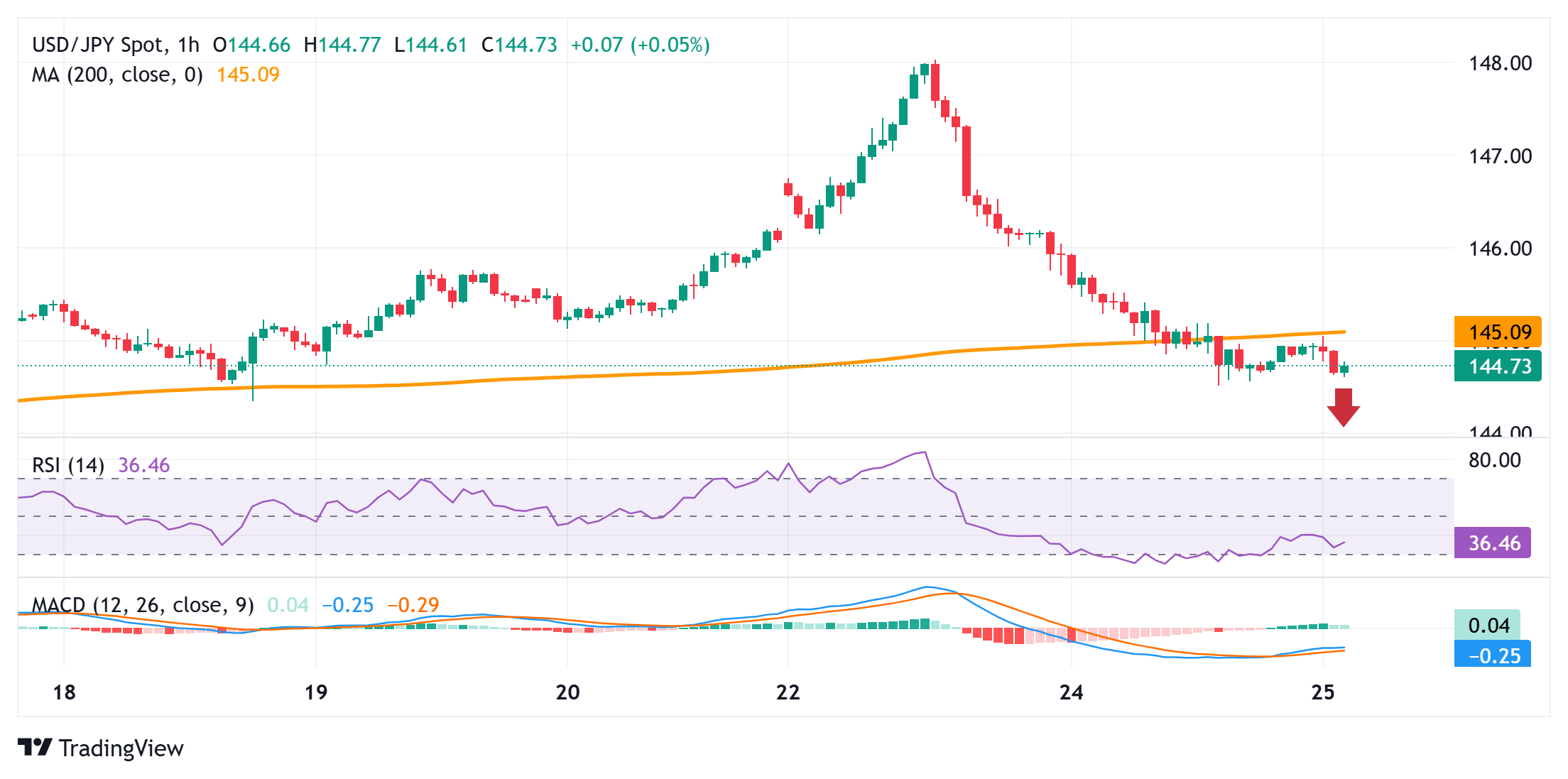
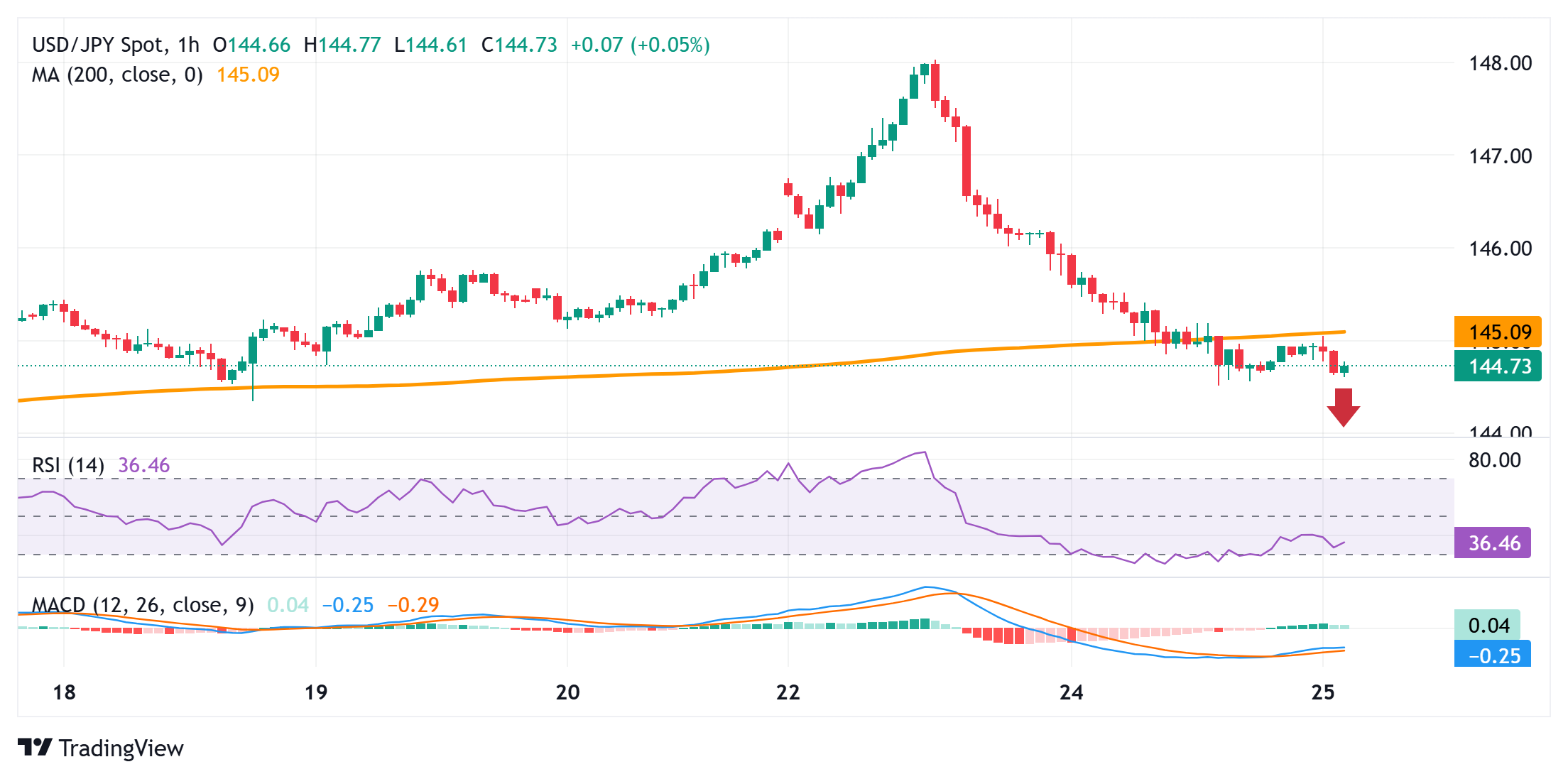
From a technical perspective, the overnight decline below the 145.35-145.25 resistance-turned-support and acceptance below the 200-hour Simple Moving Average (SMA) was seen as a key trigger for the USD/JPY bears. Moreover, oscillators on the daily chart have just started gaining negative traction and validate the near-term negative outlook for the currency pair. Some follow-through selling below mid-144.00s, or the overnight trough, should pave the way for a slide towards the 144.00 round figure en route to the 143.70-143.65 region before spot prices aim to test sub-143.00 levels.
On the flip side, any attempted recovery might now attract fresh sellers near the 145.00 psychological mark and remain capped near the 145.25-145.35 static barrier. A sustained strength beyond the latter might trigger a short-covering rally and allow the USD/JPY pair to reclaim the 146.00 mark. The momentum could extend further, though it runs the risk of fizzling out quickly near the 146.65-146.70 region. The latter should act as a pivotal point, which if cleared would negate the negative outlook and shift the near-term bias back in favor of bullish traders.
Bank of Japan FAQs
The Bank of Japan (BoJ) is the Japanese central bank, which sets monetary policy in the country. Its mandate is to issue banknotes and carry out currency and monetary control to ensure price stability, which means an inflation target of around 2%.
The Bank of Japan embarked in an ultra-loose monetary policy in 2013 in order to stimulate the economy and fuel inflation amid a low-inflationary environment. The bank’s policy is based on Quantitative and Qualitative Easing (QQE), or printing notes to buy assets such as government or corporate bonds to provide liquidity. In 2016, the bank doubled down on its strategy and further loosened policy by first introducing negative interest rates and then directly controlling the yield of its 10-year government bonds. In March 2024, the BoJ lifted interest rates, effectively retreating from the ultra-loose monetary policy stance.
The Bank’s massive stimulus caused the Yen to depreciate against its main currency peers. This process exacerbated in 2022 and 2023 due to an increasing policy divergence between the Bank of Japan and other main central banks, which opted to increase interest rates sharply to fight decades-high levels of inflation. The BoJ’s policy led to a widening differential with other currencies, dragging down the value of the Yen. This trend partly reversed in 2024, when the BoJ decided to abandon its ultra-loose policy stance.
A weaker Yen and the spike in global energy prices led to an increase in Japanese inflation, which exceeded the BoJ’s 2% target. The prospect of rising salaries in the country – a key element fuelling inflation – also contributed to the move.
About The Author