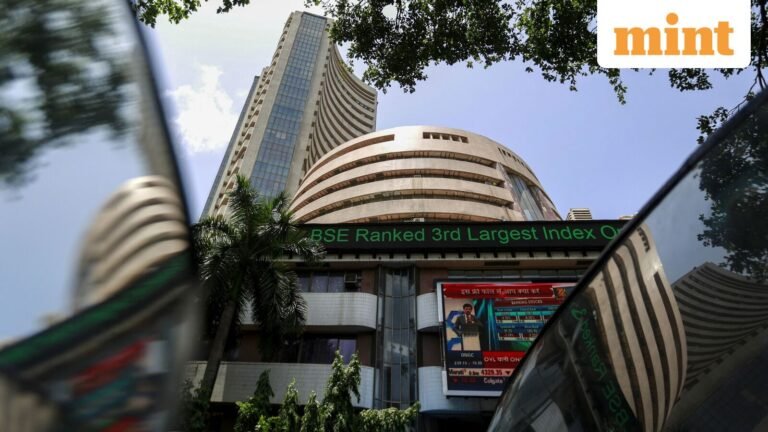
Mumbai: Markets slumped on Monday after Prime Minister Narendra Modi urged Indians to cut fuel consumption, avoid buying gold for a year, and limit foreign travel, amid rising pressure on the rupee and on India’s import bill due to supply constraints triggered by the West Asia conflict.
Investors interpreted the remarks as a signal that the government may be preparing for tougher measures, including possible fuel price hikes or steps to curb imports.
On Monday, the Nifty 50 and the Sensex marked their steepest single-day fall since 30 March, slumping 1.49% and 1.7%, respectively.
People also ask
AI powered insights from this story
•5 QUESTIONS
Markets slumped because Prime Minister Narendra Modi urged Indians to cut fuel consumption and avoid buying gold for a year. Investors interpreted these remarks as a signal that the government might implement tougher measures, such as fuel price hikes or import curbs.
The Prime Minister’s remarks triggered a broad selloff across sectors vulnerable to potential curbs or price increases. Shares of oil marketing companies, jewellers, airlines, and hotels fell sharply.
Rising crude oil prices, driven by the West Asia conflict, are increasing India’s import bill and putting pressure on the rupee. This could worsen inflationary pressures, especially if fuel prices are hiked.
A high crude oil import bill leads to a wider current account deficit (CAD), which means India needs more dollars to pay for imports. This increased demand for dollars typically weakens the Indian rupee.
The government is considering emergency steps such as curbing non-essential imports like gold and electronics, and potentially hiking fuel prices. These measures aim to preserve foreign exchange reserves amidst soaring oil prices.
The Prime Minister’s remarks triggered a broad selloff across sectors seen as vulnerable to potential curbs or price increases, with shares of oil marketing companies (OMCs), jewellers, airlines and hotels falling sharply.
Nifty 50’s biggest losers included jewellery maker Titan and airline operator IndiGo, which fell 6.85% and 5.73%, respectively. Oil marketing companies Indian Oil Corp., Bharat Petroleum Corp. and Hindustan Petroleum Corp. also declined sharply.
Reliance Industries Ltd (RIL)—India’s biggest private refiner and the heaviest-weighted stock on the Nifty 50—fell 3.48%. Other index heavyweights also dragged the benchmarks lower, with Bharti Airtel’s stock falling 3.79% and State Bank of India, 4.36%.
According to Prashant Vashisht, senior vice president & co-group head for corporate ratings at Icra Ltd, Indian OMCs are already incurring substantial losses on the sale of auto fuels and domestic LPG.
At crude prices of $120-125 per barrel, and considering the past 10-year average crack spreads for auto fuels, OMCs are incurring losses of around ₹1,000 crore per day on the sale of auto fuels and domestic LPG, said Vashisht.
Brent crude prices jumped 3% to touch $103 per barrel as of 3.30 pm on Monday.
Investors anxious
Investors are worried that a possible hike in petrol and diesel prices could worsen inflationary pressures.
Rajesh Palviya, head of research at Axis Direct, said the markets could see a further knee-jerk reaction if the government announces a hike in fuel prices. Such a move could add to inflationary pressures at a time when monsoon uncertainty and ongoing heatwave conditions are already fuelling concerns over food prices, Palviya added.
The El Nino and temperature channel can add 0.5 percentage points to inflation over a year, said Pranjul Bhandari, chief India economist/strategist, and Asean economist at HSBC Ltd. “Along with energy shocks, we expect headline inflation to average 5.6% in FY27,” Bhandari added.
To be sure, headline inflation averaged 2.06% in FY26, data from the statistics ministry showed.
George Thomas, fund manager at Quantum Mutual Fund said, “Most companies managed the current quarter (Q1FY27) using existing inventories, limiting the immediate impact. However, higher input costs will likely start reflecting in earnings from the next quarter.”
Indices under pressure
Meanwhile, in the past 12 trading sessions, the Nifty 50 has hovered within a defined range of 24,482 and 23,796. On Monday, the index closed towards the lower end of the range at 23,815.85, which indicates increased selling pressure.
The selloff was broad-based, with the Nifty Midcap and Nifty Smallcap indices falling 1% and 1.06%, respectively. Except for defensive sectors—such as Nifty Pharma (0.25% rise) and Nifty FMCG (0.08% rise)—all major sectoral indices closed in the red on Monday.
The BSE market capitalization fell by ₹6.1 trillion to ₹467 trillion on Monday.
About The Author