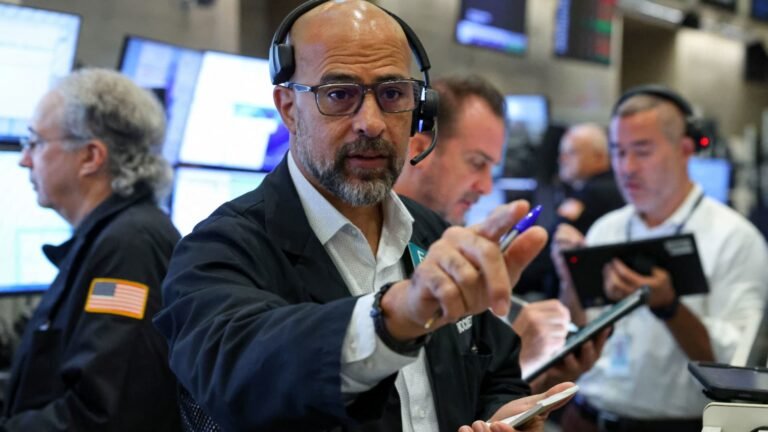
The NSE share price climbed more than 3% during Thursday’s (24 September) trading session after the National Stock Exchange made a modest debut on the BSE. The stock was trading over 4% above its issue price of ₹1,785.
The NSE share price opened at ₹1,800 on the BSE, marking a 0.84% premium over the IPO price. The stock gained momentum thereafter, rising as much as 3.36% to ₹1,845.
At this level, the National Stock Exchange commanded a market capitalisation of around ₹4.60 lakh crore.
The NSE IPO, worth ₹22,569 crore, received nearly 6 times subscription on the final day of bidding on Monday, driven by strong demand from institutional investors.
The public issue became India’s second-largest IPO, behind Hyundai Motor India’s ₹27,870-crore offering in 2024. The NSE IPO also surpassed Life Insurance Corporation of India’s ₹21,000-crore issue launched in 2022, according to reports.
The NSE IPO comprised an Offer for Sale (OFS) of up to 12.64 crore equity shares by existing shareholders, with no fresh issue of shares.
The exchange had fixed the NSE IPO price band at ₹1,700– ₹1,785 per equity share.
NSE share price – Should you buy, sell or hold?
Shivani Nyati, Head of Wealth at Swastika Investmart Ltd, said the National Stock Exchange made a modest debut on the BSE at ₹1,800, offering a 0.9% premium to its upper issue price of ₹1,785. She said the listing reflected measured market expectations rather than an aggressive debut-day spike.
Nyati highlighted NSE’s strong position in India’s capital markets, with around 93% market share in the cash segment and 99.8% in equity futures. At the IPO price band, the exchange was valued at 40.9–42.9 times FY26 diluted earnings, compared with around 54.3 times for BSE, she noted.
However, she cautioned that nearly 79% of NSE’s revenue is linked to trading activity, making its earnings sensitive to market volumes and regulatory changes.
For short-term and listing-gain investors, Nyati suggested maintaining a stop-loss at ₹1,740, while long-term investors could hold through volume-driven volatility, given the exchange’s structural growth potential.
Abhinav Tiwari, Senior Research Analyst at Bonanza, said NSE’s listing has significantly expanded its shareholder base, from around 2 lakh investors before the IPO to nearly 36 lakh after listing.
He said the exchange continues to benefit from its strong market share, high liquidity, network effects and growing contribution from non-transaction-based revenue.
However, Tiwari said the stock needs time for price discovery, adding that he would prefer to wait for at least one quarter before assessing its sustainable valuation.
He flagged lower trading activity from the Closing Auction Session and potential selling pressure following the lock-in period as near-term risks for the NSE stock.
Dr Ravi Singh, Chief Research Officer at Master Capital Services Ltd, said the stock’s limited premium at listing makes its post-listing price movement an important factor to watch. He added that NSE’s trading trajectory, along with earnings growth, trading volumes and business performance over the coming sessions, will provide greater insight into how the market values the exchange after its listing.
Disclaimer: This story is for educational purposes only. The views and recommendations above are those of individual analysts or broking companies, not Mint. We advise investors to check with certified experts before making any investment decisions.
About The Author