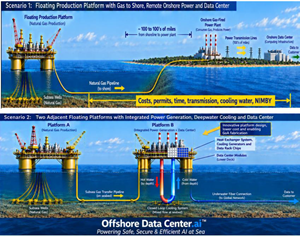
(WO) – Offshore Data Center LLC has partnered with Houston-based Riverway Group to design and build offshore platforms that use stranded or undervalued natural gas to power data centers at the source. The companies say the approach gives producers a way to make money from gas that is uneconomic to develop under conventional models.

“A significant amount of offshore gas is never developed, or is simply reinjected, because getting it to market doesn’t pencil out,” said Art Schroeder, CEO of Offshore Data Center. “By putting the data center next to the gas, we eliminate the pipeline to shore and the transmission line, and we cut the cooling bill dramatically.”
Offshore Data Center targets gas that is stranded, uneconomic to develop or undervalued. That includes gas reinjected beyond what reservoir pressure maintenance requires. Its concepts range from facilities of up to 1 GW for large-scale AI training to smaller, faster-to-deploy setups for edge and inference computing. In each case, power generation and modular, liquid-cooled GPUs and CPUs sit next to the gas supply. The platforms can also support gas-to-ammonia or gas-to-methanol conversion where the economics favor it.
The design combines semisubmersible hull designs from Offshore Data Center partner Horton do Brasil with Riverway’s automated welding and advanced fabrication methods. The companies say the result is a hull up to 50% lighter than traditional designs, with better stability, which makes construction on the U.S. Gulf Coast cost-competitive with shipyards in South Korea, China and Singapore. The hulls can carry large topsides, including data centers, ammonia or methanol units, and conventional production facilities. They also use a closed-loop deep-ocean cooling system. According to the companies, cooling can account for up to 40% of a data center’s energy use, and drawing on cold deep-ocean water cuts that load and improves power generation efficiency.
“Riverway gives us a way to build these platforms here in the United States,” Schroeder said. The companies expect the collaboration to strengthen U.S. maritime manufacturing and domestic energy development, expand AI computing capacity and create jobs.
About The Author