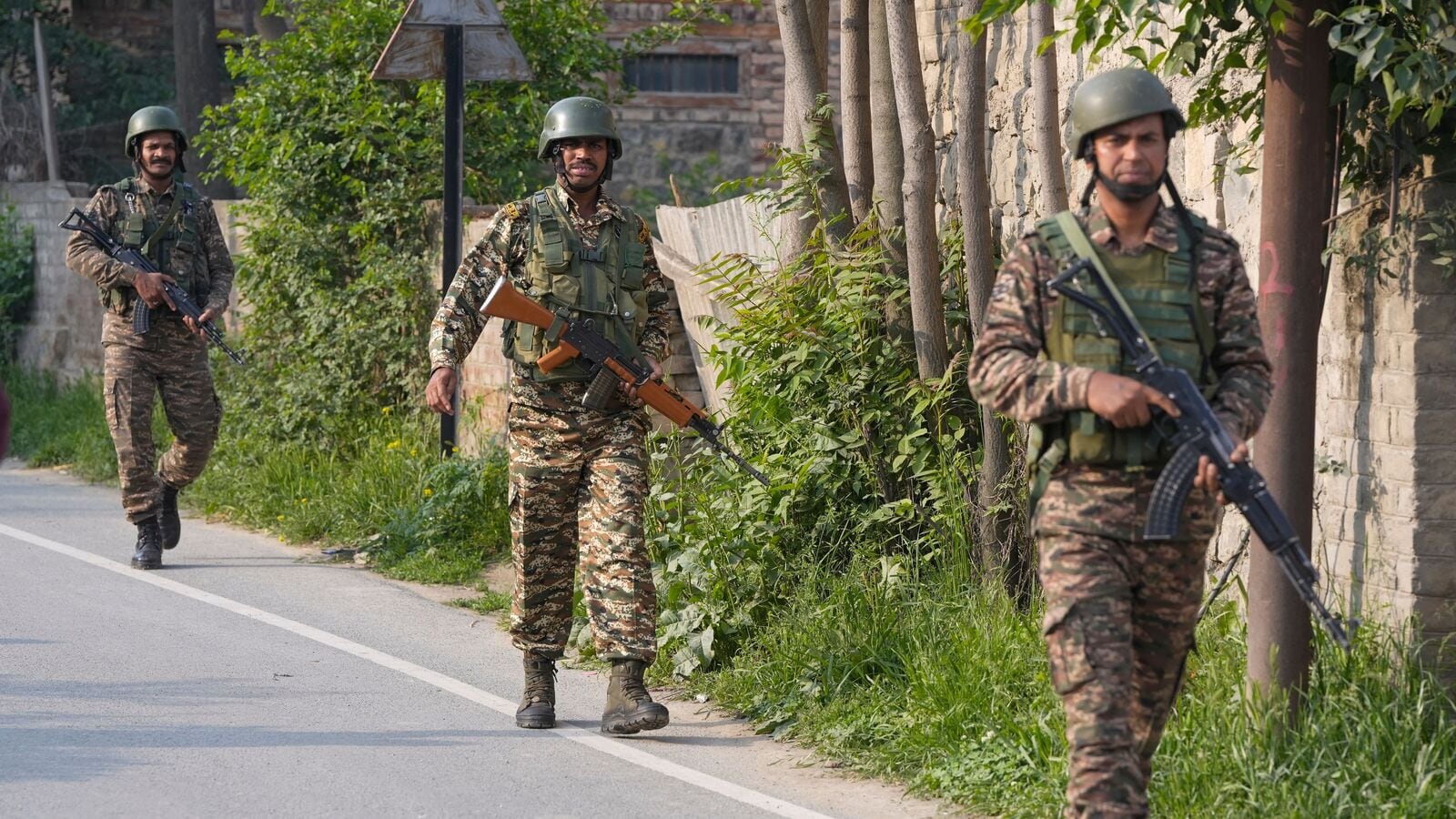
Operation Sindoor impact on stock market: The Indian stock market kicked off the trading session on Wednesday, March 7, with mild losses after Indian armed forces, as part of Operation Sindoor, hit multiple sites in Pakistan. However, it soon turned positive amid gains in banking stocks and Tata Motors.
Sectorally, Nifty Media was the top loser while Nifty PSU Bank index was the best performer, after witnessing hefty losses in the previous session.
Track this space for LIVE updates on the stock market
131 stocks hit 52-week lows today amid India-Pak tensions
While the Indian stock market remained firm in the face of rising tensions between India and Pakistan following Operation Sindoor, some 55 stocks at 55-week highs while 131 stocks traded at 52-week lows as of the afternoon trade on BSE.
The advance-decline ratio favoured losers, as 2054 stocks lost while 1716 stocks gained and 184 stocks were unchanged.
MRF announces ₹229 dividend with earnings
The Board of Directors have recommended a final dividend of ₹229/- (2290%) per share of ₹10 each, MRF said in a filing today. “The Company has already declared and paid two interim dividends of ₹3/ – (30%) each per share for the financial year ended 30 March, 2025. The total dividend for the financial year ended 30 March 2025 works out to Rs. 235/- (2350%) per share of ₹10 each,” it added.
BSE, NSE curb overseas access to their websites, Reuters report
India’s top two exchanges, the National Stock Exchange (NSE) and BSE Ltd, have temporarily restricted access to their websites for overseas users, three sources familiar with the matter told Reuters. This does not impact the ability of overseas investors to trade on the Indian markets, the sources said.
Why are Tata Motors shares rising today?
Tata Motors stock jumped 5% in trade today following two major updates: Shareholder nod to CV business demerger and the India-UK FTA agreement.
News reports suggest that shareholders have approved the demerger though the company release on the exchanges and website is being watched for.
Additionally, Tata Motors will benefit from India-UK FTA. The trade deal ensures that 99 per cent of Indian exports will be tax-free while the Indian import duties will also be reduced substantially. This could reduce tax on JLR in India, driving sales.
Mid-cap and small-cap indices surge up to 1%
While the benchmark indices traded on a flat note following rising India-Pakistan tensions after Operation Sindoor, the real buying action was visible in the broader markets.
Nifty Midcap 100 and Nifty Smallcap 100 each gained over 1% in intraday trade today. As of 12.40 pm, Nifty Midcap index was up 1.39% at 54,176, while the Nifty Smallcap was trading 1.06% higher at 16,367.
Indian stock market reaction to past India-Pakistan war instances
Historical data suggests that the Indian stock market has generally responded with resilience to serious geopolitical events. Except for the Parliament attack in 2001, all other incidents studied have led to positive market returns over the medium to long term, said Abhishek Jaiswal, Fund Manager at Finavenue.
“It’s important to recognize that the likelihood of a full-scale war remains low. As long as such escalation is avoided, India’s economic growth trajectory is unlikely to face any major setbacks. In essence, while the initial reaction to cross-border strikes may be cautious, markets tend to recover and even thrive thereafter—reinforcing the idea that political stability, strategic decisiveness, and national security assurance are valued by investors,” he added.
Operation Sindoor: Should you invest in defence stocks now?
The main focus is naturally on defence companies. They already have large order books, which will get even larger. Operation Sindoor is likely to put the focus on the pace of execution in the defence companies. These companies are likely to be given aggressive execution targets, which are likely to start becoming visible in a few quarters and 1-3 years’ time line, thus possibly boosting revenues and earnings forecast. Similarly, the companies operating in other dimensions, i.e. non-arms and ammunition, of Defence, such as cyber security, strategic minerals & rare earths, oil & gas, hydro-projects, military EPC, military logistics and railways are also likely to see execution at a higher pace.
However, one should be careful to invest only at attractive valuations and in those which pass the scientific investing criteria.
Views by: Dr. Vikas Gupta, CEO & Chief Investment Strategist at OmniScience Capital
Sensex, Nifty trade marginally lower in late afternoon trade
Sensex and Nifty traded with marginal cuts as of 11.15 am. ICICI Bank, Reliance Industries, Sun Pharma and TCS were among the top drags on BSE Sensex today. On the other hand, auto stocks Tata Motors and M&M capped losses.
Defence stocks in focus after Operation Sindoor
Defence stocks hogged the limelight in trade today after India launched Operation Sindoor in retaliation for Pakistan’s attack in Pahalgam. Under this, India launched strikes in various locations in Pakistan and Pakistan-occupied Kashmir.
“The attack gives a boost to the Indian defence companies, such as Hindustan Aeronautics (HAL), Bharat Electronics (BEL), and Bharat Dynamics, which showed an increase. Why? Because conjecture during military operations holds that higher government spending on defence is reflected in the economy,” explained Ankur Sharma, Market Analyst, VT Markets.
India-Pakistan Conflict: What’s working in favour of Indian stock markets?
Gurmeet Chadha of Complete Circle shares why the Indian stock market might remain stable in the face of Operation Sindoor, rising India-Pak conflict.
India-Pakistan standoff to cause volatility; rebound likely in long-term. Here’s why
Geopolitical tensions like the ongoing Indo-Pak standoff under Operation Sindoor tend to cause immediate market volatility, as seen with the Nifty and Sensex dropping 0.6–0.8% recently. Historically, such episodes trigger short-term dips—Kargil War (-4%), Parliament Attack (-3%), Mumbai Attacks (-4%), and Balakot Airstrike (-3%).
However, markets have consistently rebounded in the long term. After the Kargil War, the Sensex surged 63% within a year. Post-Parliament Attack, it rose over 20% the following year. Following the Mumbai Attacks, it gained 60% within 12 months, and after Balakot, it climbed 15% by year-end.
While short-term caution is reasonable, history shows that Indian markets demonstrate strong resilience once clarity returns. Unless accompanied by broader economic or global shocks, Indo-Pak tensions have not had a lasting negative impact. Investors should focus on fundamentals, not fear.
Views: Pankaj Singh, smallcase manager and Founder and Principle Researcher at SmartWealth.ai
FPIs remain buyers despite the rising India-Pakistan conflict
FPIs have remained net buyers in Indian stock market despite rising India-Pakistan tensions, providing support to the indices back home. According to data compiled by Livemint, FPIs have remained net buyers for 14 consecutive trading sessions, pumping in a cumulative ₹43,940 crore into Indian equities
Pakistan Stock Exchange tumbles after India’s Operation Sindoor
The Pakistan stock market reacted sharply to the India’s Operation Sindoor where Indian forces carried out missile strikes early Wednesday on nine terror targets in Pakistan and Pakistan-occupied Kashmir, including the Jaish-e-Mohammad stronghold of Bahawalpur and Lashkar-e-Taiba’s base Muridke.
The military strikes were conducted under the ‘Operation Sindoor’ two weeks after the Pahalgam attack that killed 26 civilians.
The Pakistan Stock Exchange was trading 2.82% lower around 10.12 am.
Vijay Kedia reacts to Operation Sindoor: Look, what he said
Ace investor Vijay Kedia posted a poem after India launched military strikes against terrorist camps in Pakistan in retaliation to the attack on Indian nationals in Pahalgam. Here’s what Kedia said:
Nifty technical view amid Operation Sindoor, India-Pakistan conflict
“We had lowered our upside target yesterday, in light of the distribution signals and loss in upside momentum. While yesterday’s slippage was held near 24400-350 region, our downside marker, only 23.8% of Nifty 500 stocks are now above their 10-day SMAs, pointing to a turn in trend in the broader market, exposing 23670-23460 on the Nifty. In the event of a sharp crack down, we expect 24050-23930 to provide a window for Nifty to consolidate. Alternatively, if dips do not extend past 24280, expect a quick recovery swing higher,” said Anand James, Chief Market Strategist, Geojit Investments.
Sensex, Nifty gain amid gains in bank stocks
Rising India-Pakistan conflict following Operation Sindoor failed to dent the stock market mood, as BSE Sensex rose 70 points to 80,710 while Nifty 50 topped 24,403, up 10 points.
HDFC Bank, Tata Motors, ICICI Bank, Axis Bank and Bajaj Finance were among the top index contributors.
Operation Sindoor: Rupee falls amid rising India-Pakistan conflict
The rupee declined 31 paise to 84.66 against the US dollar on Wednesday, after India’s military strikes against terrorist camps in Pakistan and Pakistan-Occupied Kashmir increased cross-border tensions. Indian armed forces on early Wednesday carried out missile strikes on nine terror targets in Pakistan and Pakistan-Occupied Kashmir, including the Jaish-e-Mohammad stronghold of Bahawalpur and Lashkar-e-Taiba’s base in Muridke.
Why is market discounting Operation Sindoor?
What stands out in “Operation Sindoor” from the market perspective is its focused and non-escalatory nature. “We have to wait and watch how the enemy reacts to this precision strikes by India. The market is unlikely to be impacted by the retaliatory strike by India since that was known and discounted by the market,” explained Dr. VK Vijayakumar, Chief Investment Strategist, Geojit Investments.
“The main catalyst of the market resilience in India is the sustained FII buying of the last 14 trading days which has touched a cumulative figure of ₹43940 crores in the cash market. FIIs are focused on the global macros like weak dollar, slower growth in US and China in 2025 and India’s potential outperformance in growth. This can keep the market resilient. However, investors have to watch the developments in the border,” Dr. VK Vijayakumar added.
Sensex, Nifty off to tepid start
Benchmark indices opened mildly lower as geopolitical tensions flared following Indian strikes on nine sites in Pakistan, in retaliation for Kashmir attack last month.
BSE Sensex was trading at 80,596, down 0.06%, while Nifty 50 was down 0.06% at 24,366.
Disclaimer: This story is for educational purposes only. The views and recommendations made above are those of individual analysts or broking companies, and not of Mint. We advise investors to check with certified experts before making any investment decisions.
About The Author