New Delhi: If you want to understand democracy, famous American essayist Simeon Strunsky once wrote, spend less time in the library with Aristotle and more time on the buses with people.
In much the same manner, a walk through a neighbourhood market can reveal much more about breakout sectors than a tonne of industry reports.
To spot one such opportunity, specifically in the dietary choices of Indians, a trip to Dwarka would serve as an eye-opener. At a street in this western suburb of Delhi, a number of food carts have sprung up in recent times specialising in egg delicacies. Their pièce de résistance, and the highest selling item on the menu, is something called the ‘cheese pizza omelette’.
Like all legendary dishes, it is as much to be seen as it is to be eaten.
To prepare this masterpiece, the food cart chef first slathers the pan generously with a chunk of butter and fries some chopped onions, tomatoes, green chillies and loads of masala. Four eggs follow, and two slices of bread are soaked in the mixture as it cooks in the pan.
The omelette is flipped, and more butter and masala are added. This golden, gooey concoction is then transferred to a plate, which gives the misleading impression that the dish is ready. But the chef then heats another dollop of butter in the pan, fries a few onion rings, and pours this sizzling mix over the plate. He then shifts his attention to the plate, garnishing it with generous amounts of Amul cream, grated paneer and corn. A few token lettuce leaves are then tucked in, only to be buried under a double drizzle of tandoori mayonnaise.
And with that, the magnum opus is ready, making it perhaps the only instance in the culinary world where eggs are reduced to playing a cameo in a dish called the ‘omelette’.
Plate after plate of this artery-clogger is rushed out to waiting cars lined up along the roadside, as the clientele, which includes everyone from students to entire families, hardly bothers to step out. After the dishes are devoured, cold drinks are ordered to wash it all down, followed by some rabri falooda or ice cream from the adjacent carts.
“We used to sell boiled eggs and simple bread-omelette earlier, but after Covid, demand for rich dishes has exploded,” says Umesh Raj, a food cart vendor. “Business is booming.”
Unbeknown to him, so, too, is a ₹10 trillion industry.
Health check
India’s health care market, estimated to be worth ₹10.7 trillion as of 2024, comprises four segments: hospitals, medical devices, pharmaceutical companies and diagnostics. Of these, the biggest vertical is hospitals, accounting for around 60% of the total pie.
This ₹6.3 trillion industry is heavily skewed towards the private sector. Private and trust hospitals hold 67% of the market, with government hospitals making up the remaining 33%.
The private hospitals segment is projected to grow from ₹4.2 trillion currently to ₹6.6 trillion by 2028, at a healthy CAGR of 12%, as per a recent report by financial services firm Avendus.
The optimism surrounding India’s hospital sector is reflecting clearly on Dalal Street. A telling indicator of this momentum came from Association of Mutual Funds in India’s (Amfi) biannual reclassification of stocks, in July.
By definition, the top 100 companies constitute large-caps, the 101st to 250th are mid-caps, and 251st onwards fall in the small cap category.
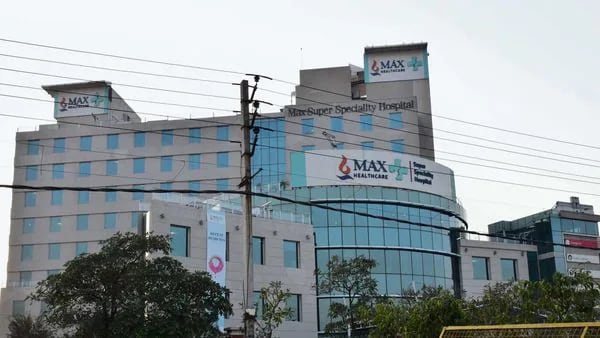
Within this framework, the hospital segment has staged a remarkable ascent. Out of the 10 mid-cap companies that graduated into the large-cap bracket in the latest reshuffle, two were hospital chains—Max Healthcare and Apollo Hospitals, both of which have crossed the ₹1 trillion market cap mark. Similarly, among the nine small-caps that broke into the mid-cap league, two were from the hospital space—Narayana Hrudayalaya and Global Health Ltd (Medanta).
Max Healthcare is also set to be included in the benchmark Nifty 50 from September 30, joining Apollo Hospitals.
While hospital stocks understandably surged in the aftermath of covid, the remarkable aspect of the bull run is that the buoyancy still persists, underscoring the Street’s conviction that the momentum is far from episodic. What was once seen as a temporary pandemic-driven rerating has evolved into a sustained revaluation of the sector’s long-term prospects. In essence, the stock market is signalling that healthcare should no longer be considered a defensive play but a structural growth story with legs for the long haul.
“The steady outperformance of hospital stocks is a function of structural demand, formalization of healthcare, and a growing monetizable base. Between FY14 and FY24, major listed hospitals delivered revenue CAGR of 14–16%, outperforming pharma (~9–11%) and the Nifty 50 (~12%),” Anirudh Garg, Partner and Fund Manager INVasset PMS, told Mint.
This divergence has widened post-covid as hospitals shifted from being capital-heavy infrastructure providers to high-throughput, platform-style service businesses.
“Unlike pharmaceuticals, where IP risk and regulatory cycles can compress valuation, hospitals operate real estate-backed, cash-generative models. They benefit from demographic tailwinds and secular demand,” he added. “This convergence of health infrastructure, insurance, and affordability has structurally re-rated the hospital business in public markets—making it one of the most resilient long-duration assets in India’s consumption basket.”
Pharma may often hog the limelight, but it is hospital stocks that have quietly outperformed. As per Avendus, at the end of FY25, the 10-year CAGR of the Nifty stood at 11%, and pharma companies at 5%, while hospital stocks delivered a stellar 14%.
The sector’s recent performance has been equally impressive.
Shares of Max Healthcare have surged 35% in the past year, outpacing the Nifty Healthcare index, which has stayed flat, and the benchmark Nifty 50, which is down around 2%.

View Full Image
Similarly, Apollo Hospitals is up 15% over the past year, Global Health is up nearly 30% and Narayana Hrudayalaya has vaulted 35%.
Fit to fab
The runway for India’s hospital sector is immense, underpinned by a combination of demographic, lifestyle, and economic factors that are reshaping the country’s healthcare services sector. A steady rise in non-communicable diseases (NCDs) such as diabetes, hypertension, and obesity has emerged as one of the gravest healthcare challenges for India. NCDs account for around 63% of all deaths across the nation, according to the Ministry of Health and Family Welfare.
Unhealthy diets, sedentary lifestyles, pollution and mounting stress levels are among the major causes for the rise of lifestyle-related ailments both among urban and semi-urban populations.
In its latest edition of the ‘Health of the Nation’ report, Apollo Hospitals noted that out of 2.5 lakh individuals who were screened in 2024, 65% were found to have fatty liver. Not just that, 85% of individuals with fatty liver cases were non-alcoholic.
Compounding the lifestyle-related diseases is the fact that India remains grossly under-served in terms of hospital bed capacity. The country has around 8 lakh public hospital beds and 12 lakh private hospital beds, translating into about 15 hospital beds per 10,000 people—barely half the global average of 29. For perspective, this crucial public health barometer stands at 20 for Malaysia, 24 for the UK, 27 for the US, 78 for Germany and 127 for Japan.
India’s healthcare spending, too, at around 3.8% of GDP, compares unfavourably with the global average of 11% and countries such as Vietnam (5%), Argentina (10%), Japan (11%) and the US (17%).
At the same time, the country’s median age continues to rise and the share of the population aged 60 years and above is expected to double to 21% in the next 25 years. This convergence of under-penetrated healthcare spending and rising need underscores the significant headroom for growth in hospital infrastructure and services.
Another powerful driver is medical tourism. India has earned a reputation as a cost-effective healthcare destination offering advanced medical practices and world-class specialists at a fraction of global costs.
Availability of skilled personnel, the latest medical technology, and facilities accredited by global body Joint Commission International (JCI) augur well for further development of medical tourism in India, domestic brokerage Emkay said in a report earlier this year.
With travel restrictions during the pandemic now behind, the inflow of foreign tourists is picking up, although it is still below the peaks witnessed before FY20.
“Medical tourism remains a highly profitable prospect for corporate hospitals, given their higher share of JCI-accredited facilities in India (68%), skilled personnel, and established brand, as international patients offer higher ARPOBs (average revenue per occupied bed) vs cash patients and thus better profitability. Additionally, corporate hospitals are now moving toward first-hand direct sourcing of international patients vs the agent model which should further aid margin uptick in coming years,” it added.
Report Card
The sector’s latest quarterly scorecard also underscores its robust health. Apollo Hospitals reported a consolidated net profit of ₹433 crore in Q1 FY26, a sharp 42% jump year-on-year, buoyed by a turnaround in its digital health and pharmacy verticals. That segment swung into the black with a net profit of ₹57 crore against a loss of ₹13 crore in Q1FY25, aided by strong revenue growth and narrowing losses in Apollo 24/7, its digital consultation and treatment arm.

View Full Image
Max Healthcare posted a 17% year-on-year rise in profit after tax to ₹345 crore in the June quarter of FY26, compared with ₹295 crore a year earlier, driven by improved utilisation of operational beds across its hospital network.
“Hospital stocks have delivered a robust CAGR of 16.5%/26% in revenue/Ebitda over the past five years. The momentum continued in 1QFY26 with YoY revenue growth of 16.5%. Ebitda growth moderated to 20.5% due to the addition of hospitals/beds, consistent scale-up, and improvement in operating efficiency. Hospitals are executing multiple projects to add beds over the next 3-4 years,” Sneha Poddar, VP–Research, Wealth Management, Motilal Oswal Financial Services, told Mint.
“Specifically, FY26 is expected to witness bed additions of 7,830, implying 20% YoY growth in operating beds. Importantly, the current aggregate occupancy rate of 59% offers ample scope for improvement, ensuring incremental capacity can be absorbed without diluting profitability. This, coupled with strategic bed additions, would help the companies sustain strong growth over the next 4-5 years,” she added.
In a report earlier this month, Axis Securities noted that the hospital sector delivered strong growth in Q1FY26, with higher purchasing power and increased insurance penetration contributing to the rise in occupied beds.
Insurance payers contributed 33% to total revenues this quarter, growing 24% y-o-y and 7% q-o-q.
“However, insurance penetration remains relatively low, presenting significant growth potential as awareness of health coverage rises and purchasing power improves. Additionally, high-growth therapies such as cancer and cardiac care continue to drive double-digit growth, further boosting ARPOB and occupancy rates,” it said.
Investors’ corner
Just as medicines have side effects, one major fallout of a booming sector is that stocks tend to trade at nose-bleed valuation levels. If you as an investor are uncomfortable paying 50 or 60 times earnings for soap makers or paint manufacturers, welcome to the hospital segment, where the biggest company by market cap (Max Healthcare) trades at a price-to-earnings (P/E) ratio of around 100, and the next four players at 70 and thereabouts.
While the traditional approach is to steer clear of stocks with such high P/E ratios, there is a lot of nuance in the case of hospital stocks, market experts explain.
“Hospital chains have emerged as one of the most consistent compounders post-covid, with occupancy, ARPOB and medical tourism all trending higher. That growth explains the premium multiples, but at ~65-70x P/E, the sector trades richer than global peers. The way to navigate is with discipline, paying for earnings compounding that can be underwritten today through brownfield expansions, strong specialty mix and tight cost control, while avoiding names where the story is running ahead of the numbers,” Nirali Shah, analyst at Ashika Institutional Equities, told Mint.
However, some experts maintain that the rich valuations are justified given robust earnings visibility, industry tailwinds, and companies’ ability to scale infrastructure to meet the growing patient pool.

View Full Image
“In our view, the sector remains structurally attractive, underpinned by sustained demand, improving operating leverage, and disciplined capacity expansion,” said Motilal Oswal’s Poddar.
INVasset’s Garg echoed that view, saying the valuation premium assigned to listed hospital companies is not an aberration but a reflection of deep entry barriers, consistent cash flows, and structural growth visibility.
“Hospitals are one of the few sectors where capacity takes years to build, but once stabilized, assets generate high fixed-cost leverage, allowing return on capital employed (ROCE) to cross 18–20% in mature facilities, as seen in several top-tier chains,” he said.

View Full Image
Rather than focusing on P/E alone, institutional investors typically track operating metrics such as ARPOB ( ₹2,000– ₹2,500/day), occupancy ramp-up timelines (target: 60–65% within three years of commissioning), and scalability of high-margin verticals such as oncology, robotic surgery, and daycare procedures.
“While near-term valuations may appear stretched, long-term investors would do well to assess execution track record, return ratios, and regional dominance. In a consumption economy shifting toward services and quality-of-life upgrades, hospitals are increasingly viewed as compounding machines—not cyclical plays,” he added.
The sector has also caught the eye of private equity firms, which have poured around USD 11 billion into it since 2015—a clear signal of where the ‘smart money’ is going.
Investors, however, should also be mindful of the risks. The regulatory environment in India is fragmented and often unpredictable, with multiple authorities at the national, state, and local levels. Just as the National Pharmaceutical Pricing Authority (NPPA) caps prices of essential drugs, moves to regulate pricing by hospitals can be margin-dilutive for hospital chains.
Reuters reported last month that the government is mulling over whether to put an existing health insurance claims portal under the finance ministry and insurance regulator to curb overcharging by healthcare providers. Such regulatory moves are a persistent overhang on these companies.
That said, the outlook for the sector remains strong. Healthcare providers with scale, brand equity, and diversified offerings look best placed to capture the growing demand. Much like Dwarka’s egg carts and their endless orders.
About The Author