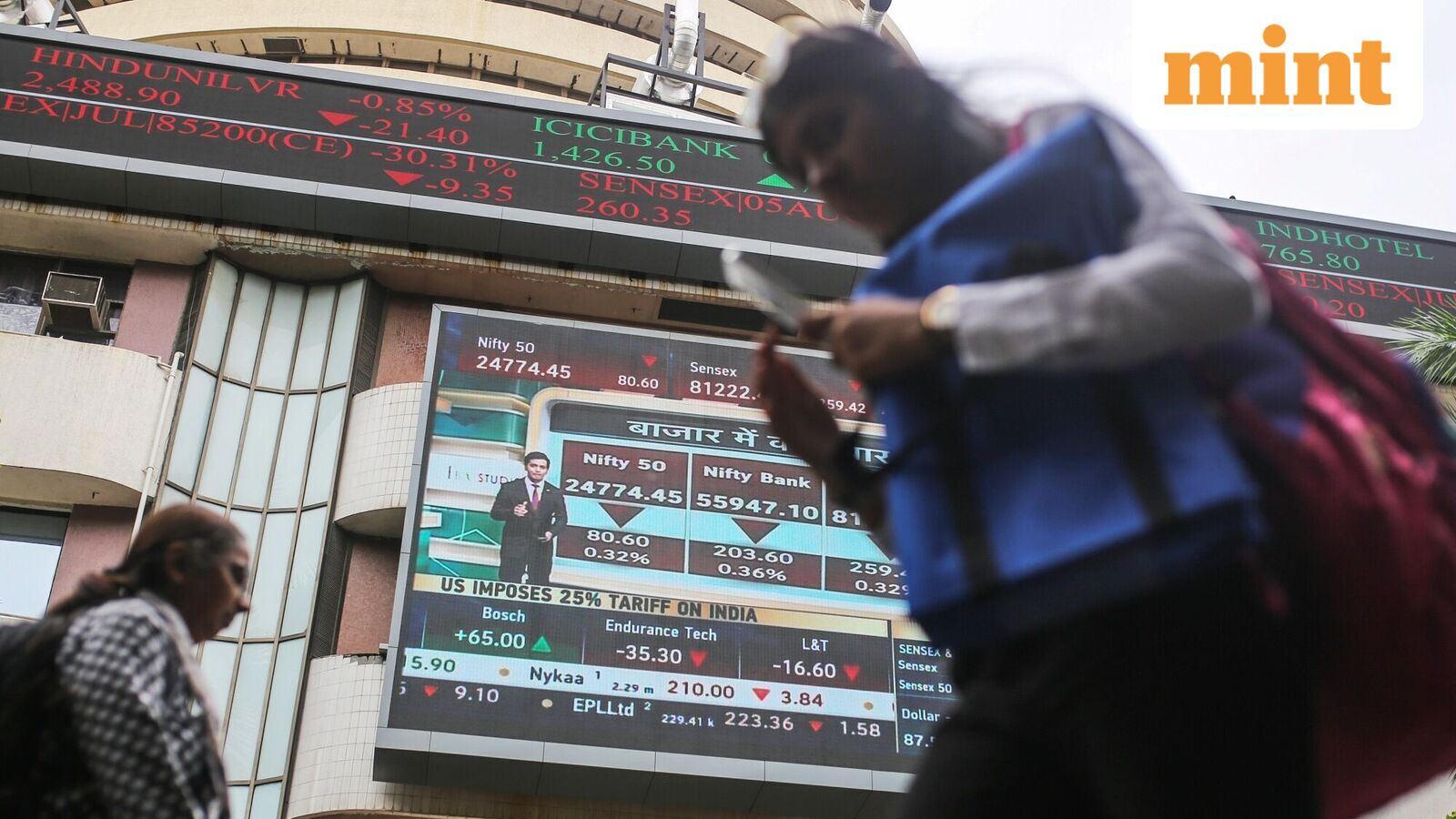
India’s equity markets ended the week with modest gains, even as investors lacked conviction about the road ahead. Benchmark indices traded with a mild positive bias through Friday’s session, supported by a stronger rupee. But profit booking at higher levels erased much of the intraday gains, reflecting the fragile underlying sentiment.
The Sensex rose 0.24% over the week to close at 75,415.35, while the Nifty 50 gained 0.32% to end at 23,719.30. Analysts said the Nifty’s failure to hold above the crucial 23,800 mark for a second straight session signalled weak momentum, keeping markets stuck in a narrow range through the week.
Crude, forex
Brent crude oil eased to around $105 per barrel from $109.26 last Friday amid some modest progress in the US-Iran peace talks, but concerns around imported inflation, fiscal pressure and pressure on corporate margins remained elevated in India.
Meanwhile, the rupee staged a sharp recovery after weakening toward the 97-per-dollar mark earlier this week. The currency strengthened nearly 0.7% to trade near 95.65 on Friday, aided by aggressive intervention from the Reserve Bank of India (RBI). Analysts said RBI’s recent measures to stabilize the currency helped restore confidence and reduce volatility in the forex market.
The macro pressures, however, still prevail. India’s goods trade deficit widened to $28.4 billion in April from $20.7 billion in March, while concerns over likely weaker corporate earnings in the June quarter (Q1FY27) continue to weigh on investor sentiment.
“Markets are no longer in the earlier liquidity-driven comfort zone,” said Rajesh Iyer, managing director of global investment solutions and asset management at LGT Wealth India. “Crude prices, the rupee and early signs of earnings moderation have moved back into focus, making the setup more cautious and less directional.”
Tech support
The changing macro environment was reflected in the equity market’s sectoral trends this week. Information technology (IT) stocks emerged as the top performers, rising 4% over the week, while fast moving consumer goods (FMCG) was the biggest laggard, declining nearly 1.5%.
Iyer attributed the rally in IT stocks to the rupee’s weakness, which boosts the sector’s dollar-denominated earnings, along with renewed preference for globally-linked defensive sectors amid the domestic uncertainty. The sector also benefited from tactical buying after a prolonged period of underperformance, he added.
FMCG stocks, on the other hand, remained under pressure as concerns around slowing consumption demand and margin stress resurfaced. Rising commodity-linked input costs and weakening pricing power have started clouding the sector’s earnings outlook, especially as current growth increasingly relies on price hikes rather than volume expansion, Iyer said.
Meanwhile, corporate earnings for the March quarter remained moderately supportive for the market. Q4FY26 earnings for Nifty 50 companies have so far come in around 2% ahead of expectations, though analysts noted that management commentary has turned more cautious amid softer demand expectations and macro uncertainties.
Cooling FPI outflows
India remained a feeble gainer compared with several global peers. While the domestic markets outperformed China, Vietnam, Hong Kong and Indonesia this week, they continued to lag South Korea, Taiwan and Japan. European indices also outperformed most global peers during the week, as investors gravitated toward the developed markets amid elevated uncertainties
“Higher US bond yields and a strong dollar continued to divert capital toward developed markets, limiting flows into emerging economies like India,” Iyer said.
Foreign portfolio investor (FPI) outflows, however, showed signs of easing. Outflows moderated sharply to ₹1,534.8 crore during the week, marking their lowest level of weekly selling in over a month.
Yet, experts cautioned against interpreting this as a decisive turnaround. “What we are seeing is more of a slowdown in selling, rather than a sustained revival in flows,” Iyer said. “A durable recovery in foreign inflows would require stability in crude prices, a stronger rupee and better earnings visibility.”
However, Nikhil Gangil, smallcase manager, founder and chief executive at Intrinsic Value expects FPI flows to turn positive from mid-June, arguing that India is currently among the few fairly valued markets globally. He added that foreign investors, typically momentum-driven, could turn positive if the market rally seen in April extends into June.
For next week, analysts expect markets to remain range-bound, with domestic institutional buying limiting sharp declines even as continued foreign selling keeps gains in check.
About The Author