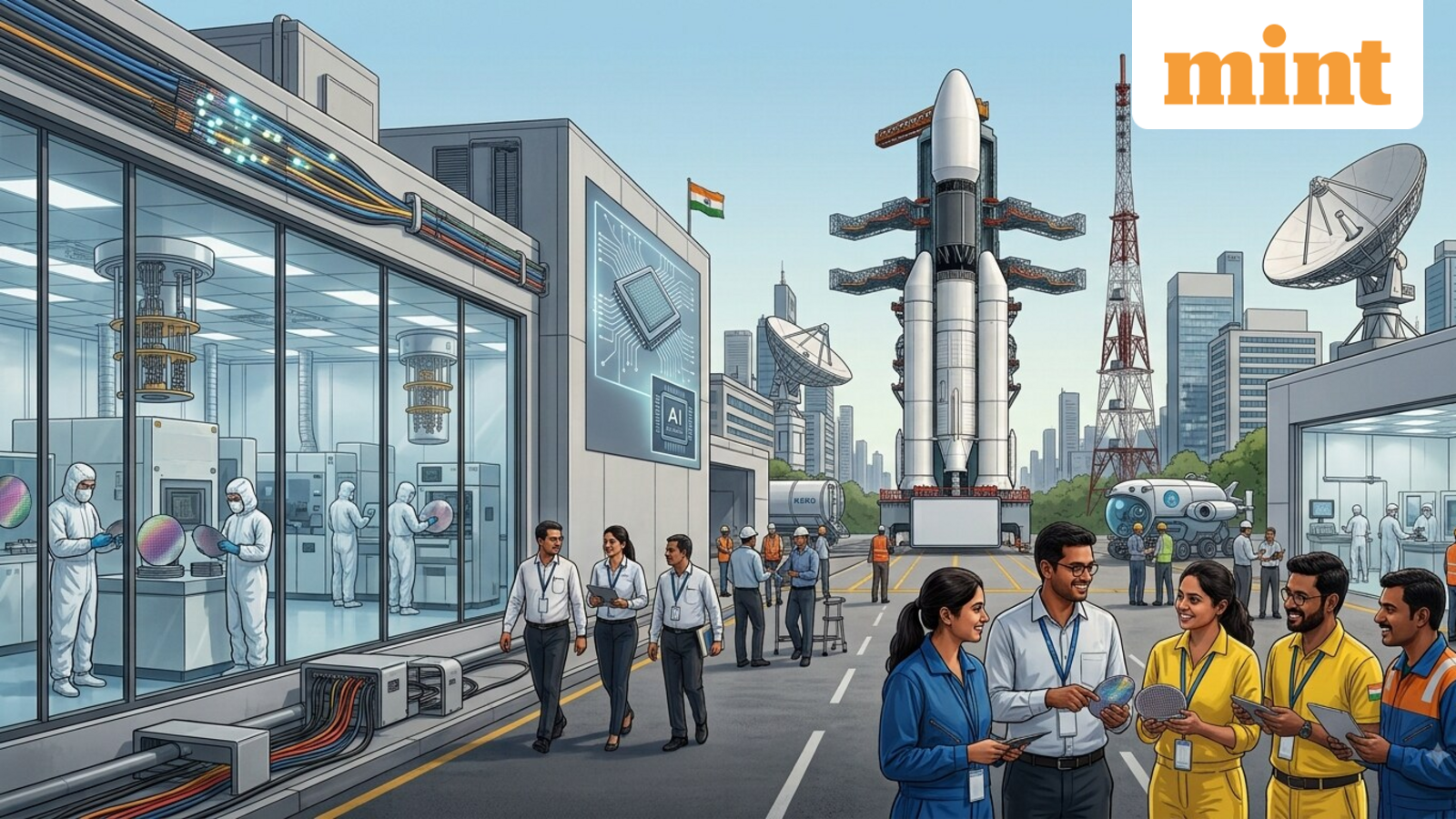
Deep-tech industries such as semiconductors and space-tech are attracting strong interest from high-net-worth (HNW) and ultra-high-net-worth (UHNW) investors, for these industries, which were earlier viewed as best on future possibilities are now seen as strategic industries critical to India’s economic growth and technological aspirations.
Semiconductors and space-tech are signalling a broader deep-tech investment cycle in India and the confirmation lies not in the headlines but in the architecture assembling behind them.
Many experts believe these industries are reflecting early signs of a much wider deep-tech investment cycle, as they have quietly become strategic building blocks for the new economy.
For example, space-tech has moved well beyond satellite communications, navigation and earth observation into launch, propulsion, logistics and even defence. Semiconductors are at the foundation of everything from AI and electronics to automotive and ‘Industry 4.0’.
Harshal Dasani, Business Head at INVAsset PMS, underscored that a genuine deep-tech cycle needs three things arriving together: patient capital, policy scaffolding, and demand anchors, and for the first time India has all three simultaneously.
“The capital is now measurable, with space-tech startups alone raising $871 million across 241 rounds and nearly 285 companies working across launch vehicles, satellites, and propulsion, alongside a $1 billion deep-tech alliance on the semiconductor side and corporate balance sheets committing at scale, including the $15 billion Google-Adani AI hub,” Dasani highlighted.
Dasani added that the demand anchors are the strongest part, defence indigenisation, AI data centres, and a global chip shortage that makes self-sufficiency economics viable rather than aspirational.
The honest caveats, however, is that the gestation periods are long, fab economics remain brutal, as the paused tower project showed, and listed-market expressions of this cycle are still mostly proxies, the EMS and defence-electronics names, where valuations already price part of the promise.
“This cycle is real and a decade long, so back the picks-and-shovels and companies with revenue and order books, and let the concept-stage stories prove themselves in the private markets first,” said Dasani.
No more isolated pockets
Ajay Modi, Director at Piper Serica – a Mumbai-based, SEBI-registered Category I and Category II Alternative Investment Fund (AIF), points out how strategically important the semiconductors and space-tech sectors are.
“Both sectors have pulled in serious government support, and that’s helped the ecosystem actually take shape on the ground. In semiconductors, we now have a full chain forming from chip design and DLI-supported companies through to fabrication and packaging, with 12 projects worth around ₹1.64 lakh crore already approved,” said Modi.
“In space-tech, there are roughly 400 startups working across satellites, components, propulsion and launch systems. When you have strategic demand, policy backing and an end-to-end ecosystem coming together like this, it naturally becomes the spark for a broader deep-tech cycle rather than just a couple of hot sectors,” Modi said.
Modi emphasised that smart money is already responding to this.
“Piper Serica’s ₹800 crore Bharat Tech Fund (with a ₹300 crore first close) is one example, and a few other India-focused venture funds have recently launched too, all of them spreading across semiconductors, AI infrastructure, spacetech, defence, robotics and biosciences instead of betting on just one theme,” said Modi.
“We’ve deployed close to ₹260 crore across 33+ startups in our first fund, including Sensesemi and Pantherun in semiconductors and electronics, along with Alt Mobility, Yaanendriya, Coratia Technologies and Six Sense Mobility across mobility and other deeptech areas. And this isn’t just an India trend globally, deep tech now makes up 36% of total VC funding, nearly three times what it was in 2016. That’s a good indicator that capital is genuinely broadening out into a multi-sector cycle, even though spacetech and semiconductors remain the sectors people notice first,” Modi added.
Vishnu Rajeev, Investment Partner at Speciale Invest- a venture capital firm, underscored that several distinct sectors are moving through their own stages of maturity, and semiconductors and spacetech simply happen to be furthest along.
“They’re ahead for two structural reasons. The first is supply-side: both sit on two or three decades of accumulated research talent. India has been doing serious silicon design inside Intel, IBM, Nvidia, TI, Qualcomm, and AMD for twenty-five years, which gives us a deep bench of people who have shipped real chips,” Rajeev said.
“Space has ISRO, which provides both the talent pool and, just as critically, a vendor ecosystem already qualified to build to flight standards. Neither of these can be manufactured in five years. The second is demand. Both sectors have visible, funded, largely non-discretionary buyers,” said Rajeev.
Space-tech growing rapidly
Modi highlighted that the 2023 Space Policy and IN-SPACe made it possible for private players to enter the sector.
The Indian space economy has turned from a policy-enabled opportunity into a real commercial ecosystem, with its own supply chain, order book and business models, which is pulling investors to it.
“The clearest sign of that shift was India’s first private orbital rocket launch in July 2026. That moment mattered less as a headline and more as proof, proof that the ecosystem has grown past just satellites and applications, into launch vehicles, propulsion and all the downstream businesses that depend on those systems being reliable,” said Modi.
Ecosystem active, but is it working?
Funding raised and projects announced tell you the ecosystem is active, but they don’t tell you whether it’s actually working. Over the next 3-5 years, the real test comes down to three transitions.
Experts say the real scorecard for India’s deep-tech push isn’t funding deployed or projects approved. It’s IP ownership, export revenue share, unprompted global supply-chain qualification, and fund-level returns.
Those four things are really the difference between technology being built in India and technology the world actually chooses to buy from India.
“The first test is moving from assembly and technology adoption to genuine indigenous design, IP and manufacturing. Taiwan’s semiconductor journey is the reference point here, TSMC didn’t become TSMC by assembling chips designed elsewhere, it built its own design and process IP, and that’s the layer that captured all the value. So the metric to watch isn’t how much fab capacity gets added, it’s how much of what gets manufactured domestically carries India-designed IP and India-owned patents,” said Modi.
“Funding raised and projects approved are inputs. They measure activity, not capability, and they should be retired as headline metrics. The honest test is whether capital comes back out. Exits and revenue growth in the more mature deep-tech companies are what prove the asset class works, and we already have evidence at real scale,” said Rajeev.
Read all market-related news here
Read more stories by Nishant Kumar
Disclaimer: This article is for educational purposes only and does not constitute investment advice. The views and recommendations expressed are those of individual analysts or broking firms, not Mint. We advise investors to consult with certified experts before making any investment decisions, as market conditions can change rapidly and circumstances may vary.
About The Author