Sen.Kirsten Gillibrand, D-N.Y., is”veryoptimistic”the Senate Agriculture Committee’s updated legislation to regulatecryptocurrencies will advance,even thoughRepublicans have yet to reach a deal with Democrats.
“Senators have been working on a bipartisan basis for the last six months prettyintensely,and we have two different bills,” GillibrandtoldCNBC in an exclusive interview.
One piece of legislation is in the Agriculture Committee, which oversees the Commodity Futures Trading Commission and the second piece is at the Banking Committee, which oversees the Securities and Exchange Commission and banking issues, she said.
“Because these types of digital assets have some characteristics of bothcommodities and securities, you need regulation under both those committees,” Gillibrand said.
The Democraticsenator is not a member of the SenateAgricultureCommittee, but has been involved in negotiations on cryptomarketstructure. She explained thatthetwo bills, which addressdifferent partsof crypto market structure,are beingworked onsimultaneously.
“Ithink both senators on theBanking andAgcommittee are working in a bipartisan way and in good faith,” she said.
On Wednesday night, the Senate Agriculture Committee released the updated legislative text, which builds on a previously released bipartisan discussion draft. The bill would give theCFTC new authority to regulate digitalassets.
In a statement, the chairman of the committee, John Boozman, R-Ark.,acknowledged that “differences remain on fundamental policy issues,” but that the bill”builds on our bipartisan discussion draft while incorporating input from stakeholdersandrepresents months of work.”
“Althoughit’s unfortunate that we couldn’t reach an agreement, I am grateful for the collaboration that has made this legislation better,”Boozman said, adding that”it’stime we move this bill.”
Markup of theSenate Agriculture Committee’slegislation to regulate digital commoditiesis scheduled for Jan. 27.
The Senate Banking Committee’s markup hearing on its drafttextto regulate digital assets was scheduled for Jan. 15, but waspostponed at the last minute after opposition from the crypto industry, including Coinbase.
When asked if she thinks the Senate Agriculture Committee’s hearing is also at risk of delay, Gillibrand told CNBCthat there arestill areas that need bipartisan resolutions, butshe believes the markup will take place on Tuesday.
Gillibrand noted thattheSenate Agriculture Committee’s draft is still in review, adding that”hopefully the senators will work on a bipartisan basis to amend that draft to make it stronger, to make it better, to continue their negotiations in the areas where therewasn’t resolution.”
She said that an earlier draft from the Agriculture Committee had a lot of bipartisan compromises in it, some of which were left out. “My hope is that those senators can get back to the drawing board and try to re-include some of those compromises that I thought were very strong,” Gillibrand said.
Senate Banking Committee bill on hold
Bipartisan negotiations are continuing for the Senate Banking Committee’s draft text ofcrypto market structurelegislation, according toChairmanTim Scott, R-S.C.
“I’ve spoken with leaders across the crypto industry, the financial sector, and my Democratic and Republican colleagues, and everyone remains at the table working in good faith,”Scottsaid in a statement.
A new date for a hearing onthe Senate Banking Committee’s draft of a crypto market structure bill has not yet been set.
“I think that people are going to keep working over the next few weeks,” Gillibrand told CNBC, noting that “people want to get this done now.”
Speaking with CNBC’s”Squawk Box”from the World Economic Forum’s annual meeting in Davos, Switzerland on Tuesday,Coinbase CEO Brian Armstrong kept the pressure on the Senate’s crypto legislative efforts. He said the company’s legal team and executivesstarted to notice”some pretty serious issues in the draft text”of the Senate Banking Committee’s billand thatit didn’t seem like there wasa planin place torectify those issues.
“We felt like we had an obligation to go out and defend our customers’ rights and say, ‘We have some issues here,'”Armstrong said.

In a post on X, Armstrong wrote thatthe version of the bill “would be materially worse than the current status quo.”
Armstrong also outlined some of the issues Coinbase had with the Senate Banking Committee’s draft text, including “draft amendments that would kill rewards on stablecoins, allowing banks to ban their competition.”
The Senate Banking Committee’s text would haveprohibited stablecoin issuers from offering rewards for holding them. Instead,those rewards would have to be offered through the completion of a transaction or a rewards program.
Thebanking industryis urgingCongress to close whatitdeemeda loophole in theGENIUS Act stablecoin legislation, which banned stablecoin issuers from directly paying interest.Banks argue this would lead to a flight of deposits from the insured banking system.Somecrypto companies, especiallyCoinbase, have pushedback against thatclaim.

Gillibrand wasthe leadDemocratic senator on theGENIUSActandhelped guidetheregulatory framework through Congress.In July, President Donald Trump signed it into law.
When askedwhatshethinksaboutthe banking industryclaims of a loophole in the GENIUS Act, she said she is “optimistic that we can find some common-sense bipartisan language that satisfies everyone’s concerns on this issue.”
“I thought we had done that in GENIUS,but if it needs more work, we will keep working,” she added. “Wehadvery stronglanguage to that effect that we were fine with rewards and points and other programs, but that youcouldn’tbeoffering interest-like products on stablecoins,” she said.
Gillibrand said that lawmakerswanted to givethe crypto industry an opportunityto show thatitcan follow the rules of the road, and added that lawmakers don’twant to see deposit flights from banks.
“We wanted to make sure that no consumer was confused about what a stablecoin is versus whata dollar sitting in a bank account is because stablecoins are not FDIC insured,” she said, adding that there different protections put in place for stablecoins.
“We made sure that every stablecoin was backed by a U.S.dollar or a U.S.dollar equivalentand sowe thought the compromise and the language that we concluded with in that bill wasvery strong,” Gillibrand added.
A Republican ally announces retirement
The Democratic senatorhas pushed for crypto legislation since 2022,when sheandSen. Cynthia Lummis, R-Wyo., introduced theLummis-GillibrandResponsibleFinancialInnovationAct, a bipartisan framework for cryptocurrencyregulation.
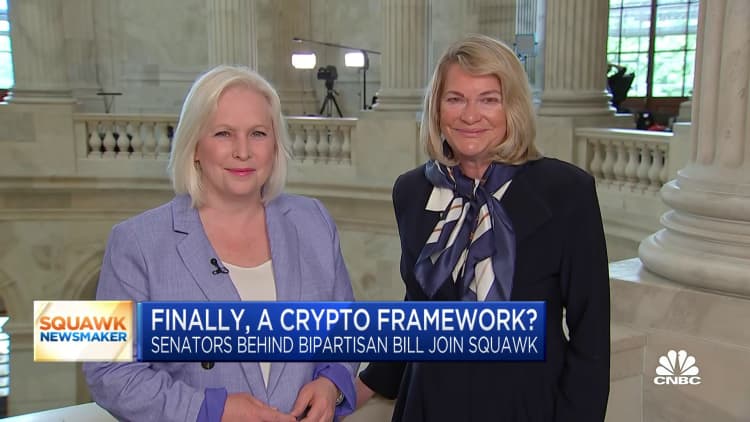
In December, Lummisannounced she will retire at the end of her termthis year.Lummis chairsthe Senate Banking Committee’s crypto subcommittee, and also guided the GENIUS Act to passage. Both senators are currently negotiatinglegislationas part of an industry-backed push for broader regulation ofdigital assets.
“It’sa huge loss to the U.S. Senate andit’sa personal loss to me,” Gillibrand saidof Lummis’ expected retirement.

Despite Lummis’ retirement, Gillibrand said her advocacy for digital assets will not change. She stressed that she is “committed” to crypto because she thinksit provides opportunities for entrepreneurship and innovation.
“Idon’t want China or Asia or other parts of the world to have the benefit of these industries because we are unwilling or unable to regulate it,” Gillibrand said.
“If we want to protect consumers and we want to protect the traditional financial services, the best way to do that…is to regulate it.It’sthe one thing thatactually makesit possible to compete worldwide,” she added.
Gillibrand stressed that lawmakers muststay at the negotiating tableandkeep working on a bipartisan basistocreateacomprehensiveregulatory frameworkfor digitalassets.
About The Author