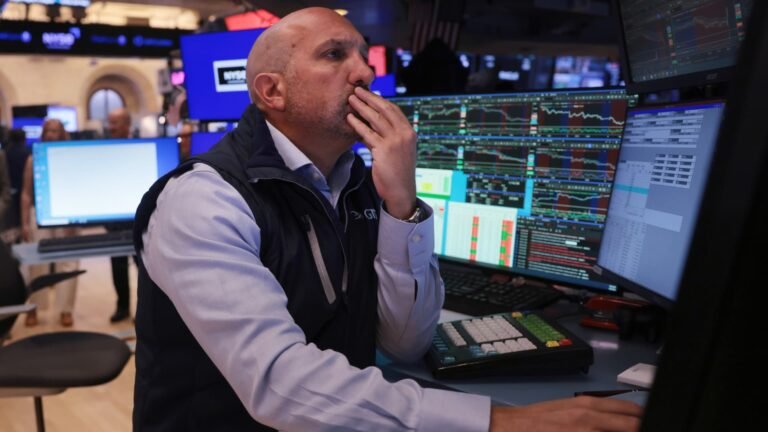
The Sensex and Nifty 50 suffered massive losses of over 2% each in morning deals on Thursday, April 2. A day after rising by more than half a per cent, the benchmarks resumed their downward march after US President Donald Trump’s address to the nation.
BSE Sensex plunged over 1,500 points, or 2%, to an intraday low of 71,546, while the NSE barometer Nifty 50 crashed 500 points, or 2%, to the day’s low of 22,183.
Investors lost ₹10 lakh crore in a day as the overall market capitalisation of BSE-listed firms dropped to ₹412 lakh crore from ₹422 lakh crore in the previous session.
Why is the Indian stock market falling?
Let’s take a look at five key factors behind the market selloff:
1. Trump’s aggressive tone on Iran war
While the US President said Washington is nearing the completion of its core objectives in Iran, he added that the US military will carry out aggressive strikes on the West Asian country over the next two to three weeks.
Trump’s words on Iran were aggressive, raising fears that tension in the West Asian region may not end soon.
Ahead of the White House speech, Trump asserted on his Truth Social platform that Iran’s president had sought a ceasefire. Tehran swiftly rejected the claim, with its foreign ministry spokesperson describing the remarks as “false and baseless.”
“With President Trump’s declaration, ‘we are going to hit Iran extremely hard in the next two to three weeks,’ market sentiments have again turned negative. President Trump’s statement cannot be taken at face value, as he has been notoriously inconsistent in his views. He can change his position anytime,” VK Vijayakumar, Chief Investment Strategist, Geojit Investments, noted.
2. Brent crude prices jump
Crude oil prices rebounded, with Brent Crude jumping over 4% to surpass $105 per barrel, while West Texas Intermediate jumped 3% to trade above $103 per barrel.
Crude oil prices jumped after Trump’s speech failed to offer clarity on the opening of the Strait of Hormuz, a crucial waterway for global oil trade.
“Investors’ primary concern is the fate of the Strait of Hormuz. Any cessation of outright warfare would be a good thing—hopefully no one wants to see casualties and major disruptions—but the notion that it might occur without a reopening of the Strait of Hormuz seemed rather incomplete. A ceasefire is a necessary condition for a resolution; reopening the Strait is the only condition sufficient to return global economies to a state of relative normalcy,” Vikram Kasat, Head – Advisory, PL Capital, said.
3. Weak global cues
The domestic market mirrored the trend in other major Asian markets, including Japan’s Nikkei and Korea’s Kospi, which crashed up to 4% after crude oil prices rose sharply.
Asian markets crashed after Trump said the US military may wrap up its operation in Iran over the next two to three weeks, but did not say whether Iran will open the Strait of Hormuz.
4. FPIs’ aggressive selling
Foreign portfolio investors continue selling Indian equities aggressively amid oil price volatility due to the US-Iran war and the rupee’s weakness against the dollar.
On April 1, they sold Indian stocks worth ₹8,331.15 crore, as per the NSE data.
“FPIs continued selling heavily with a sell figure of ₹8,331 crores on April 1st. The high crude price, the widening trade deficit, the fear of declining remittances and sustained FPI selling are acting cumulatively to put high pressure on the rupee, which continues to decline despite RBI’s decisions on restrictions on dollar futures deals,” said Vijayakumar.
5. US dollar, bond yields rebound
The US dollar index rose by 0.40% to reclaim the 100 mark, while the US 10-year bond yields surged more than 1% to 4.38%, putting pressure on emerging markets like India. A stronger dollar and higher bond yields can potentially aggravate foreign capital outflow.
Read all market-related news here
Read more stories by Nishant Kumar
Disclaimer: This story is for educational purposes only. The views and recommendations expressed are those of individual analysts or broking firms, not Mint. We advise investors to consult with certified experts before making any investment decisions, as market conditions can change rapidly and circumstances may vary.
About The Author