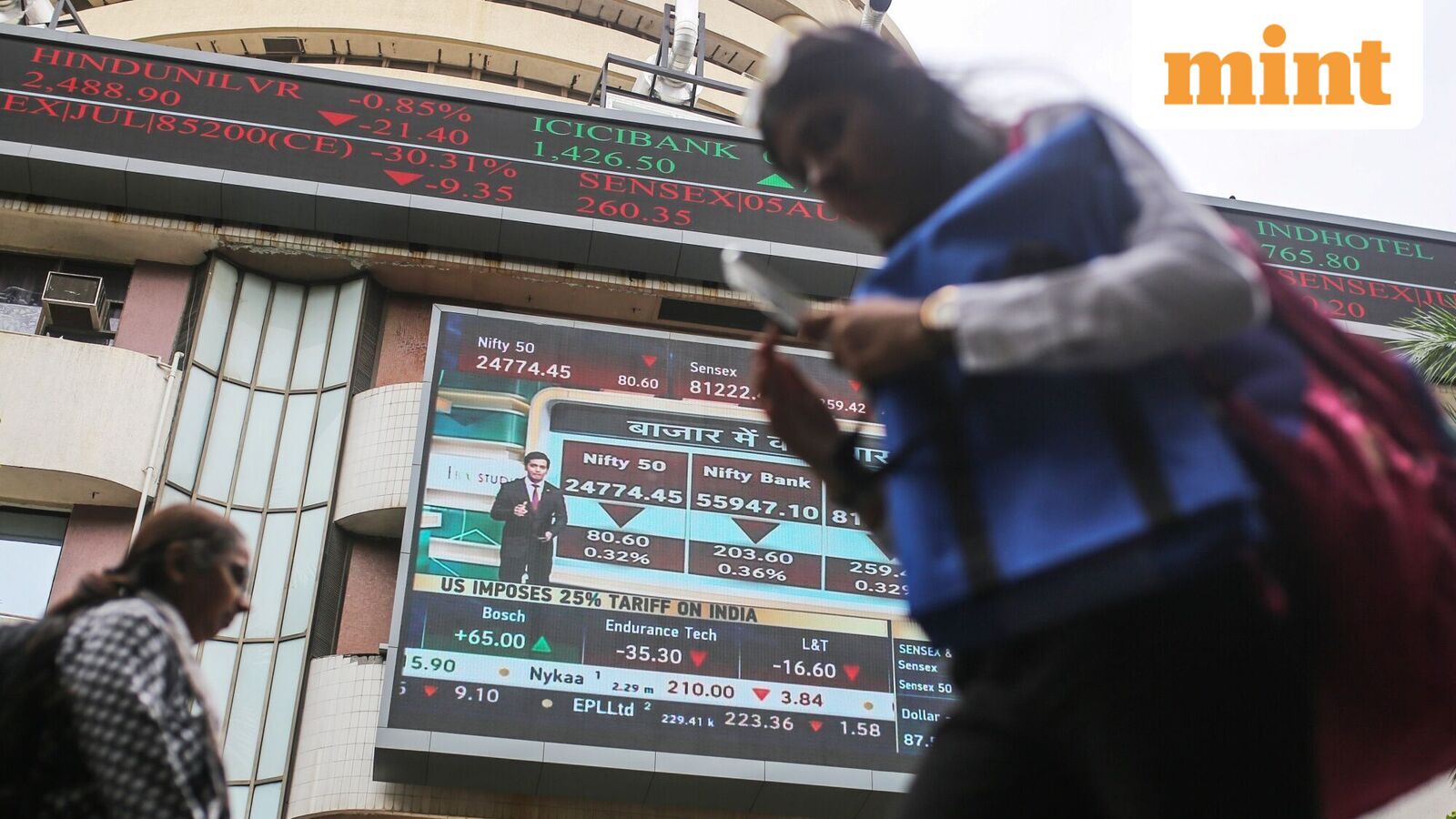
Mumbai: The shadow of the West Asia conflict continued to hammer Indian markets on Tuesday as escalating tensions in the region, surging crude oil prices, relentless foreign fund outflows, a plunging rupee, and Prime Minister Narendra Modi’s call for economic restraint rattled investor sentiment.
The uncertainty triggered a broad-based selloff, deepening anxiety over the impact a prolonged conflict could have on prices, supply chains and, ultimately, household wallets.
On Tuesday, the Sensex tumbled 1.9% while the Nifty 50 fell 1.8%, extending its losses over four successive sessions to 4%. Investor wealth worth ₹10.95 trillion was wiped out in a single day as selling pressure hammered BSE-listed companies.
People also ask
AI powered insights from this story
•5 QUESTIONS
The Indian stock market has declined due to escalating tensions in West Asia, leading to surging crude oil prices, significant foreign fund outflows, and a weakening rupee. These factors have rattled investor sentiment and triggered a broad-based selloff.
Rising crude oil prices, exacerbated by the West Asia conflict, are pressuring India’s current account deficit and contributing to the rupee’s depreciation. This also poses a threat to corporate earnings and could lead to inflation concerns.
The India VIX, known as the market’s ‘fear gauge,’ has risen due to increased uncertainty. A higher VIX signals a sharp increase in expectations of heightened market volatility ahead, indicating investor caution.
The government has urged citizens towards economic restraint and austerity measures. Potential policy responses include measures to improve dollar inflows, curb imports (like gold), and possibly gradual increases in retail petrol and diesel prices.
Some investors are considering holding cash due to market uncertainty, similar to strategies employed by figures like Warren Buffett. However, others suggest a balanced approach, looking for buying opportunities on dips while hedging against further downside.
Global markets, too, took a dive. South Korea’s Kospi slid 2.3%, while major European indices also traded in the red, with Germany’s DAX falling 1.3% and France’s CAC 40 slipping 0.6%.
The selloff intensified across the broader market as the Nifty Midcap 100 and Nifty Smallcap 250 fell 2.5% and 2%, respectively. Among the biggest drags on the Nifty 50 were Adani Ports and Special Economic Zone and Shriram Finance, both of which slipped 4.3%. IT stocks followed, with Tech Mahindra falling 4.2% and HCL Technologies, 4%.
The rout also pushed up the India VIX—widely regarded as the market’s ‘fear gauge’—5% to 19.46, signalling a sharp rise in expectations of heightened volatility ahead. Levels between 15 and 20 typically signal elevated caution.
Tuesday’s decline was exacerbated by weekly Nifty derivatives expiry-related positioning and long unwinding in the options segment. Market participants noted that provisional FPI selling figures were not particularly large, indicating that long liquidation in index options amplified the sharp intraday decline.
On Tuesday, provisional data from BSE and NSDL showed that FIIs were net sellers of Indian equities worth ₹1,959.39 crore, while DIIs were net buyers with purchases worth ₹7,990.32 crore.
Why investors are nervous
A Reuters report said hopes for a ceasefire faded on Tuesday after Donald Trump said negotiations with Iran were “on life support” after Tehran rejected a US proposal and stuck to its own list of demands.
Against this backdrop, the Prime Minister renewed his call on Monday for economic restraint. The PM had on Sunday appealed to Indians to undertake voluntary austerity measures, including not buying gold for a year, limiting foreign travel, and using public transport or electric vehicles.
Some market participants believe the PM’s remarks signal possible austerity measures in the coming weeks if the conflict continues.
According to Sunny Agrawal, head of fundamental research at SBI Securities, the PM’s appeal appears to be a precursor to potential policy measures aimed at improving dollar inflows and curbing demand for imports, including raising import duties on gold, and tightening norms around gold ETFs. Additionally, retail petrol and diesel prices may gradually be increased to help oil marketing companies stay financially healthy amid high crude oil prices.
The West Asia war, which began on 28 February, has lifted crude 44% to $104 a barrel as of 11 May. On Tuesday, Brent crude oil rose nearly 2% to $106.3 per barrel.
The pressure is visible in the currency markets. Since 28 February, the rupee has depreciated 4.75% to 95.31 against the US dollar as of Monday. On Tuesday, the rupee further depreciated 35 paise to close at an all-time low of 95.6.
Drawing parallels with the 2013 crisis playbook—when the US taper tantrum led to sharp 15% depreciation in rupee-dollar exchange value in a month—Agrawal said the RBI could launch a special deposit scheme to attract foreign currency inflows from NRIs and the Indian diaspora through dollar-denominated fixed-income products with assured returns over 2-3 years.
Market outlook
Ponmudi R., CEO of online trading and wealth tech firm Enrich Money, said the 23,300-23,150 region is now a crucial immediate support area for Nifty 50. “A decisive close below this band could extend weakness toward the 23,000 mark in the coming sessions,” he said. The Nifty 50 closed Tuesday at 23,379.55.
“Most global investors in the Indian market are feeling very apprehensive right now,” said Saurabh Mukherjea, chief investment officer and co-founder of Marcellus Investment Managers, adding that investors are choosing to stay on the sidelines until there is greater clarity on the economic outlook.
Mukherjea believes that once the economy begins to stabilize, companies will start passing on higher costs through price hikes, which could then pave the way for gradual interest rate increases. That, in turn, may set the stage for attractive valuations to kick-in in the Indian market. But until that cycle kicks in, Mukherjea expects foreign investors to continue pulling money out of Indian markets.
To be sure, FPIs have sold cash shares worth ₹2.28 trillion in calendar 2025 through 11 May—just ₹120 billion short of the record ₹2.4 trillion secondary market outflows seen in the whole of 2025, according to depository and exchange data. Of this, ₹1.85 trillion—over four-fifths of total outflows—came between March and 11 May alone, underscoring investor concerns about the impact of elevated crude on India’s macroeconomic fundamentals and corporate earnings if the war drags on.
“Trading frequency frequently rises even when market conditions are less predictable, a trend that closely tracks the rising India VIX,” said Archit Gupta, founder and CEO of tax filing platform ClearTax.
Gupta pointed out that data consistently shows retail traders tend to become more active during market corrections. Currently, retail participants account for nearly 62% of NSE F&O volumes and 45% of cash market turnover, underlining their growing influence on market activity. During volatile trading sessions, options volumes typically spike as sharp price swings create opportunities for short-term bets.
He also noted that behavioural factors often amplify this trend. After suffering losses, many traders instinctively try to recover quickly by placing more trades instead of stepping back, which can further fuel trading activity during turbulent market phases like the one being witnessed now.
Mukherjea also flagged the monsoon as a key risk, warning that weak or uneven rainfall could hurt rural spending and derail the earnings recovery narrative markets have been banking on.
Ram Sahgal contributed to this story.
About The Author