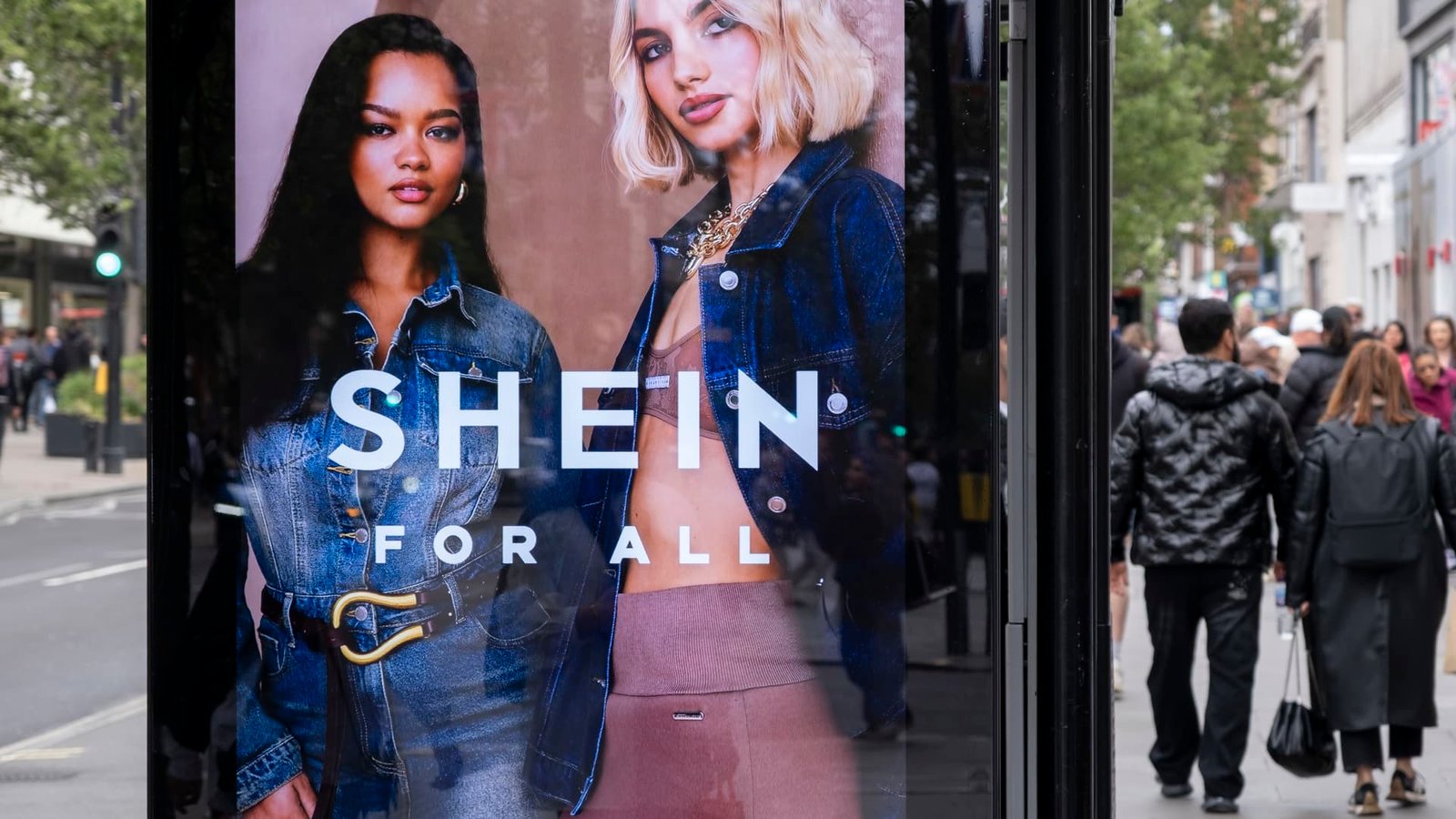
Bus stop advertising for Chinese fashion company Shein in London, England, May 4, 2025.
Mike Kemp | In Pictures | Getty Images
Discount retailer Shein had long argued trade law loopholes weren’t the reason for its success. But now that those exemptions are gone, its once meteoric growth has stalled in the U.S. and Europe, posing a threat ahead of its Hong Kong initial public offering.
In documents released in connection with its upcoming IPO, Shein blamed a slowdown in U.S. sales on its decision to raise prices to offset the cost of new tariffs as it warned a similar dynamic could come in Europe, its largest market.
“Since May 2025, we have begun passing on the majority of the additional tariff costs by increasing our prices in the U.S. market,” Shein said in the filing. “Since May 2025, we observed a negative impact on our net revenues from the U.S. market in the remainder of 2025.”
Between 2024 and 2025, revenue in the U.S. declined more than 3%. During the first quarter, sales plunged 14% compared with the year-ago period.
In Europe, which recently ended duty-free shipping for low value packages and implemented new, flat-rate fees, the impact could be even worse, Shein said in its filing.
“Similar to the U.S. market, we expect to pursue a wide range of options in response, including increasing our prices in Europe to offset a portion of the increased costs, and there might be a short-term adverse impact on our sales volume in Europe as a result,” Shein stated in response to the changes. “Although it remains too early to fully assess, it is possible that trends in the EU could be generally in line with or exceed the impact observed in the U.S. after the removal of the de minimis exemption there.”
Even without higher costs in Europe, Shein has seen growth slow down significantly in the region. In 2025, sales grew about 9% from the prior year, down from the 33% growth it saw between 2023 and 2024. In the first quarter, sales grew by just 2%.
Angela Lee, a professor of venture capital at Columbia Business School and the founder of investment firm 37 Angels, said the regulatory changes pose a serious risk to Shein’s business model, which she said was built on little more than low prices.
“This is a much more fundamental shift. This is not just a new cost. They are losing access to a regulatory advantage that was built into their business model at the very center, and so it’s a very significant shift because it changes the way the entire company operates,” Lee said. “It’s a scary future, as I look forward for Shein.”
A spokesperson for Shein declined comment to CNBC.
During Shein’s rapid rise, which earned it a reported valuation of $100 billion at its peak several years ago, the company was criticized for being an outsized beneficiary of the U.S. de minimis exemption, which allowed packages valued under $800 to enter the country duty-free.
At the time, Shein was adamant that wasn’t the reason for its success and its ability to offer low prices. Instead, it said its business model was possible because of its tech-driven supply chain and its small-batch approach to inventory that allowed it to keep costs low elsewhere in the business.
However, after President Donald Trump took office and closed the de minimis exemption through executive order and raised tariffs on goods imported from China, Shein saw its costs increase dramatically, its filing shows.
Previously, it faced tax rates of between 0% to 62.5%. It now has fees of between 10% and 87.5%.
Though Shein raised prices, the change still hit its profitability, which fell 39% companywide between 2024 and 2025. During its first quarter, Shein swung to a loss of $99 million, a 125% decline from the $395 million in profit it booked in the year-ago period.
Meanwhile, similar changes underway in Europe — which accounted for 35% of the company’s revenue in 2025 — could further weigh on Shein’s profitability.
In July, the European Union ended its own version of the de minimis exemption, which had allowed packages valued under 150 euros (US$173) to enter into the territory duty-free. Under the new framework, packages will be subject to a flat-rate duty of 3 euros (US$3.46) for each distinct category of product in the shipment.
Lee, who regularly advises founders and invests in startups, said Shein faces an uncertain future because its main competitive advantage has long been pricing, which is starting to disappear.
“Pricing is usually not a great competitive advantage. If that is your only competitive advantage, it’s incredibly hard to maintain, because that doesn’t build customer loyalty, because if all they’re looking for is the cheapest price, the second you’re not the cheapest price they’re gonna flee your company,” Lee said. “Their brand is not associated with trust, right? It’s associated with cheap prices, and so if that goes away, what is their brand known for? Almost nothing. And then, unfortunately, I do think their brand is associated with low quality at this point, and it is very hard to expand a business from that place.”
As it faces slowing growth and profitability, Shein is working to evolve its business model. The company has been growing its third-party marketplace and taking steps to commercialize its supply chain, often considered its strongest asset.
Those side businesses come at a higher margin and are currently the fastest-growing part of Shein, with services revenue up almost 40% in 2025. The retailer’s expanding “brand enablement services,” which involves the company lending its supply chain and product infrastructure to designers and brands, only accounts for about 1% of revenue but is among the company’s most promising segments because it offers brands a solution to one of the most difficult parts of running an e-commerce business.
Brands that are part of the program are able to reach annual sales milestones faster than other direct-to-consumer brands with a healthier financial profile, Shein said in its filing. For example, one of the brands grew sales by about 15 times in its second year working with Shein as operating margin improved by 30 percentage points and inventory turnover days fell by about two-thirds, it said.
“The provision of brand enablement services is also driving better profitability for us, with brand enablement operating margin approximately twice as high as our group operating margin,” Shein said. “As we empower more partners of all sizes to thrive, our partner base becomes increasingly efficient, flexible and resilient, which in turn enriches the selection for our customers and fuels our growth.”
Deborah Weinswig, the CEO of research and advisory firm Coresight Research, said if Shein continues to expand this side of the business, she’s bullish on its potential for future growth.
“These supply chains need a major overhaul, and so I just think everyone’s looking for a better way to do it, if you will, and so I think therein lies the opportunity for Shein and for others,” Weinswig said. “Things that are really difficult, they seem to do very well, and they’re good at explaining them. …. There’s increasingly more difficult problems to solve, and I think they’re uniquely positioned to do it.”
About The Author