Owning a home has long been part of the American Dream. But in the country’s 250th year, many Americans feel the goal, a milestone of adulthood and a marker of financial success, eludes them.
Homeownership is something many people still aspire to. More than half (58%) of respondents said they’d need to own a home to feel they’d achieved the American Dream, according to a CNBC and SurveyMonkey American Dream Pulse Survey, second only to reaching financial stability.
But housing prices, borrowing costs and homeownership expenses are high. While homeowners can still build long-term wealth through their properties, experts say amassing equity can take longer today than it did for buyers in previous decades, given higher expenses and decelerating home value appreciation in today’s market conditions.
What’s more, renting is now cheaper than owning in every large metro in the country, according to a January LendingTree analysis of Census data. But the decision is increasingly swayed by more than the immediate costs: Over roughly the last decade, a growing share of people also say it’s more convenient or flexible to rent, it’s less financially risky, and they prefer it, for the short- or long-term.
“I never stopped and asked myself: Is it a value of mine to actually own property?” says Marina Brochado, who bought and sold four different homes throughout her lifetime before she returned to renting in her 40s. Homeownership, she says, wasn’t worth the hassle.
Even millionaire renters, who could afford to buy a home in cash, are on the rise. “Why would I spend more to own a worse place in a worse neighborhood, that requires me going to the worst place on Earth, Home Depot, every Saturday?” says personal finance expert Ramit Sethi, who says renting in both New York City and Los Angeles is a better financial and lifestyle decision for his family than buying in either location.
Higher-income households have been driving rental demand in the last five to 10 years, says Whitney Airgood-Obrycki, senior research associate at Harvard Joint Center for Housing Studies. That means a greater demand for buildings with premium amenities or space for a couple to grow their family.
There are now more options in the rental market to suit Americans’ changing tastes and evolving needs, from downtown apartments to single-family rentals to suburban options with a fenced-in yard, Airgood-Obrycki says. While homeownership remains out of financial reach for a growing share of Americans, she says, there’s also “a shift in what’s available and what’s culturally acceptable given how expensive it is to buy.”
With other housing options now available, the dream is changing for some Americans.
CNBC Make It spoke with renters around the country — millionaires, former homeowners, forever renters — for their thoughts on whether owning a home is still a part of their American Dream.
As told to Jennifer Liu. Interviews have beenedited andcondensedfor clarity.
A homeowner’s return to renting was ‘the best decision’
Marina Brochado, 44, lives with her wife, Brenna Brochado, 41, and 15-year-old teenager outside of Boston. They pay $2,900 per month to rent a two-bedroom, 2½ bathroom townhouse with a finished basement.
I’ve bought and sold four different homes throughout my life. I decided to go back to renting about three years ago, and it’s the best decision I’ve ever made.
I got married in 2005 and we purchased our first home in 2008 in Raleigh, North Carolina. It was a four-bedroom, 2½ bathroom with a yard on a corner lot. It had a white picket fence and everything. It just felt like the thing to do: You get married, you buy a house, you get a dog, you have a kid.
Marina and Brenna Brochado rent a townhouse outside of Boston.
Zac Staffiere | CNBC Make It
We moved to the Boston area around 2012 after my daughter was born. We rented a condo and ended up buying it. In 2016 we sold the condo and bought what was supposed to be our forever home. Then I split up with my ex, so we sold that.
After my divorce, I bought a condo by myself in 2021, and a year into it, I realized that it was the biggest mistake I had made. All I did was look around and think about all the things that needed to get fixed.
In my late 30s, I realized I’d rather use my time and money to travel, see live music, go on wellness retreats, or get really good Red Sox tickets.
I went back to renting in 2023. My rent is $2,900. My last mortgage was around $2,200. The increased monthly cost is worth it because it’s about the mental load for me. I feel like I’m so much more available to being a parent and a partner because I’m not spending all of my time stressing about when the next thing breaks, can I afford it? In our rental, we are able to afford someone to help clean or walk the dog when my wife and I have to work.
I am Brazilian, so I moved here for the American Dream when I was 14. I thought I had made it when I got the white picket fence and the marriage. When I think about the American Dream now, it’s more about being able to provide for a life that has the least amount of stress possible.
We daydream about van life and traveling around the country. That, to me, would make me feel like I made it.
A millionaire who says it’s smarter to rent
Ramit Sethi, 43, lives with his wife, Cassandra Sethi, 41 in New York City and Los Angeles. Sethi declined to say how much he pays in rent but says his fixed costs, including housing, cars, debt and groceries, take up 50% to 60% of his net pay.
I’ve been renting by choice for over 20 years in some of the biggest cities in America, including San Francisco, New York and LA.
I remember living in Mountain View and Palo Alto right after I graduated from college. I realized even in 2005 that it made absolutely no financial sense to buy and yet, every piece of advice that I heard was telling me I needed to buy, that rent was throwing money away, that equity is the greatest force in all of the universe.
Today, it would cost more than twice as much to own the same place as I rent. So effectively, I am saving thousands of dollars every single month. What’s quite shocking to people is that I have made more money renting for the last 20 years than I ever would have made owning.
Cassandra and Ramit Sethi say it’s cheaper for them to rent their homes in New York City and Los Angeles rather than buy, and they use their discretionary funds for things like travel.
Said Karlsson
People do not factor in phantom costs of homeownership including taxes, interest, maintenance, transaction fees. Most of all, they don’t include opportunity cost, or the amount you could make if you took the down payment and invested it in the stock market.On a typical fixed 30-year mortgage, you are paying more towards interest than principal for [roughly] the first 20 years.
It’s important that people run the numbers. Specifically, ask: Is it a better financial decision to buy or to rent and invest the difference? If I buy, can I comfortably afford it? Are payments on this house less than 28% of my gross income, maybe even 32% or 34% in expensive cities?
Secondly, we have to ask ourselves, do I want to buy a house? Why? It might be that I want to buy a house because I prefer to live in this area, I want to send my kids to a certain school, I love to decorate and renovate, or frankly, I just want it. But we don’t ask those questions. We just go, “Oh, that’s what everybody does. So I’ve got to do it, too.”
I’m not against homeownership. At some point, I think my wife and I will buy a house. I personally love interior design and have a vision for what a future house would look like. Any family reasons could influence us. Carefully running the numbers would influence us.
I will say this: I know that whenever we buy a house, it is going to be the biggest financial mistake of our lives. And we will do it anyway, because you don’t always have to make decisions based solely on the numbers. There are plenty of other reasons to make a decision, but you do have to know the numbers.
For this family, buying a home would require a third salary
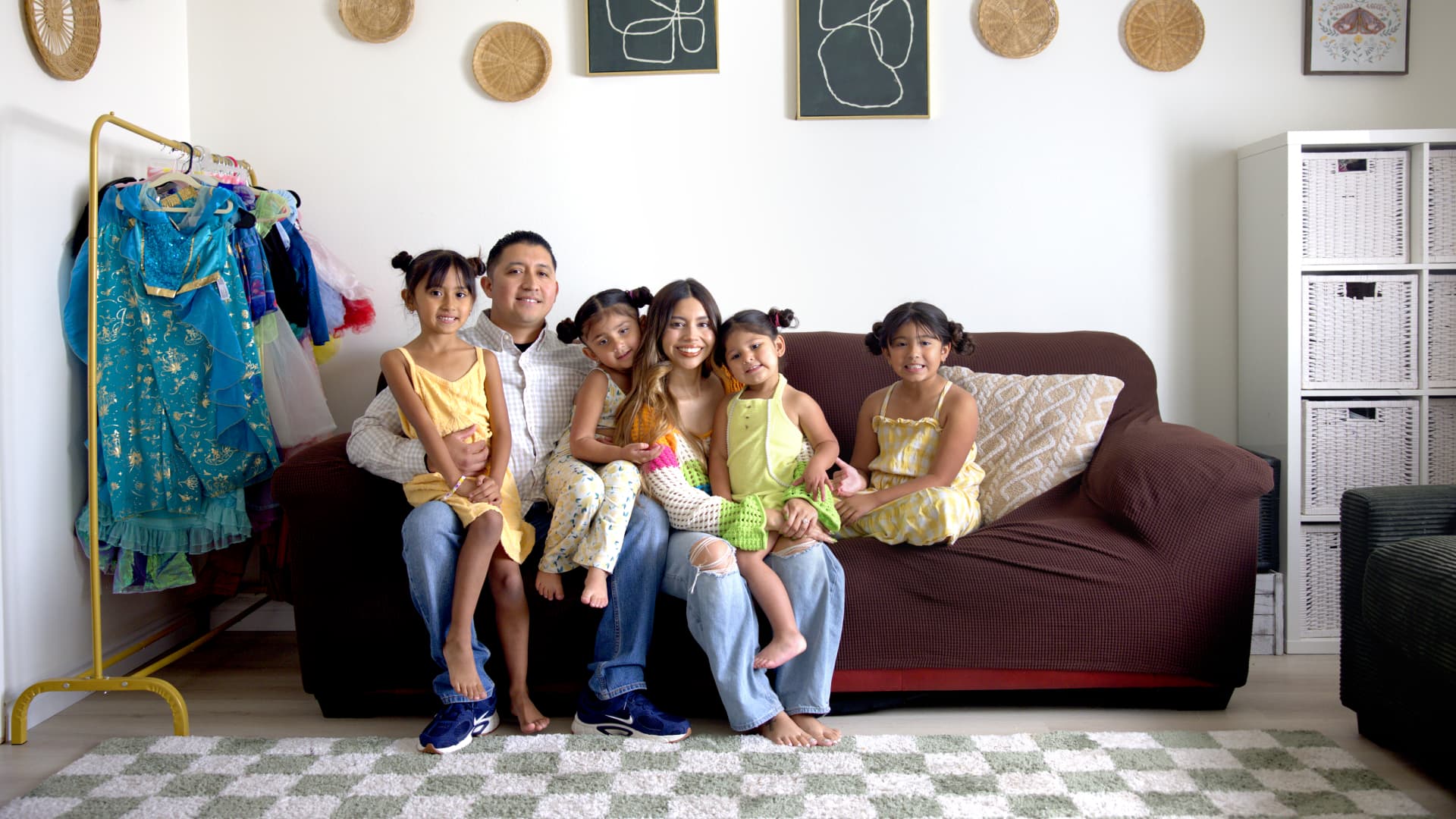
Danelle Sandoval, 36, lives with her fiance, Gabriel Mariano, 32, and four kids ages 3 to 6 in Los Angeles County. They pay $3,750 for a three-bedroom, two-bathroom single-family home.
Where we live in LA County, it’s so expensive and out of reach to buy a home if you don’t want to be house poor.
The type of home we rent is selling for right under $1 million dollars in our neighborhood. We pay $3,750 for rent. If we were to buy a home of the same size, the mortgage would be about $5,700 per month, and likely more after taxes. That’s almost $2,000 more per month. For us, it makes more sense to rent. We have kids and that $2,000 can go towards other things.
Gabriel Mariano and Danelle Sandoval rent a single-family home in Los Angeles County.
Andrew Evers | CNBC Make It
For me, buying a home has not been a goal. My fiance and I both work for LA County. Even with two strong careers, it’s just unattainable in the area that we live in. I calculated if we wanted to pay the same share of our income to a mortgage what we currently pay in rent, we would have to make $90,000 more a year. That’s a whole other full-time job.
We signed a two-year lease here because we’re not going anywhere in one year. The market is crazy.
As far as whether we’ll buy a house, maybe one day, but it’s not for us right now. I have friends that bought during the pandemic when home prices and mortgage rates were lower. They got in at a really good time, but I was not in the position during that time to buy a home, so it’s like we missed our window of opportunity.
A former homeowner says renting frees him of a ‘mental burden’
Nick Waddell, 29, lives on his own in Charlotte, North Carolina. He pays $1,489 per month to rent a studio apartment.
I bought a two-bedroom, two-bathroom home in Columbia, South Carolina, about a year ago. I sold it in April because of the time, financial and mental burden it caused.
As a homeowner, you’re just constantly worrying about what’s going to happen next. I remember there was a small crack on the crown molding of my ceiling in my living room, and I was just worried thinking, “Is something going to happen to the roof?”
Having a yard was important to me at the time because I convinced myself I needed that space or in case I got a pet. Then I bought the home and realized I hardly ever used it. I thought I needed a home gym only to realize after I built it that I like going to an actual gym and having a community of people. I convinced myself I needed all these things out of a home, and then realized I didn’t utilize them.
Nick Waddell rents a studio apartment in Charlotte, North Carolina.
Courtesy of subject
I did take a step down in terms of size of place. My home was two bedrooms, but as a single guy, I only used about half of my house. Now I’m in a studio apartment in uptown Charlotte near the football and baseball stadiums.
I view going from being a homeowner to a renter as an empowering move. I think a lot of people would view that as a step back. People think renting is just throwing money away. I don’t really view it that way. Now I have my time freedom back, and I don’t have any worries if something happens to my dishwasher or fridge. I just call maintenance. It’s really freeing for me.
I started a career sabbatical around the time I sold my house. The flexibility of renting has allowed me to take a step back out of my pharmaceutical sales career and not be overwhelmed worrying about a mortgage or if something happens to the home.
I’m able to invest and save more of my money now that I otherwise would have been putting toward a mortgage and increased utilities. I also have more money for everyday things like going out on dates with my girlfriend. It’s freed up more of my money to spend on things that I get more value out of.
A forever renter says she has no plans to buy
Ashlei Pollock, 33, lives with her husband, Brandon Pollock, 36, and three kids ages 11 to 15 in Davenport, Florida. They pay $2,830 per month to rent a five-bedroom, three-bathroom single-family home.
We’re originally from Colorado, and it’s always been expensive to buy a home out there. Then we moved to North Dakota to work in the oil fields, but those crashed during Covid, so there wasn’t money there anymore.
Since we rented in North Dakota, we were able to relocate when we wanted and start new careers. If we owned a home in North Dakota and the oil went down, that would definitely affect us negatively.
Brandon and Ashlei Pollock rent a single-family home in Davenport, Florida.
Courtesy of subject
We moved to Florida in 2020 and decided in 2021 that we definitely wanted to stay. By then, it was too late to buy with how much [home prices] went up. We started a power-washing business that my husband does full-time, plus working part-time at Disney for the benefits, and I’m a car salesperson.
The interest rate on mortgages isn’t great, and then the housing is just impossible to qualify for, and you have to have the income to support it. When we were looking at one point, the bank said we could afford a $1,200 mortgage. OK, I can afford a $1,200 mortgage, that’s all you’ll give me, but I’m paying three grand a month in rent, and you approved me for that?
I would consider myself a forever renter. I don’t have any idea of buying a home. If I do, it’s going to be when the kids are older, and I’d maybe buy something smaller.
I know that we could probably rent a house for cheaper, but it was important to me that our kids had their own rooms and a fenced-in backyard, and so we pay more for that. I’ve asked their opinion if they want to live in a house we own. They’re happy in the house because we can still paint the rooms — we just have to paint them back. As long as they’re happy, then I’m good.
About The Author