SpaceX gives the AI trade a shot in the arm. What it means for our stocks
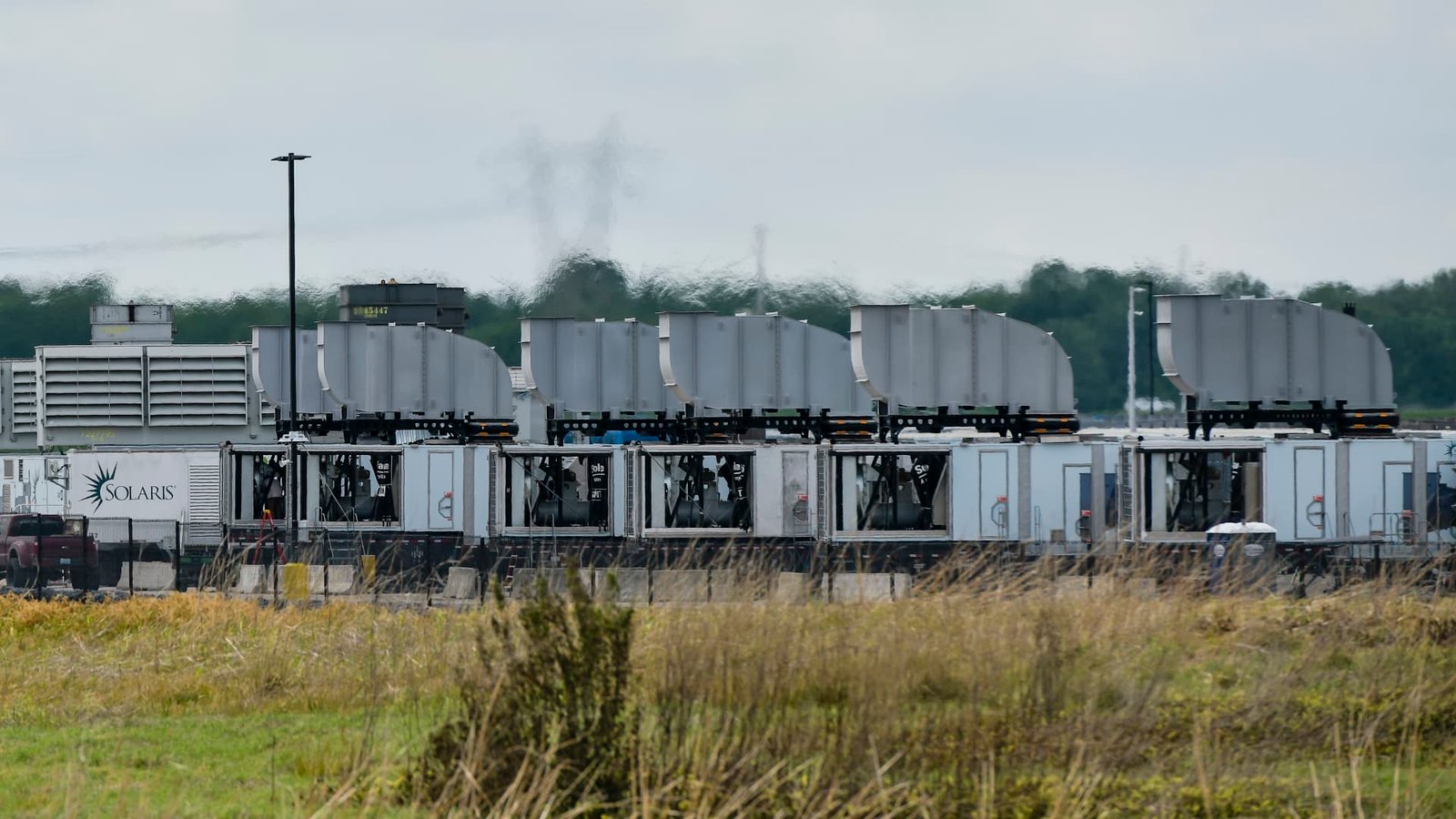
Listening to Elon Musk on SpaceX’s earnings call sounded like the basis of a best-selling science fiction novel. But what this rocket, artificial intelligence, and global connectivity company is doing in the real world is big business. And there are far-reaching implications for a bunch of the biggest stocks in our portfolio. SpaceX shares are soaring 7% on Wednesday after the company reported strong third-quarter results with a robust outlook through year-end and into 2027. Musk’s sprawling brainchild, which he wants to merge with his EV and solar company Tesla, gives SpaceX access and insight into so many of the various industries currently powering the stock market — pretty much every level of the five-layer AI cake that Nvidia CEO Jensen Huang talks about, from power to semiconductors, to data center infrastructure, to AI models and applications. Layer in Musk’s visionary nature and ability to get investors excited, and you’re left with an earnings conference call that should be considered required reading for any market participant. After all, AI now touches so much of the market and economy more broadly that whether you’re a top-down macro investor or bottom-up fundamental investor, you need to have some view on where AI spending goes from here. Now, let’s examine what Musk said as a read-through to the Club names that sit across the various layers of the AI cake. Data center suppliers Unlike the earlier days of the AI boom, semiconductor availability is no longer the major issue constraining compute supply, Musk said. “I think people are starting to realize the constraint on deployment of super intelligence is more in power and cooling and infrastructure than it is in chips,” he said, using President Donald Trump’s preferred term for artificial intelligence. In September, Trump signed an executive order instructing all executive branch departments and agenciesto use “SI” instead of AI. Musk has embraced the president’s rebrand internally at SpaceX, and he uses the term in multiple quotes throughout this story. Musk’s constraint commentary is very much in line with a Business Insider report from earlier this week, which said Amazon is racing to buy AI hardware to ensure it has enough, even as it lacks the power infrastructure required to actually get that compute online. Musk said SpaceX has redeployed some of its engineers — the same ones behind the company’s wildly successful rocket-ship innovations — to solve the power and cooling bottlenecks. “It’s a team that has been able to achieve results that are an order of magnitude greater than the rest of all competitors in space combined and applied that same team to the deployment of terrestrial compute. So, this is a bit like the New York Yankees playing in Little League. It’s not fair.” As a result, he claimed SpaceX is “able to deploy power cooling infrastructure at a rate that is vastly faster than anyone else and may, at some point, be faster than everyone else combined.” SpaceX plans to bring on between 2.5 and 3 gigawatts of compute power by the end of the year, according to Musk. Looking to next year, Musk said he is “fairly confident” in being able to bring 10 GW of additional compute in 2027, but suggested much more could be possible. A gigawatt of power can provide electricity to more than 750,000 homes for a year. “There’s a non-zero possibility … of SpaceX having over 20 gigawatts of super intelligence compute online next year. A small possibility. It used to be zero. It’s not zero anymore,” he said. Why do we care? Because if he is going to achieve his goals, he is going to need a lot more of the components needed to do it. And while SpaceX appears able to make some of what it needs in-house — like blades and vanes for gas-powered turbines — the ambitious targets also point to upside demand for companies like Club names GE Vernova and Eaton . GE Vernova is a leading maker of heavy-duty gas turbines, and Eaton provides all sorts of electrical and cooling equipment used across the grid and inside data centers. Agentic demand SpaceX’s earnings also served as an appetizer of sorts for Meta Platforms’ report on Wednesday night. Within its AI business, SpaceX has social media site X, recently acquired coding assistant Cursor, and the Grok chatbot. In August, the company officially launched an agentic AI offering known as Grok Bot, which is similar to Meta’s Muse. These agentic systems are capable of completing multi-step tasks with little to no human intervention, and they represent a sizable advancement over the generative AI chatbots of a few years ago. “We’re seeing the fastest growth of a product that I’ve ever seen in my life for Grok Bot,” Musk said. I’ve never seen anything grow this fast. We’re also seeing that the usage of Grok Bot grows over time per user. It does not decline. So, as we make Grok Bot more useful, we’re seeing users use it more per week, not use it less.” Grok Bot “already had paid weekly users of 800,000 earlier this month, more than doubling over the last month,” President and COO Gwynne Shotwell said on the call. Musk also said, “I think Grok Bot may end up being what uses most of our Super Intelligence compute.” We’ll be comparing that commentary against what Meta has to say about Muse on Wednesday night. The Muse launch in September was met with much praise as the app quickly surged to the top of Apple’s App Store downloads list. However, commentary on retention will be critical for investors. Usage matters far more to the long-term AI story than initial downloads. The market is also wondering whether Meta will disclose any concrete figures on Muse usage and paid sign-ups. We would love to get that information, so let’s hope Meta follows SpaceX’s lead in this regard. On a similar note, we’re interested to hear what Muse means for Meta’s compute needs and spending plans going forward. Chipmakers and cloud providers Musk’s commentary on Grok Bot usage also points to sustained demand for the semiconductors that make AI possible. Just because they aren’t the central constraint anymore doesn’t mean they’re not important. They certainly are. This includes both AI accelerators like Nvidia’s graphics processing units (GPUs) and Alphabet’s tensor processing units (TPUs), along with workhorse central processing units (CPUs) and memory chips. Agentic AI requires way more CPUs and memory than predecessor systems. That bodes well for the year ahead as far as our semiconductor names are concerned. Here we’re talking about Nvidia on the GPU front, Intel on the CPU front, Micron for its high-bandwidth memory, and Broadcom for its custom silicon work, including on Google’s TPUs. Nvidia and Broadcom also stand to benefit on the networking front, as we are long past the days when compute was about a single chip or server. One of the big concerns in recent weeks has been whether all this spending on AI infrastructure will deliver adequate returns to justify more spending. On this debate, SpaceX’s comments indicate that pricing power for those selling compute is only improving. “What we’re seeing in the market is extraordinary,” CFO Bret Johnsen said. “At current pricing, new compute deployments are generating a payback of less than a year. Pricing is currently tracking slightly above the high end of the $30 to $50 per watt range we were discussing just last quarter, which further supports the attractiveness of these terrestrial SI compute investments.” That bodes well for the hardware players because it means demand is as strong, if not stronger, than it was just three months ago. For the hyperscaler players with cloud businesses like Microsoft , Alphabet, and Amazon , it means the return on capex could come even quicker than Wall Street was expecting. We will certainly be looking out for similar commentary as those reports come in next week. Bottom line While we’re not aggressively bullish right now as the AI trade still works through other headwinds (namely those of the political variety), SpaceX’s earnings report is incredibly supportive of the theme going forward. We acknowledge Musk always puts out very ambitious targets and timelines, like the ability to get 20GW of compute online next year. However, that doesn’t negate the fact that what SpaceX is seeing on the ground, in the here and now, is accelerating demand for AI solutions. That, in turn, is driving strong pricing power for those able to supply the compute, whether that’s the semiconductor companies or the power and cooling solutions providers needed to get and keep chips running. Combine this with the view we shared earlier this week — that we see no change in the long usable life of these chips — and Tuesday night’s SpaceX call served as another win for the bulls because it provided further confirmation that the fundamentals of the AI investment cycle remain very much intact. (Jim Cramer’s Charitable Trust is long NVDA, MU, ETN, GEV, META. See here for a full list of the stocks.) As a subscriber to the CNBC Investing Club with Jim Cramer, you will receive a trade alert before Jim makes a trade. Jim waits 45 minutes after sending a trade alert before buying or selling a stock in his charitable trust’s portfolio. If Jim has talked about a stock on CNBC TV, he waits 72 hours after issuing the trade alert before executing the trade. THE ABOVE INVESTING CLUB INFORMATION IS SUBJECT TO OUR TERMS AND CONDITIONS AND PRIVACY POLICY , TOGETHER WITH OUR DISCLAIMER . NO FIDUCIARY OBLIGATION OR DUTY EXISTS, OR IS CREATED, BY VIRTUE OF YOUR RECEIPT OF ANY INFORMATION PROVIDED IN CONNECTION WITH THE INVESTING CLUB. NO SPECIFIC OUTCOME OR PROFIT IS GUARANTEED.