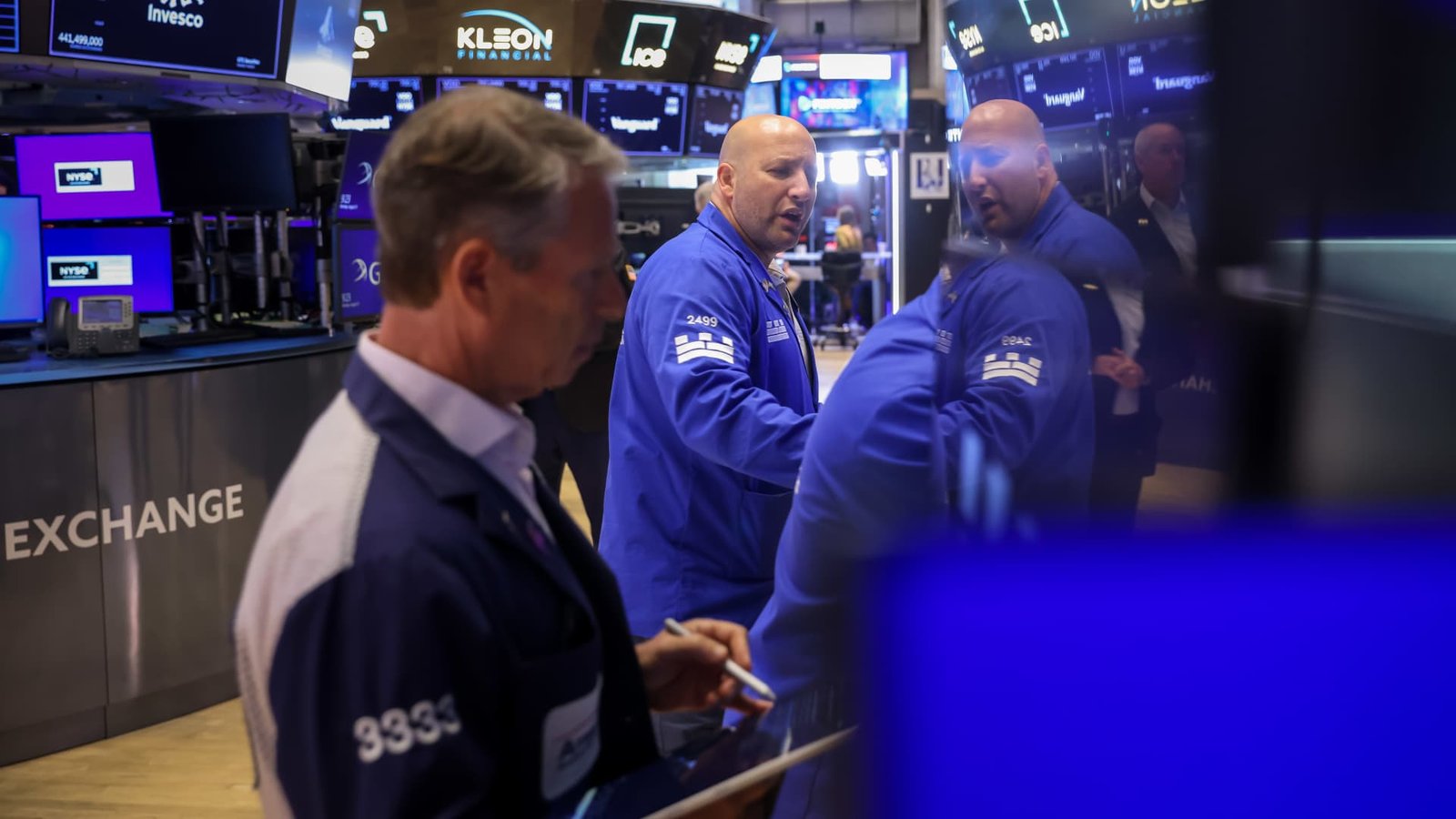
Traders work on the floor at the New York Stock Exchange (NYSE) in New York, US, on Monday, Aug. 31, 2026.
Michael Nagle | Bloomberg | Getty Images
U.S. equity futures were little changed Wednesday evening after the major averages snapped a three-day losing run sparked by rising Treasury yields amid more fighting between the U.S. and Iran.
S&P 500 futures were up 0.02%. Dow futures were up 19 points, or 0.04%, and Nasdaq 100 futures were up 0.03%.
Stocks closed higher in Wednesday’s regular trading, with all three major averages ending a three-day slump. The Dow Jones Industrial Average gained nearly 300 points, or about 0.6%. The S&P 500 and the Nasdaq Composite each gained 0.5%.
In Asia, South Korea’s Kospi rose 0.86%, while the small-cap Kosdaq fell 0.19%. Japan’sNikkei 225 was little changed, but the Topix was 0.65% higher. Australia’s S&P/ASX 200 inched up 0.12%.
On Wednesday, the 2-year Treasury yield hit 4.41%, the highest level since January 2025. The 10-year Treasury yield briefly touched 4.818%, the highest mark since November 2023. Both ended the day off their highs, however. Oil prices were modestly higher on the day, with West Texas Intermediate futures rising 0.9% to close just above $91 a barrel.
Though investors are worried about inflation, New York Federal Reserve President John Williams told CNBC on Wednesday he sees higher Treasury yields as the result of solid economic prospects following record-breaking corporate profits in the second quarter.
“What’s driving it, in large part, is … really a strong U.S. economy and a strong economic outlook fueled by big investments in AI and data centers and technology in general,” he said. “So, I think it’s not really about financial conditions affecting the economy. It’s more about the economy affecting financial conditions.”
Earlier in the week, stocks were falling and bond yields were rising amid renewed fighting between the U.S. and Iran. U.S. officials had signaled a transition from overt military action to economic sanctions prior to the resumption of hostilities in which the U.S. and Iran exchanged strikes.
“I’m finding it hard to make real sense of it,” Richard Haass, president emeritus of the Council on Foreign Relations, told CNBC on Wednesday. “It looked as though over the last few weeks we had switched to an economic coercive approach … I thought we’d come to the conclusion that more military action wasn’t going to pay off.”
On Thursday, traders will have an eye on weekly jobless claims. The main event for economic data will be out on Friday in the form of August’s payrolls report.
In terms of earnings, reports are due from optical networking player Ciena and consumer staples giant Campbell’s Thursday morning. Zscaler, Docusign and UiPath will report in the afternoon.
About The Author