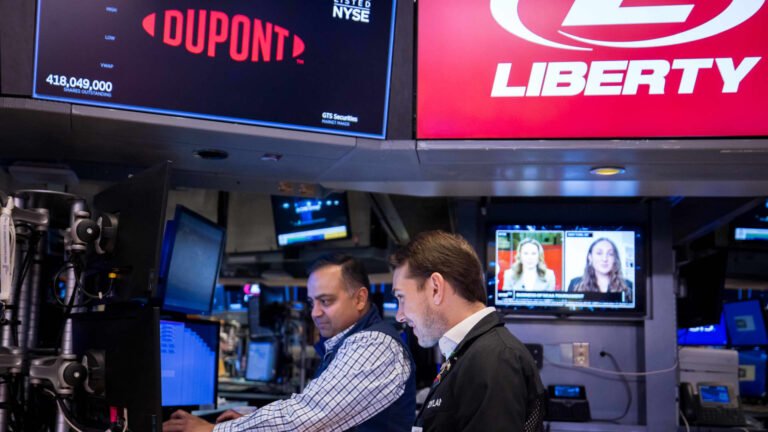
Traders work at the New York Stock Exchange on Aug. 29, 2025.
NYSE
Stock futures edged higher Tuesday night after a federal court decision in an Alphabet antitrust case fueled optimism that the tech giants will be able to weather regulatory threats.
S&P 500 futures rose 0.3%, while Nasdaq-100 futures jumped by 0.4%. Futures tied to the Dow Jones Industrial Average opened lower by 35 points, or about 0.1%.
Shares of the Google parent jumped more than 7% in after-hours trading after a federal judge ruled Tuesday that Google can keep its Chrome browser but it won’t be allowed to strike exclusive search deals and must share its search data. The decision avoided the worst-case outcome for the tech giant, and largely drew from the idea that artificial intelligence has provided more choice to consumers.
The decision also means that Apple can continue to preload Google Search onto its iPhones, which is a lucrative arrangement for Apple. The company, which also is facing its own antitrust case, saw its stock rise more than 3%.
September trading began on a negative note, with stocks losing momentum during Tuesday’s trading session. Each of the three major U.S. indexes ended the session in the red as investors raked in profits from the summer rally. TheDow Jones Industrial Averagelost about 249 points, or 0.55%, while theS&P 500shed nearly 0.7%. TheNasdaq Compositedropped about 0.8% as tech giants posted losses, with Nvidia ending the day down about 2%.
Tuesday also saw a spike in bond yields. The10-year Treasury yieldjumped to 4.27%, while the30-year yieldtopped 4.97%. Yields rose as traders weighed the consequences of a federal appeals court’s ruling Friday that many of President Donald Trump’sglobal tariffsare illegal. The decision could force the U.S. to refund the billions brought in from trade duties.
September is a typically weak month for U.S. equity performance. Scott Wren, senior global market strategist at Wells Fargo Investment Institute, said that September has been the worst month for the S&P 500 since 1950, with the average return of -0.7%.
“Stocks are entering September with a time out from the recent calm,” Wren said. “Market volatility should increase, especially equities and short- & long-term fixed income, while economy slows, tariff impacts arrive piecemeal, and political uncertainties continue.”
Investors are eyeing the August jobs report due Friday as the next major test for stocks.
About The Author