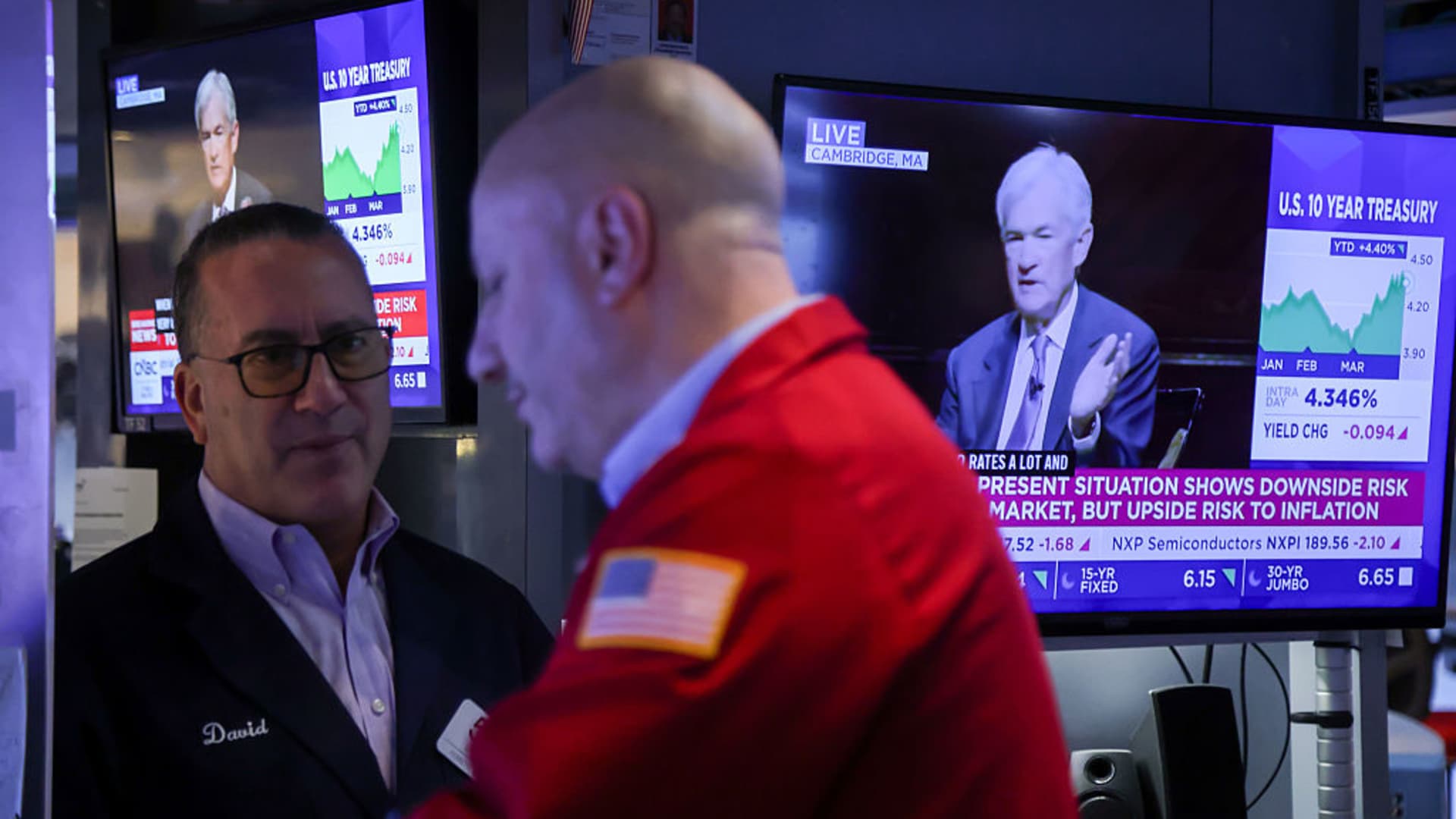
A television station broadcasts Jerome Powell, chairman of the US Federal Reserve, on the floor of the New York Stock Exchange (NYSE) in New York, US, on Monday, March 30, 2026.
Michael Nagle | Bloomberg | Getty Images
As Federal Reserve Chair took the podium for what was probably his last press conference leading the central bank, investors began drawing conclusions on what his tenure has meant for Wall Street.
Powell has served as chair of the board of governors since 2018. Kevin Warsh — Powell’s nominated successor who’s expected to take over next month — was cleared by the Senate Banking committee on Wednesday in preparation for a final Senate confirmation vote.
Powell’s exit as chair comes with the stock market near record highs and the economy posting moderate growth after dodging a post-Covid recession. But the Ivy League grad has faced criticism for his handling of inflation and interest rates in the latter years of his tenure, which led to huge losses in the bond market in 2022 and headwinds since.
“Most investors would say that they felt that they were getting honest information from him,” said Sam Stovall, chief investment strategist at CFRA Research. “It was an apolitical tenure focused on doing the right thing for the economy.”
Stocks
The Dow Jones Industrial Average has climbed nearly 9% annually under Powell, according to CFRA Research. While a slower rate of growth than under his predecessor Janet Yellen, that exceeds the average of around 6% for chairs going back more than a century.
By contrast, the S&P 500 rallied 14.7% annually under Powell, the third best performance for Fed chairs going back to 1970, Bespoke Investment Group found.
Investors benefited from Powell’s decision to hold press conferences after every Fed decision, said Art Hogan, chief market strategist at B. Riley Wealth. Powell’s answers helped traders separate “the noise from the news,” Hogan said.
“There’s been an evolution of Fed transparency that I think has only been positive,” Hogan said. “That helps markets in trying to ascertain the path of monetary policy and the path of interest rates.”
Powell’s background as an investment banker at Dillon, Read and partner at private equity firm Carlyle Group (1997–2005) often favored investors counting on stock market gains. But it didn’t always play out as well for everyday Americans trying to budget in the face of high prices, said One Point BFG Wealth Partners investing chief Peter Boockvar.
“He believed in easy money. He voted for all the QEs. He voted for zero interest rates,” Boockvar said. “It’s only when inflation mugged him by reality that he became more hawkish in.”
But the problem with accommodative monetary policy is, “Easy money gets investors drunk on things, and puts beer goggles on them,” Boockvar said. ‘Sometimes it ends up OK, but other times it ends up in rampant inflation.”
Bonds
Bonds haven’t fared as well as stocks under Powell. The Bloomberg US Aggregate Bond Index that aims to track all U.S. investment-grade debt returned just under 2% annually during Powell’s tenure, far below the average of 6.5% since the 1970s, according to Bespoke.
The culprit: high inflation after Covid, which led the Fed to drive up benchmark lending rates as high as 5.5%, and stubbornly, sticky prices since.
Prices surged in the aftermath of massive fiscal stimulus aimed at offsetting the Covid-induced economic slowdown, with the consumer price index hitting a 40-year high in 2022.
“Powell has had a big challenge with inflation and interest rates,” Stovall said. “It has not been as easy as it had been, let’s say, for Janet Yellen.”
But CFRA data shows inflation ran at an annual rate of 1.8% throughout all of Powell’s time as head of the Fed — below the average of more than 3% for all central bank chiefs going back more than a century. The Fed aims for no more than a 2% annual increase in inflation to meet its statutory goal of achieving “stable prices.”
But Hogan said investors also benefited from a flexible view of inflation under Powell, when the Fed chair understood that if inflation ran below 2% some years, it allowed for hotter readings other years.
“That was very good for markets, knowing that we’re not going to see an overreaction by the Fed,” Hogan said. “The Fed did a pretty good job of not oversteering or overreacting.”
About The Author