Faced with shrinking margins and market share in its key markets, the $1 trillion EV giant is finally testing Indian waters. On Tuesday, Tesla inaugurated its first showroom in the country and launched its bestselling Model Y.
Customers are lining up to flaunt a Tesla in their driveway. But will Elon Musk’s company manage to snatch a sizable share from incumbents, or will the initial euphoria die down eventually?
The road race
Tesla’s inaugural experience centre follows the government’s new electric vehicle (EV) import scheme. The new scheme offers significant import duty cuts on electric cars imported into India if the car makers commit to making them in India. Interestingly, as per reports, Tesla does not intend to manufacture in India.
Result? Its Model Y with standard features, which costs around ₹30 lakh, will sell for almost ₹60 lakh, including import duty in India. A higher model with a longer range is priced at around ₹68 lakh. This premium pricing places Tesla in competition with the likes of BYD, Mercedes-Benz, and BMW.
Industry tailwinds
India has emerged as the third largest automobile market in the world, and is expected to double in size to ₹25 trillion by 2030. Combined with the government’s goal to achieve net-zero emissions by 2070, clean mobility stands as one of the direct beneficiaries. The aim is to expand EV penetration from less than 6% in 2024 to 30% by 2030.
India is miles behind countries like China and Europe, which sport 50% and 20% EV penetration, respectively, in new car sales. This leaves a long runway for the growth of EV manufacturers in India.
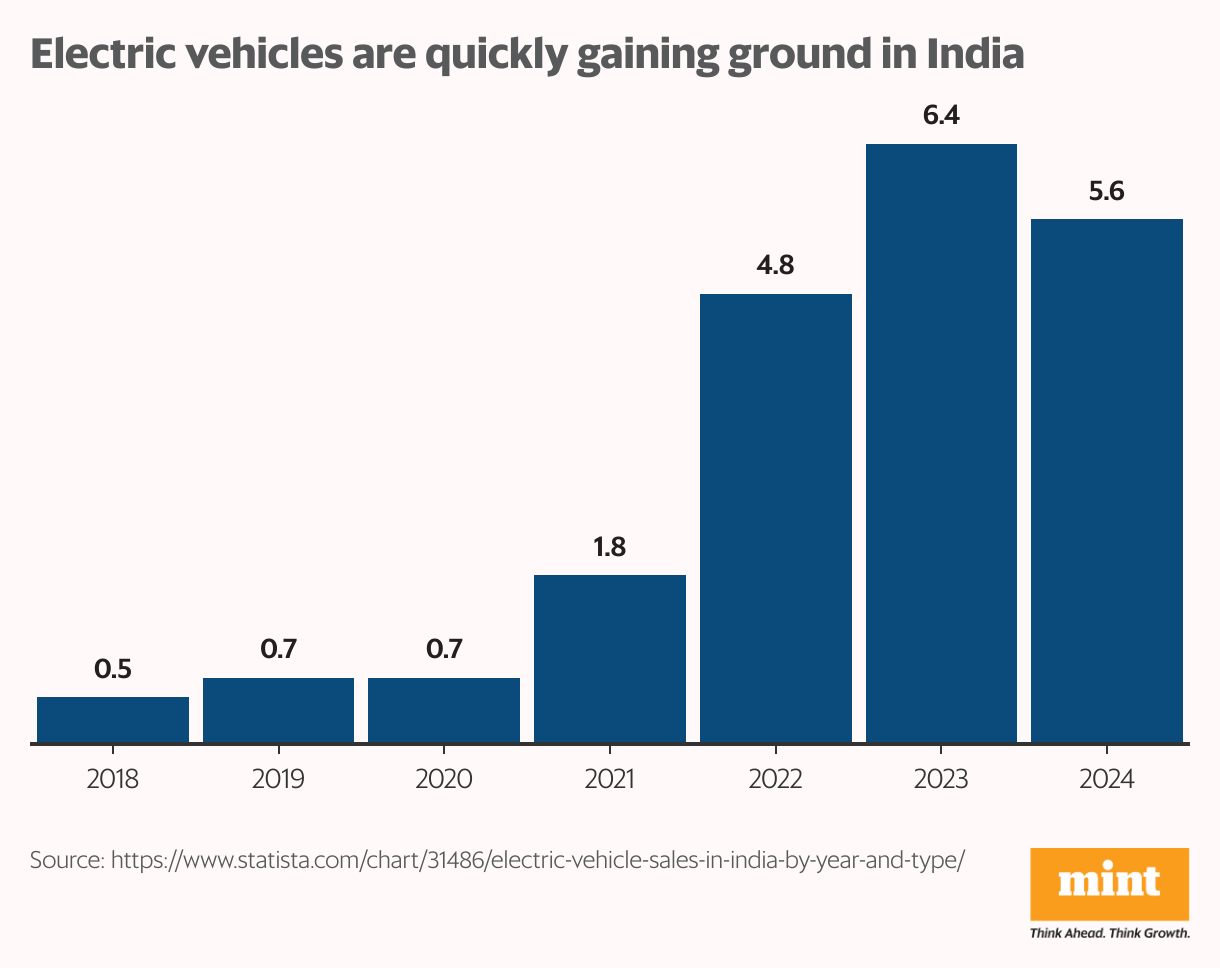
To be sure, a bulk of India’s current EV penetration comes from 3-wheelers and commercial vehicles, with that in cars standing at just 2.6%. But electric cars are catching up quickly. More than 1 lakh electric cars were sold in India in FY25, an 18% increase over the previous fiscal. For comparison, overall car sales had seen a much more modest 4.9% growth during the year.
Tesla’s premium play
Since the pandemic, mimetic desire, YOLO (you live only once), and probably even snob value have driven up the demand for premium products. Cars have been no different, with affordable carmakers like Maruti falling behind their peers who have pivoted faster towards producing more premium cars.
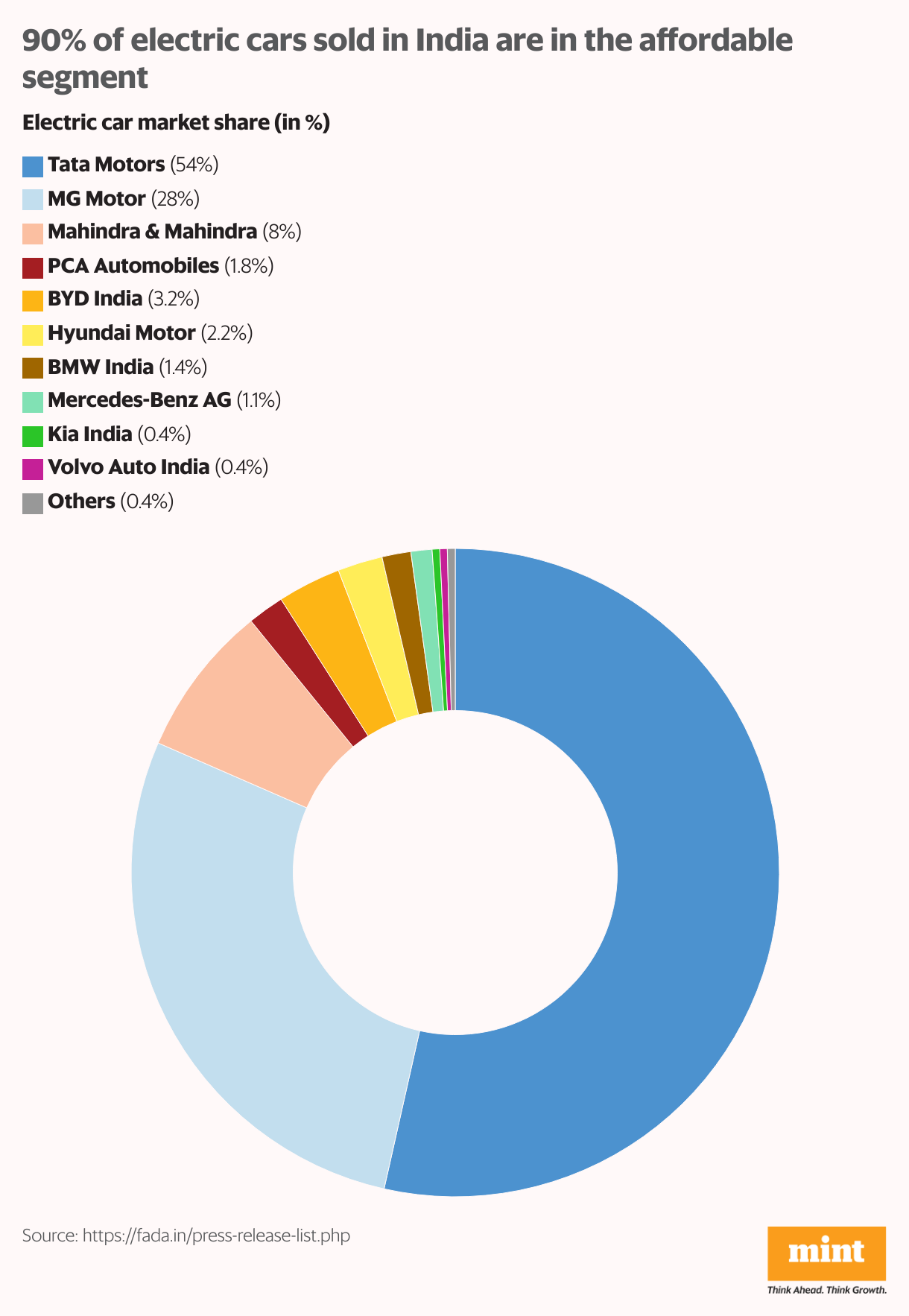
But India’s electric car market is dominated by Tata Motors, MG Motor, and Mahindra & Mahindra, which together claim almost 90% of electric cars sold in India. Their electric cars are primarily placed in the affordable range.
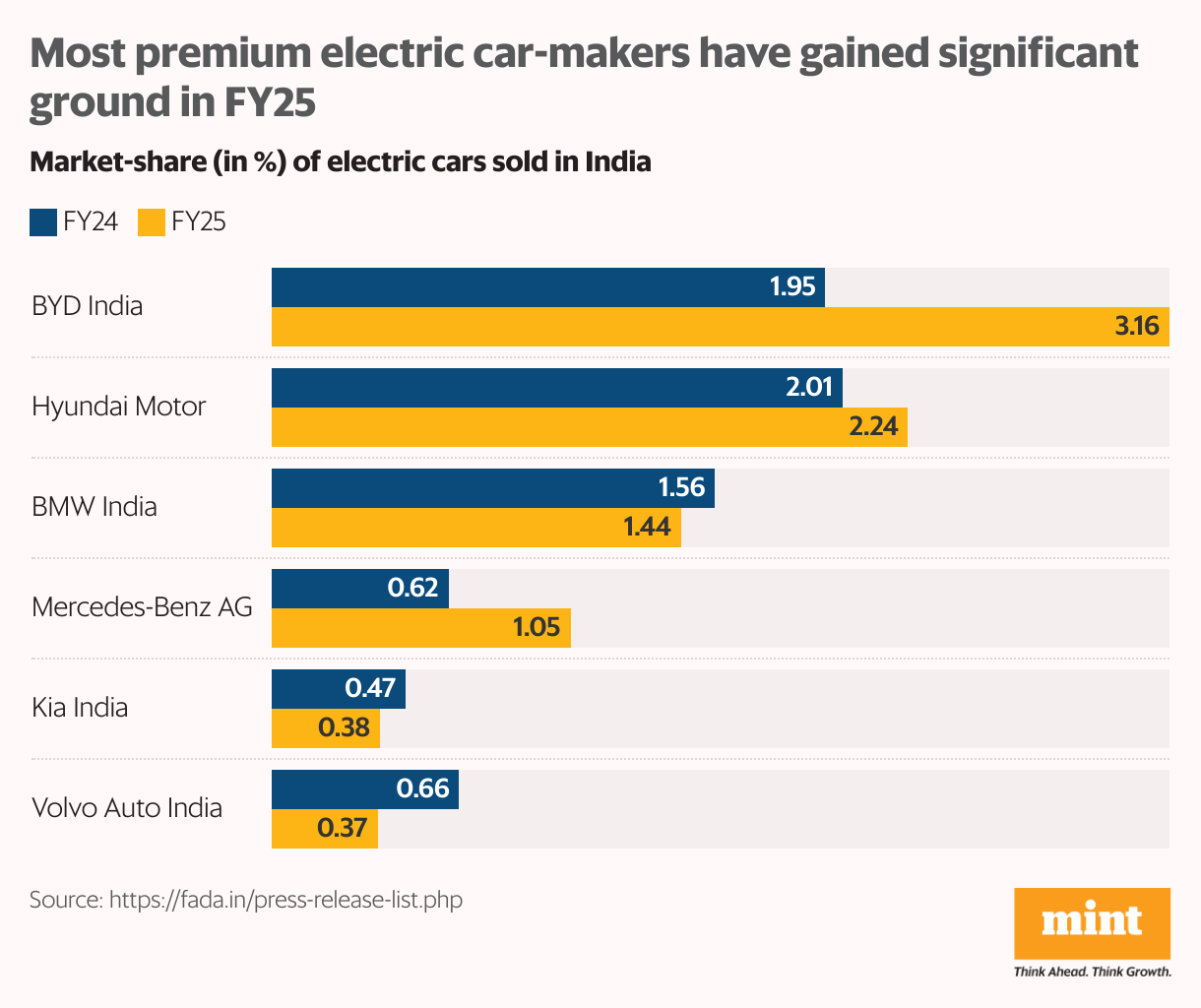
Among manufacturers who have electric cars in the premium range, BYD commands the highest share at 3.2%, followed by the newly listed Hyundai at 2.2%. While their share is small, they have been gaining ground fast. BYD and Mercedes-Benz have expanded their market-share by more than 1.5 times between FY24 and FY25. Such companies together claimed around 9% share of India’s electric car market in FY25, up from around 7% in FY24.
Considering Tesla’s clout, its debut in India is expected to accelerate premiumization in India’s electric cars. The pie of premium electric cars is likely to get larger, benefiting Tesla too along the way.
How is Tesla placed against competition?
With a global brand image, Tesla is a formidable competitor. But whether demand sustains once the novelty wears off, will depend on how its features stack up against the competition. In EVs, range anxiety and aftersales service are the primary concerns.
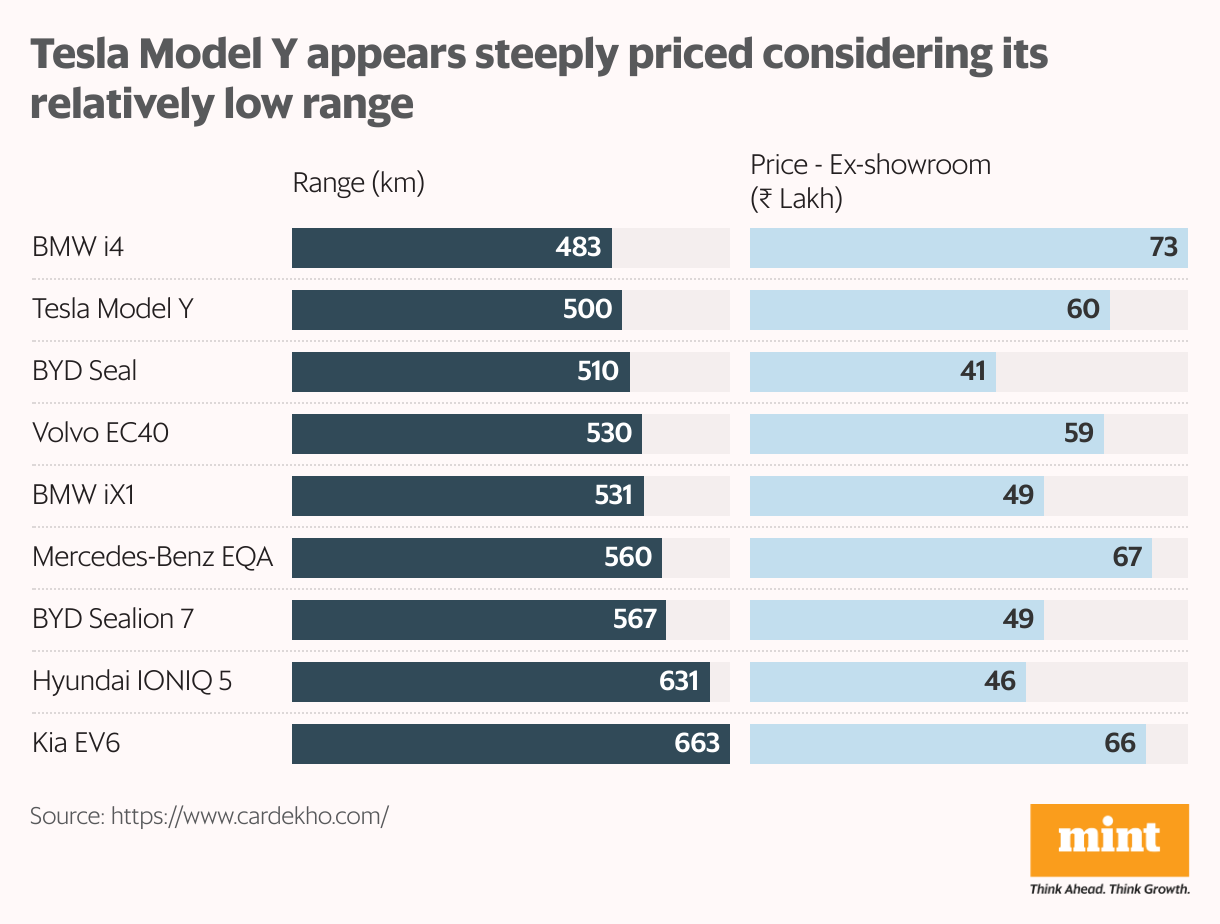
Model Y reports a range of 500 km at the lower end of the industry. This makes its ₹60 lakh ex-showroom price appear steep. Its popular superchargers, which add 250 kms of range in just 15 minutes of charging, can prove to be gamechangers. Sixteen such superchargers are planned for India, but the timeline is unclear. That said, they can be charged at other stations through compatible adapters. Also, home-chargers are complimentary in an early bird offer.
One of Tesla’s most marketed features is its self-driving capability. This can be added to Model Y at an additional cost of ₹6 lakh. But its safety on Indian roads is an unknown, and there’s regulatory ambiguity as well. Other features where Model Y holds an edge over most peers, are that it can go from 0-100 kmph in less than 6 seconds, and can reach a top speed of more than 200 kmph.
With Tesla’s cars yet to hit the roads, after-sales service is another unknown. Its new store in Mumbai will soon be supplemented with another store in Delhi. But with just two stores and an engineering hub in Pune, its network is markedly smaller than peers. Until Tesla expands and demonstrates decent aftersales service, it is unlikely to clock sizable sales.
Duty uncertainty
Tesla has opted to import from China rather than make in India. However, its competitors, Hyundai, Mercedes-Benz, and Kia, have expressed interest in India’s EV import scheme. If this pans out, they would get discounts on duties, which would enable them to offer similar features at more competitive prices. This could disadvantage Tesla.
The ongoing reshaping of trade relations can also impact Tesla’s prospects. The trade agreement recently signed by India with the UK will phase down duties on cars imported from the country from 110% to 10%. This would leave Tesla at a price disadvantage versus its UK-based competitors.
To be sure, Tesla has factories outside of China – in the US and Germany. But it will have to be seen if the trade agreements in the works with the US and Europe offer similar duty cuts for Tesla’s cars.
Furthermore, these potential savings on duties will need to more than make up for the higher shipping costs of importing from the US or Germany versus China. Meanwhile, India’s volatile relationship with China could affect Tesla’s supply-chains.
Risks in an evolving landscape
With the US threatening tariffs and an anticipated slowdown in the EU’s climate goals, electric car makers could increasingly consider other markets, including India. Domestic legacy car manufacturers could also enter premium electric cars, heating up the competition further.
They would have a significant leg-up, thanks to the duty advantage they enjoy over international players like Tesla. Meanwhile, if the government’s incentives to encourage clean mobility were to gradually wind down, as they have in other countries, the demand for EVs could take a hit.
Tesla’s Model Y is slated to hit the roads this quarter itself, and the higher model is scheduled to deliver later this year. Bookings will be a key monitorable over the next few months. It will also have to be seen whether demand sustains once the hype fades out. Customer reviews regarding on-road quality and after-sales service will also need to be tracked.
For more such analysis, read Profit Pulse.
Ananya Roy is the founder of Credibull Capital, a Sebi-registered investment adviser.
Disclosure: The author holds shares of some of the companies discussed. The views expressed are for informational purposes only and should not be considered investment advice. Readers are encouraged to conduct their own research and consult a financial professional before making any investment decisions.
About The Author