
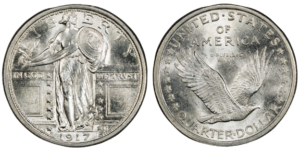
In 1917, the U.S. Mint changed a coin design mid-year, something that had almost never happened before. The reason was sculptor Hermon MacNeil’s original depiction of Liberty on the Standing Liberty Quarter, which showed her right breast exposed beneath a flowing gown. Whether the public outcry was as widespread as legend suggests remains debated, but the design was modified within months, creating two distinct quarter types struck within the same year. This article examines the artistic vision behind the 1917 Type 1 Standing Liberty Quarter design, the controversy that ended it, and why these short-lived quarters remain among the most sought-after coins in American numismatics.
The Standing Liberty Quarter Genesis
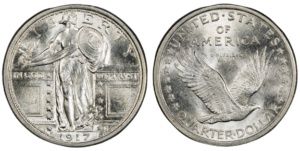
Obverse and reverse of the 1917 Type 1 Standing Liberty Quarter in Full Head condition, showing Liberty’s exposed right breast on the obverse and the eagle in flight with no stars below on the reverse.
Source: PCGS
The Standing Liberty Quarter was born out of a broader effort to modernize American coinage, arriving at a moment when the country could not ignore what was happening in Europe.
Design Competition and MacNeil’s Vision
The Barber quarter had been in circulation since 1892. Under an 1890 law, the Treasury Secretary could order a new design after 25 years. Mint Director Robert W. Woolley set a competition in motion in 1915 to replace the Barber dime, quarter, and half dollar. Chief Engraver Charles Barber submitted designs but they failed to impress the Commission of Fine Arts, which then brought in three outside sculptors. Hermon Atkins MacNeil, known for his sculptural depictions of Native American subjects, won the quarter. The Treasury Department, the Mint Director, and the Commission of Fine Arts all approved his design in 1916.
MacNeil placed Liberty in the opening of a stone gateway, shield raised in her left arm and olive branch extended in her right. The imagery was deliberate. With Europe already at war and the preparedness movement shaping American political life, a Liberty standing guard carried a different weight than the passive seated figures that had appeared on earlier coinage. The exposed right breast was part of MacNeil’s classical artistic vision, presenting Liberty as a human figure rather than a distant symbol.
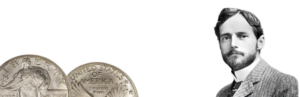
Hermon MacNeil, the sculptor whose design was selected for the Standing Liberty Quarter, pictured alongside both sides of the coin.
Source: Greysheet News
Artistic Elements of the Type 1 Standing Liberty Quarter Design
Obverse
On the obverse, Liberty stands full-length between two stone pillars, her gown in motion as she steps forward. She carries a shield in her left arm and an olive branch in her right, symbols of defense and peace. Thirteen stars run along the gateway walls to either side of her, seven on the left and six on the right. The date sits in low relief on the coin’s base, a placement that would prove a lasting problem, as it was among the first details to wear away in circulation.
Reverse
The reverse breaks from tradition with an eagle shown in full flight rather than perched. On the Type 1 Standing Liberty Quarter, no stars appear below the eagle. The thirteen stars are instead distributed to either side of the bird, seven on the left and six on the right. When the design was modified later in 1917, three of those stars were moved to beneath the eagle, and that shift in placement remains the most straightforward way to tell a Type 1 from a Type 2.
The Controversy and Public Reaction
The story of why the Type 1 Standing Liberty Quarter design was modified has been told many ways over the decades. The truth is more complicated than the headline version, and the most repeated explanation is also the least supported by evidence.
For an entertaining look at how a 1917 Type 1 Standing Liberty Quarter holds up in the real world, this segment from Pawn Stars shows what happens when one surfaces unexpectedly.
Moral Outrage and Public Criticism
Some numismatic historians, most notably Walter Breen, have claimed that the Society for the Suppression of Vice pressured the Treasury Department to pull the design. According to this account, the group viewed Liberty’s exposed breast as obscene and pushed for the coins to be recalled. But Roger Burdette, whose research on early twentieth century American coinage is considered authoritative, disputes this narrative directly. Burdette found no contemporary documents citing the exposed breast as a problem, and pointed out that equally revealing allegorical figures appeared on public buildings across the country at the time. Numismatic News has similarly noted that no proof has ever been offered of a public outcry over the design. The moral outrage story has been repeated so often it has taken on a life of its own, but the evidence behind it is thin.
Government Response and Political Pressure
What the record does show is that MacNeil was already dissatisfied with unauthorized changes the Mint had made to his design, and that merchants were complaining the high-relief coins did not stack properly. After a meeting between MacNeil, Mint Director von Engelken, and Treasury Secretary McAdoo in early 1917, MacNeil was permitted to revise his own work. The new design was already being struck before Congress formally weighed in. Congress passed legislation in July 1917 authorizing the design modifications, providing retroactive legal cover for changes that had already been implemented. A government press release that August offered yet another explanation for the redesign, citing germ accumulation on coins. The gap between that official rationale and the more obvious ones is telling.
Whatever the true combination of pressures, the result was a mid-year design change that split 1917 production into two distinct types. Both were struck at all three mints, creating one of the most unusual years in American coinage history and leaving collectors with two versions of the same coin produced side by side.
1917 Quarter Type 1 vs Type 2: Understanding the Differences
The two 1917 types share the same basic design but differ in ways that are easy to spot once you know what to look for. The reverse is the most reliable place to start.
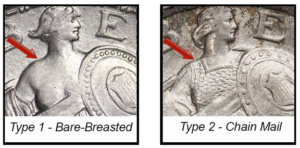
Close-up comparison of the Type 1 and Type 2 Standing Liberty Quarter obverse, showing Liberty’s exposed breast on the left and the chain mail covering on the right.
Source: Edmonton Coin Club
Obverse Distinctions
On the Type 1, Liberty’s right breast is exposed. On the Type 2, her torso is covered in chain mail. The redesign also reduced the number of rivets on her shield from 30 to 16, modified her hair into a more helmet-like cap, and refined the lettering. These obverse differences are clear on well-struck examples but can be obscured by wear on circulated coins.
Reverse Variations
The reverse distinction is definitive and holds up even on heavily worn coins. On the Type 1, no stars appear below the eagle. The thirteen stars are distributed to either side of the bird. On the Type 2, three of those stars were moved to beneath the eagle, which was also repositioned higher on the coin. If you see three stars below the eagle, it is Type 2. No stars below the eagle means Type 1, regardless of what the obverse shows.
Production and Mintage Analysis
The Type 1 design had a short production window, and the numbers reflect it. Both types were struck at all three mints during 1917, making it one of the most unusual years in American coinage history, with Philadelphia, Denver, and San Francisco each producing both designs within the same calendar year.
1917 Type 1 Standing Liberty Quarter Production Data
Philadelphia struck 8,740,000 Type 1 quarters before the design change, making it the most available of the three. Denver produced 1,509,200 and San Francisco 1,952,000, both considerably smaller runs. The mint mark for Denver and San Francisco pieces appears on the obverse to the left of the date. Philadelphia coins carry no mint mark.
Type 2 Continuation Through 1917
After the redesign was implemented, production continued for the remainder of the year under the Type 2 design. Philadelphia struck 13,880,000 Type 2 quarters, Denver 6,224,400, and San Francisco 5,552,000. The higher mintages make Type 2 examples from 1917 more accessible across all grades, and the Philadelphia issue is among the most common coins in the entire series.
The Rare 1916 Issue
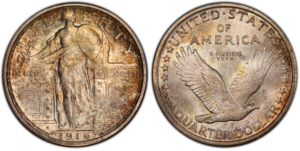
Obverse and reverse of the 1916 Standing Liberty Quarter, showing the original Type 1 design with Liberty stepping through the gateway and the eagle in full flight on the reverse.
Source: PCGS
Before 1917 production began, the Standing Liberty Quarter had a brief and quiet debut. The Philadelphia Mint struck only 52,000 examples in December 1916, making the 1916 issue one of the premier rarities in twentieth century American coinage. No other mint produced quarters that year. Most surviving examples are heavily circulated, and even lower grade specimens command significant premiums. For collectors building a complete set, the 1916 is invariably the most difficult and expensive piece to acquire.
Collecting Challenges and Grading Issues
The Type 1 Standing Liberty Quarter comes with specific grading and authentication considerations that can catch collectors off guard, particularly around date wear, strike quality, and type identification.
The Date Wear Problem
On pre-1925 issues, the date sits on the highest point of the coin’s pedestal and was among the first details to wear away in circulation. Countless examples exist today with dates that are partially or entirely gone. The problem was not addressed until 1925, when the date area was redesigned with a raised protective rim around the pedestal. Beyond the date, the series is notorious for weak strikes, and this affects even mint state examples. The Full Head designation, awarded to coins showing complete hair, hairline, and facial detail on Liberty, carries meaningful premiums precisely because so many pieces fall short of it. Grade sensitivity is pronounced throughout the series, with dramatic value differences between adjacent grades.
Authentication and Identification
1917 Standing Liberty Quarter Type 1 vs Type 2 Determination
The reverse star arrangement is the most reliable identification method on most circulated examples. When the obverse is sufficiently preserved, Liberty’s torso provides a secondary confirmation. Collectors should also be aware that altered Type 2 coins are sometimes fraudulently presented as Type 1, making reverse verification essential before any purchase.
Mint Mark Verification
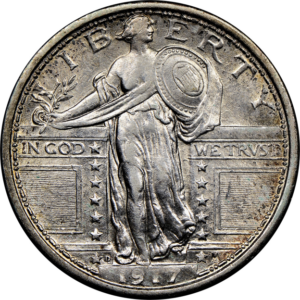
Close-up of the obverse of the 1917 D Type 1 Standing Liberty Quarter in mint state, showing Liberty’s exposed right breast, the olive branch, shield, and the D mint mark visible at the base.
Source: PCGS
Denver and San Francisco mint marks appear to the left of the date and can be difficult to locate on worn coins; magnification is often helpful. Weak strikes mean that some genuine mint marks are barely visible on uncirculated coins, not just circulated ones. Philadelphia pieces carry no mint mark.
Investment and Collecting Strategies
The Standing Liberty Quarter series spans 15 years, and a complete date and mint mark set totals 37 coins. For collectors looking to add tangible assets to their portfolios, knowing what to look for when searching for a 1917 Type 1 Standing Liberty Quarter for sale makes a significant difference .
Building a Type Set
For collectors who want representation without pursuing a full date run, acquiring one 1917 Type 1 Standing Liberty Quarter and one Type 2 example is a natural starting point. Most collectors begin with a Type 2 Philadelphia issue, which is among the most common coins in the series, before moving to a Type 1. Grade consistency across both examples adds visual and market coherence to the pairing.
Date Run Completion
A complete circulated set is achievable for intermediate collectors with patience, but the budget will be weighted heavily toward the 1916, which is the undisputed key date of the series, and the three Type 1 issues from 1917. Beyond those, the 1918/7-S overdate, where remnants of a 7 are visible beneath the 8 in the date, is one of the most important and sought-after issues in the series. Choosing a condition tier at the outset, whether circulated or mint state, helps avoid the trap of mixing grades across a set.
Authentication Priorities
Third-party certification from PCGS or NGC is worth the cost for any key date, any Full Head example, and any Type 1 Standing Liberty Quarter purchase where the type designation is driving the price. Certification confirms authenticity, locks in the grade, and makes coins significantly easier to resell.
Artistic Legacy and Numismatic Significance
The Standing Liberty Quarter is regularly cited among the finest coin designs in American history. That reputation rests on the Type 1, the design MacNeil originally intended before the Mint and public pressures reshaped it.
MacNeil’s Contribution to American Coinage
MacNeil’s Standing Liberty arrived during the golden era of American coin design, alongside Weinman’s Walking Liberty Half Dollar and Mercury Dime, both introduced in the same 1916 redesign initiative. What set his work apart was the sense of motion and humanity in the figure. Liberty was not seated or static. She was stepping forward, exposed and unarmored, a deliberate artistic choice that made the Type 1 Standing Liberty Quarter design both beautiful and controversial. The chain mail of the Type 2 resolved the controversy but altered aspects of the original design. Many collectors and historians view the Type 1 as the version that most closely reflects MacNeil’s original artistic vision.
Place in U.S. Numismatic History
The fifteen-year series, the brief Type 1 production window, and the story behind the redesign together give the Standing Liberty Quarter a depth that purely technical specifications cannot convey. The Type 1 in particular occupies a rare position in American numismatics: a coin that was changed not because of a mistake but because of an idea, and one that collectors have been seeking out ever since precisely for that reason.
Conclusion
The 1917 Type 1 Standing Liberty Quarter exists at the intersection of artistic ambition and historical moment. MacNeil’s original design captured something the modified version could not: Liberty as a human figure, unguarded, stepping into an uncertain world. The controversy that ended the Type 1’s brief production run has only deepened collector interest over the past century. Whether approached as a type set acquisition, a key date investment, or simply one of the most beautifully designed coins in American numismatic history, the Type 1 rewards the attention. Explore Blanchard’s inventory of rare coins, including Standing Liberty Quarters, which offers a starting point for collectors at every level of the series.
FAQs
1. Why did the Standing Liberty Quarter design change in 1917?
The redesign resulted from a combination of pressures, including complaints about the coin’s high relief, MacNeil’s own dissatisfaction with unauthorized Mint alterations, and the broader cultural climate of wartime America. The traditional explanation that public moral outrage forced the change is widely repeated but not well supported by the historical record.
2. What is the difference between Type 1 and Type 2 Standing Liberty Quarters?
The 1917 Standing Liberty Quarter Type 1 shows Liberty with an exposed right breast and no stars below the eagle on the reverse. The Type 2 adds chain mail covering Liberty’s torso and moves three stars to beneath the eagle.
3. Are Type 1 Standing Liberty Quarters rare?
Relative to Type 2, yes. All three Type 1 issues from 1917 have lower mintages than their Type 2 counterparts, and the 1916 is one of the premier rarities in twentieth century American coinage.
4. How much is a 1917 Type 1 Standing Liberty Quarter worth?
1917 Standing Liberty Quarter value depends heavily on mint mark, grade, and whether the coin carries the Full Head designation. The range is broad, from modest sums for well-worn examples to significant premiums for high-grade mint state pieces.
5. How much silver is in a Standing Liberty Quarter?
Standing Liberty Quarters are struck from 90% silver and 10% copper, with each coin containing approximately 0.18084 troy ounces (5.625 grams) of pure silver.
About The Author