POWER POINT
What I’m hearing from energy insiders
“Meet the new boss, same as the old boss”
The classic lyric from The Who’s masterpiece “Won’t Get Fooled Again” certainly applies to the global energy markets. The ‘boss’ is a headline about the breaking of any fragile peace around Iran and every time oil prices fall, the markets seem to get fooled (again).
I was all set to write this week’s piece highlighting some of the optimism around Iran and energy markets. Then Iranian militants launched a surprise missile attack on U.S. forces in Jordan. The barrage was repelled before it could do any damage. But the message seems clear: there are those in Iran who will benefit from continued fighting. Whether it’s because they want to force the U.S. and its allies into a harder bargain, they are fearful of their own outcomes, or something more sinister, markets and investors need to be ready for anything to happen at any time.
Ahead of that, the fragile ceasefire – don’t call it ‘peace’ – sent sellers into the global oil market. Prices went from over $90 back to the high $60s and then briefly back over $90 on the latest attacks. A nearly 40% pop from July lows to July highs is a huge move for oil.
One question some are asking is, with all that’s going on, why aren’t oil prices even higher? JPMorgan analyst Natasha Kaneva says it may be as simple as a market that “seems reluctant to replace risk repeatedly” because investors view a “prolonged stalemate as unlikely” and have to price in some kind of resolution.
The prediction markets tell a similar story. Kalshi traders see a 65% chance that WTI crude ends the year at $75 or higher. But they’re far less convinced oil is headed for another major spike, pricing in just a 32% chance of $90-plus crude. In other words, the market sees higher prices but not necessarily a full-blown oil shock.
While the world waits for “some kind of resolution,” one thing that seems increasingly clear is that Iran continues to ‘reprice’ lower the value of the Strait of Hormuz. Consider what is going on right now. Saudi Arabia is maxing out its big East-West pipeline to the Red Sea. The U.A.E. is actively rushing to build a new pipeline that goes around the Strait. And Chevron is actively investigating the feasibility of reopening a damaged Iraq to Syria pipe that would eliminate the need to move some oil by water. There is now also some talk that Israel could offer up an old pipeline to the Saudis. That pipeline – which was, oddly, built as a joint project with Iran – could also be connected to a new pipe in Saudi Arabia. It’s not clear what may ultimately materialize, but there is some big talk around big plans. The bottom line is that by shooting ships, Iran is also blowing up the one big negotiation lever it has: the value of Hormuz itself.
By shooting ships, Iran is also blowing up the one big negotiation lever it has: the value of Hormuz itself.
Meanwhile, the Russia story grows every week. Ukraine is realizing the value of drones and continues to pound Putin deep inside Russia. The country slammed two big Russian refineries, one owned by Lukoil and the other by Rosneft. Combined, these two refineries can handle a few hundred thousand barrels of oil per day. This will further tighten the market for refined products like diesel, but may add some barrels to the global market if Russia is able to sell them since it can’t refine them. While getting firsthand information from inside Russia can be daunting, reports of long lines and high costs for fuel are growing. When a population runs out of energy, people tend to get angry. When they get angry, they tend to demand change. Could oil – which long has acted as a sort of bank account for Putin and his army – ultimately lead to the end of his time in Moscow? Energy and regime change can often be a part of the same story.
I am taking a week off and so will Power Insider – hopefully. ‘See’ you all soon and again thanks for the incredible support.
WALL STREET’S TAKE
Here in the thick of earnings season we can often see analyst calls slow down a bit as they wait for the numbers and guidance from the companies. Not this week. This week there are a few really interesting notes and commentary on some new names. Those are below.
Ahead of that, markets will focus on what are likely to be monster earnings from ExxonMobil (XOM) and Chevron (CVX). Both are due Friday, July 31st. Shell is out the day before and Marathon Petroleum (MPC) and ConocoPhillips (COP) are August 4th and 6th respectively.
Look at these EPS estimates:
I did say “monster earnings,” right?
Those numbers are not misprints.
Oil analysts are expecting a doubling, tripling or – in Marathon’s case – a more than 700 percent surge in earnings. The numbers will be stunning.
My take → Oil company earnings will be stunning enough to attract some very negative political attention.
Those expected earnings are enough to prod Bank of America to express more love for Chevron. It calls Chevron a ‘top pick’ in integrateds and refining and likes that CEO Mike Wirth is making or thinking about big bets on Venezuela, Iraq and more. They call it “refilling the funnel.”
Bank of America had upgraded ExxonMobil but is now downgrading it back to neutral, saying they recommend “cashing in the call option.” In other words, BofA says the near-term money may have been made in XOM shares.
Now let’s move outside just oil and gas.
A couple weeks ago I wrote about how some renewable stocks were getting love on Wall Street. Citigroup adds to that with a recent call on two storage-focused companies. Analyst Vikram Bagri upgrades Fluence (FLNC) and Energy Vault Holdings (NRGV) to ‘buy / high risk.’ He has a $24 target on Fluence and $5 price tag on Energy Vault.
Caution on that Citi call, however, because Bagri labels both companies as “high risk.” He writes that Fluence will likely “miss the consensus” with upcoming earnings, but calls those expectations “unreasonable.” Instead, Bagri says focus on Fluence’s growing storage business and the potential for the company’s “first hyperscaler customer” order in the near term. As a bonus, the Citi analyst likes the recent increase in nodule price increase out of the European Union.
Bagri likes that Energy Vault has a lower cost of capital via some new financing, as well as growth in recurring investment income and a greater broadening of its customer base to places like Australia. That said, one big risk he sees is increased competition in the battery storage market, which is becoming increasingly crowded.
Looking for some other new (to us) names in the AI power game? Baird’s Luke Junk has two more for you.
This is Forgent Power Solutions (FPS). Outperform. $55 target. Forgent is a supplier of the electric equipment. Company that is ‘structurally important’ says Junk. Huge amount of bottlenecks in the electrical equipment world. Junk likes that Forgent is vertically integrated and uses lead times as a business ‘weapon.’ It has a backlog of $2.4 billion dollars.
Junk also sees value in shares of nVent Electric PLC (NVT). The British company was part of the larger Pentair until eight years ago. nVent plays in the liquid cooling space. Junk says much of the NVT story is about both cooling more efficiently and lowering the power bill for data centers. As a bonus, Junk notes that nVent also has a substation power business. The Baird analyst rates NVT an ‘outperform’ with a $188 target, implying about 23% upside as I write this.
Finally … we’ve spoken a lot of about nuclear this year. UBS says the recent pullback in uranium giant Cameco (CCJ) is just too enticing to pass up. Analyst George Eadie is upgrading Cameco to a buy. He says the recent selling “appears driven by broader market and AI-related sentiment” as opposed to any real change in the fundamentals. Eadie adds that the “uranium bull case has only strengthened this year” and he likes the fact that long-term contract pricing is at record highs.
TAKE A LOOK
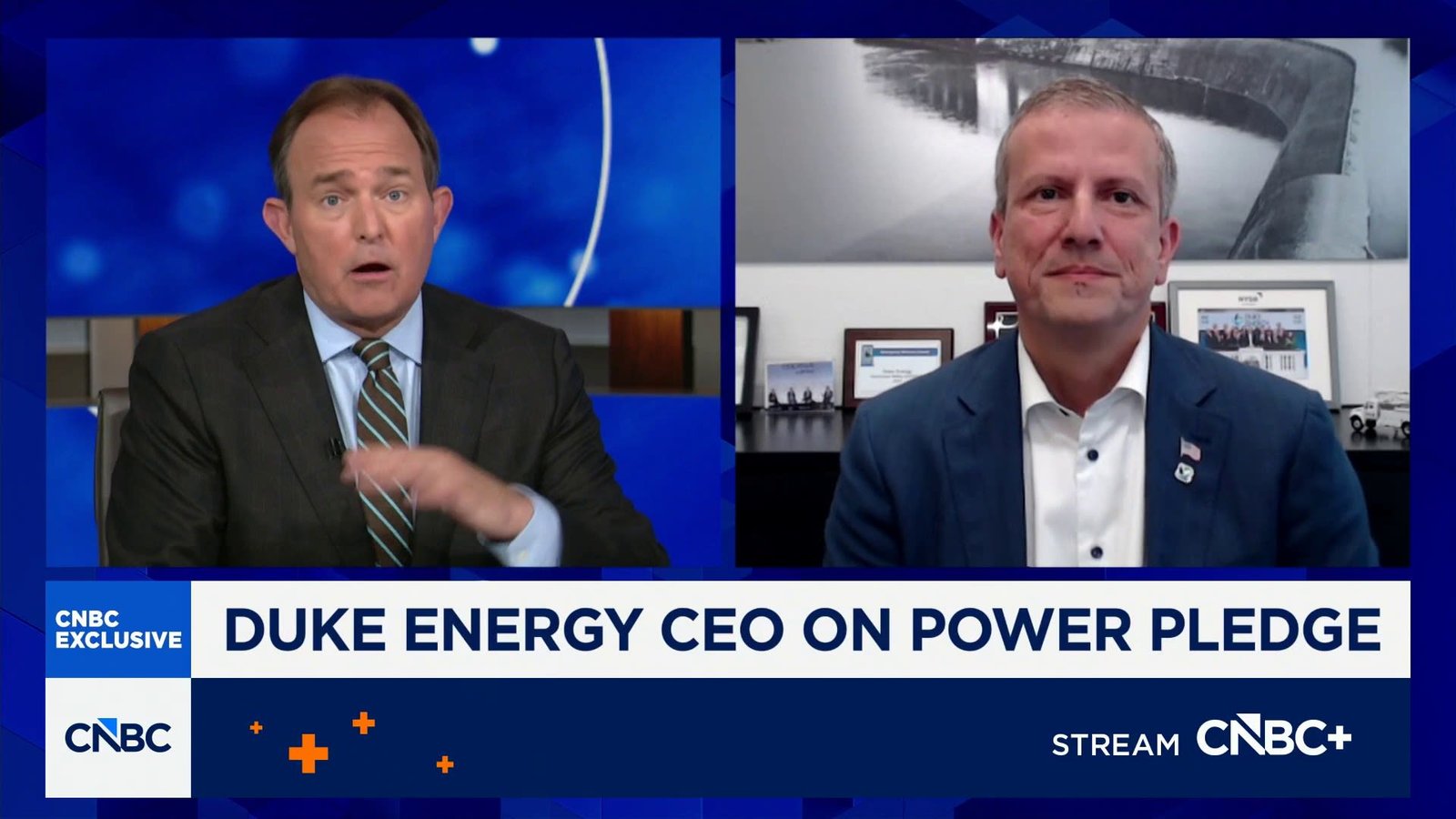
As AI data centers reshape America’s power grid, I sat down with Duke Energy CEO Harry Sideris to discuss the industry’s pledge to protect customers from higher electricity bills.

RANDOM, BUT INTERESTING
Oil and refined product prices (diesel, jet fuel, etc) have been rising this year on the Iran war uncertainty, but they aren’t the only commodities seeing price spikes. This year prices for Rough Rice, Cotton, Wheat and Aluminum are also higher. While three of those may make your grocery bill rise, the fourth – Aluminum Alloy – is an inflationary part of the energy markets. Aluminum is used across the board for electricity generation and transmission. Watch this space.
THE GRID
About The Author