The SpaceX IPO could be coming for the Magnificent Seven and chip stocks
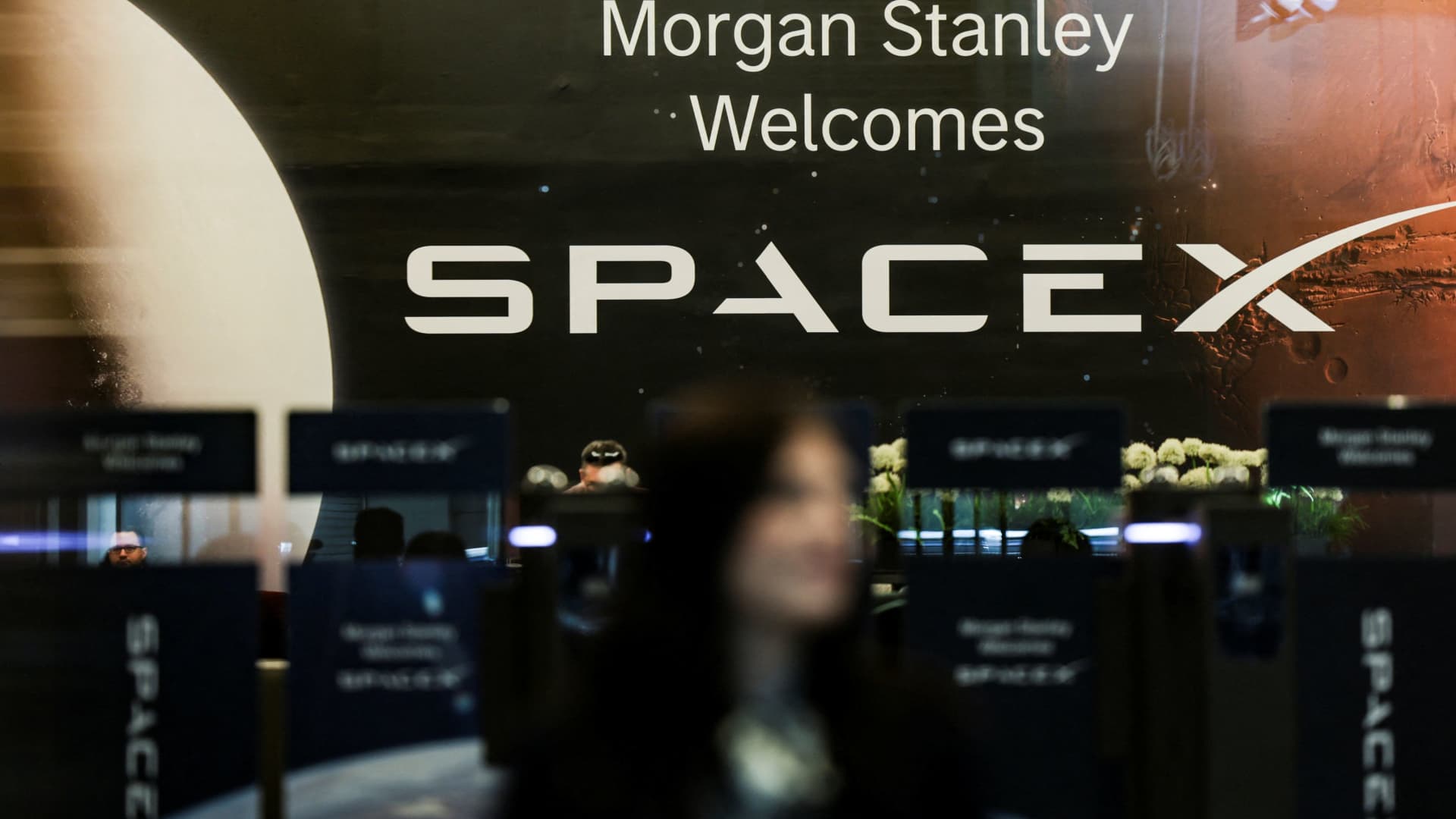
Initial public offerings for tech companies worth trillions of dollars are fast approaching, and they could spell a massive reshuffle in retail stock holdings. SpaceX, which debuts Friday on the Nasdaq, is aiming for a valuation of about $1.77 trillion. Artificial intelligence companies Anthropic and OpenAI are expected to go public later this year at valuations close to $1 trillion. The big question is where retail investors will find the money to fund the IPO floats and whether other parts of the market will suffer as a result. Investors and analysts aren’t of one mind on the question, but the Magnificent Seven stocks – comprising legacy tech giants like Amazon , Apple and Microsoft – is one locus of speculation. “Increasingly, attention has centered on the Mag 7 and [technology, media and telecom stocks] more broadly as the most likely pocket of the market to absorb selling pressure,” Jane Gibbons at Jefferies wrote in a June 5 note to clients. .MAG7 1M mountain The CNBC Magnificent Seven index in the past month Retail investors are a central part of the offering equation, which is traditionally dominated by big institutional investors. SpaceX is reserving up to 30% of its offering for retail investors – a much higher share than usual. The company is also going to be fast-tracked into some major stock indexes , which will amp retail demand from passive funds tracking the Nasdaq 100 and the FTSE Russell benchmarks, among others. “They’re going to end up having these passive flows into these names out of some of the other mega-cap tech names to fund it,” hedge fund manager Dan Niles told CNBC. “There’s going to be … a lot of interesting movements.” Dry powder from retail investors Analytics firms think retail investors may already be pulling back from some of their technology favorites in preparation for the SpaceX offering. “What we’ve been noticing in our data is that actually retail activity has been a bit flat. We’ve been hypothesizing that maybe some of that is dry powder for some of these listings,” Viraj Patel, global macro strategist at analytics firm Vanda Research, told CNBC. “People [could be] holding back from buying things like Nvidia and Tesla or anything in the Mag 7 … because maybe they’re waiting for some of these listings to come.” Retail-focused investment companies have been changing their policies to accommodate the SpaceX IPO just as exchanges have. Asset manager Fidelity is selling SpaceX IPO shares to customers with a retail brokerage account with as little as $2,000 in it. Its regular IPO rules require either $100,000 or $500,000 in household assets, depending on the IPO. Fidelity says it reduced eligibility requirements for SpaceX specifically because of its boosted retail allocation. Investment firm VanEck, which manages popular space and semiconductor ETFs, told CNBC that a market structure shift could be in the works. “We could see interest shift to individual names such as SpaceX,” VanEck product manager Nicholas Frasse said to CNBC in an email. The Mag 7 could become the Mag 10 Some investors, however, don’t foresee a large-scale reallocation resulting from the upcoming IPOs, since AI investment is so heavily intertwined within the tech sector and through different value chains. Paul Meeks, sell-side head of tech research at Freedom Capital Markets, told CNBC that he views the new public companies as additive to the overall AI investing thesis and thinks the money will come from other places. “I don’t think there will be a transfer out of [the Mag Seven],” he said. “The key theme right now is AI infrastructure building, then AI inference, then hopefully some ROI-generating apps in the long run. And because the spending is being done by the hyperscalers, which almost to a man are the Mag Seven, I think that they’re secured. I think money might come out of other investments to invest in those IPOs.” Vanda’s Patel also said the SpaceX IPO could be more additive to overall tech stock volumes than redistributive. “It’s going to take a while for the numbers to match Nvidia from a market perspective. But if they get quite close to there, you could absolutely then be talking about a Mag 10 if you add these three into it,” he said. Possible rotation out of semiconductors If the retail money to buy SpaceX gets pulled out of the tech sector, it could come out of semiconductors. Semis rocketed up through April and May, with some names like Micron and AMD going parabolic. But the sector started to dip last week and was down considerably on Tuesday as investors grabbed profits off the unusually steep stock trajectory. Multiple Wall Street analysts think chips could be a retail well for SpaceX. “Semis could become a source of funds to buy SpaceX,” Greg Boutle, strategist at BNP Paribas, told clients in a June 4 note, noting that there’s a lot of dry powder currently in retail. “Semi 3x levered long ETFs have rallied more than 600% in price terms since the March lows. Retail participation has been very heavy, and this cohort is sitting on very large unrealized [profit and loss] gains.” Asked whether VanEck was worried about a rotation out of their chips ETF, Frasse told CNBC that the sector has a lot of staying power. “We believe semis will continue to be the technology that drives the AI super cycle over the long term,” he said.