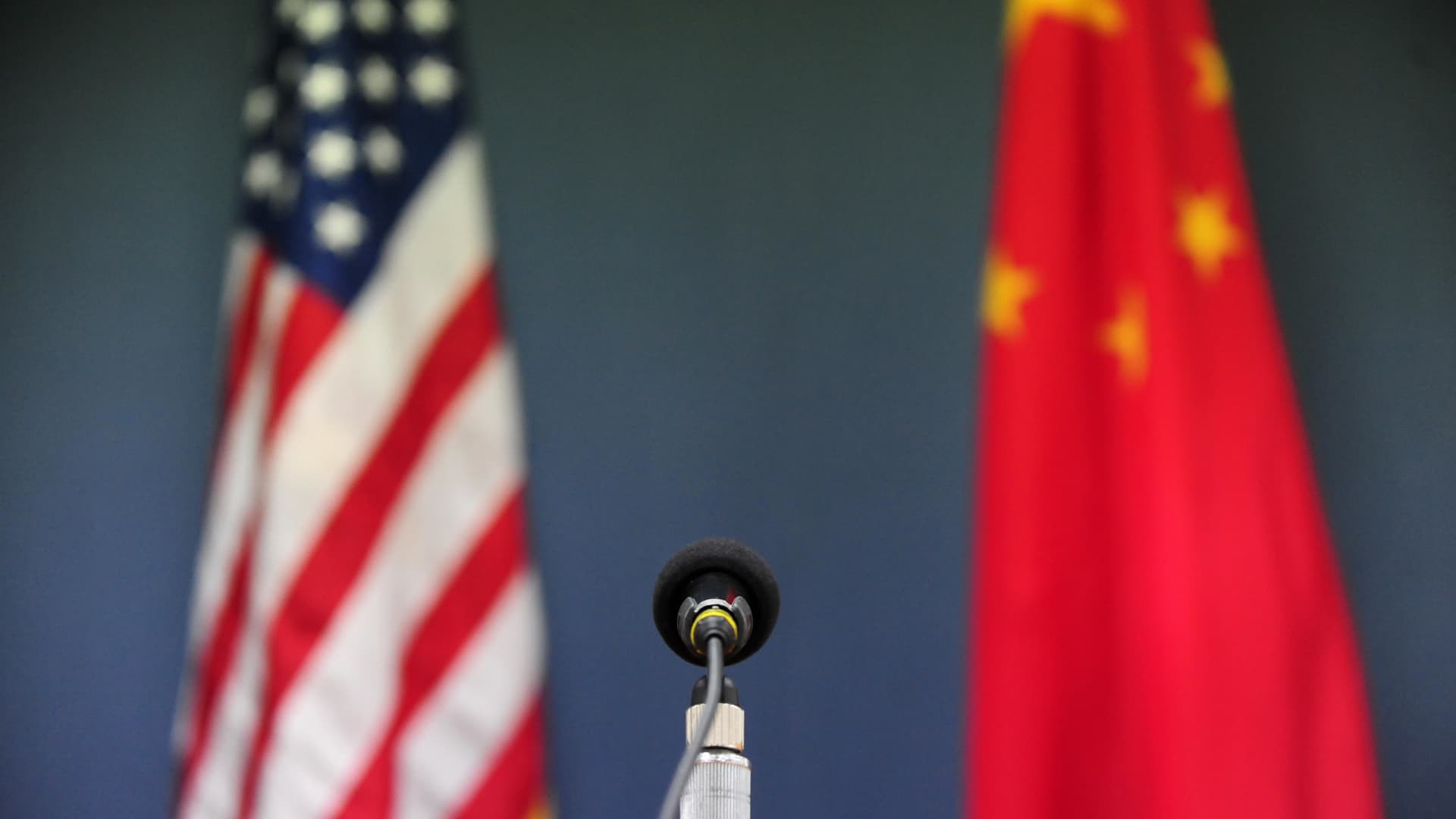
The U.S. and China flags stand behind a microphone at the U.S. Embassy in Beijing on April 9, 2009.
Frederic J. Brown | AFP | Getty Images
U.S. and Chinese officials meet in Madrid on Sunday to hash over longstanding trade irritants, a looming divestiture deadline for Chinese short video app TikTok and demands by Washington that G-7 and European allies impose tariffs on China to halt its purchases of Russian oil.
The talks in the Spanish capital mark the fourth time in four months that U.S. Treasury Secretary Scott Bessent and U.S. Trade Representative Jamieson Greer have met with Chinese Vice Premier He Lifeng in European cities to try to keep a fractured U.S.-China trade relationship from collapsing under PresidentDonald Trump‘s tariffs.
The three officials, along with China’s top trade negotiator, Li Chenggang, last met in Stockholm in July where they agreed in principle to extend for 90 days a trade truce that sharply reduced triple-digit retaliatorytariffson both sides and restarted the flow of rare-earth minerals fromChinato theUnited States.
Trump hasapproved the extensionof current U.S. tariff rates on Chinese goods, totaling about 55%, until November 10.
Trade experts said there was little likelihood of a substantial breakthrough in the talks hosted by Spain’s Socialist Prime Minister Pedro Sanchez, who has sought to improve ties with Beijing in recent years.
The most likely result of the Madrid talks is seen as another extension of a deadline for the popular TikTok app’s Chinese owner, ByteDance, to divest its U.S. operations by September 17 or face a U.S. shutdown.
A source familiar with the Trump administration’s discussions on TikTok’s future said that a deal was not expected, but that the deadline would be extended for a fourth time since Trump took office in January. Trump last monthlaunched a TikTok account.
TikTok has not been discussed in previous rounds of U.S.-China trade talks in Geneva, London and Stockholm. But the source said the issue’s public inclusion as an agenda item on theTreasury’s announcementof the talks gives the Trump administration political cover for another extension, which may annoy both Republicans and Democrats in Congress who mandated TikTok’s sale to a U.S. entity to reduce national security risks.
Wendy Cutler, a former USTR trade negotiator and head of the Asia Society Policy Institute in Washington, said she expected more substantial “deliverables” to be saved for a potential meeting between Trump and Chinese president Xi Jinping later this year, perhaps at an Asia Pacific Economic Cooperation summit in Seoul at the end of October.
These may include a final deal to resolve U.S. national security concerns over TikTok, and a lifting of restrictions on Chinese purchases of American soybeans and reduction of fentanyl-related tariffs on Chinese goods, and the Madrid discussions may help lay groundwork for such a meeting, Cutler said.
But she said resolving core U.S. economic complaints about China, including its demands that China shift its economic model toward more domestic consumption and rely less on state-subsidized exports, could take years.
“Frankly, I don’t think China is in any rush to do an agreement where they don’t get substantial concessions on export controls and lower tariffs, which are their key priorities,” Cutler said. “And I don’t see the United States in a position to make major concessions on either, unless there’s some breakthrough on its demands to China.”
RUSSIAN OIL PRESSURE
The Treasury has said theMadrid talksalso would cover joint U.S.-Chinese efforts to combat money laundering, a reference to its longstanding demands that China clamp down on illicit shipments of technology goods to Russia that aid its war in Ukraine.
Bessent urgedGroup of Sevenallies on Friday to impose “meaningful tariffs” on imports from China andIndiato pressure them to stop buyingRussianoil, a move aimed at bringing Moscow intoUkraine peace negotiationsby curbing its oil revenues.
The G7 finance ministers said on Fridaythey discussedsuch measures and agreed to speed up discussions to use frozen Russian assets to aid Ukraine’s defense.
Bessent and Greer said in a separate statement that G7 allies should join the United States in imposing tariffs on buyers of Russian oil.
“Only with a unified effort that cuts off the revenues funding Putin’s war machine at the source will we be able to apply sufficient economic pressure to end the senseless killing,” Bessent and Greer said, referring to Russian PresidentVladimir Putin.
The U.S. has imposed an extra 25% tariff on Indian goods over the country’s purchases of Russian oil, but has so far refrained from imposing such punitive duties on Chinese goods.
China’s Ministry of Commerce has said the Madrid talks will cover economic and trade issues such as U.S. tariffs, the “abuse” of export controls and TikTok.
SPAIN’S MOMENT
The Spanish government is seeking maximum exposure for the talks. Spanish foreign minister José Manuel Albares will publicly greet the two delegations before the start of the talks at 1:50 p.m. local time at the baroque Palacio de Santa Cruz, which houses Spain’s foreign ministry.
A Spanish government source said the choice of Spain for the latest round of the “delicate” talks was evidence that Madrid was consolidating itself as a seat of high-level and strategic negotiations.
Madrid hassought to be a venuefor an international peace conference to resolve theIsrael-Palestinian conflict.
The source said Spain’s government also takes advantage of the event to reinforce its own bilateral relations with the U.S. following a series of tense engagements with the Trump administration over its criticism ofIsrael’s offensive in Gaza, and its refusal to commit to spending 5% of its budget on defense along with other NATO members.
Bessent himself has alsocriticized Sanchezfor declaring Beijing a “strategic partner” at the height of Trump’s tariff offensive in April, saying that a closer relationship with the Asian giant was akin to “cutting your own throat”.
About The Author