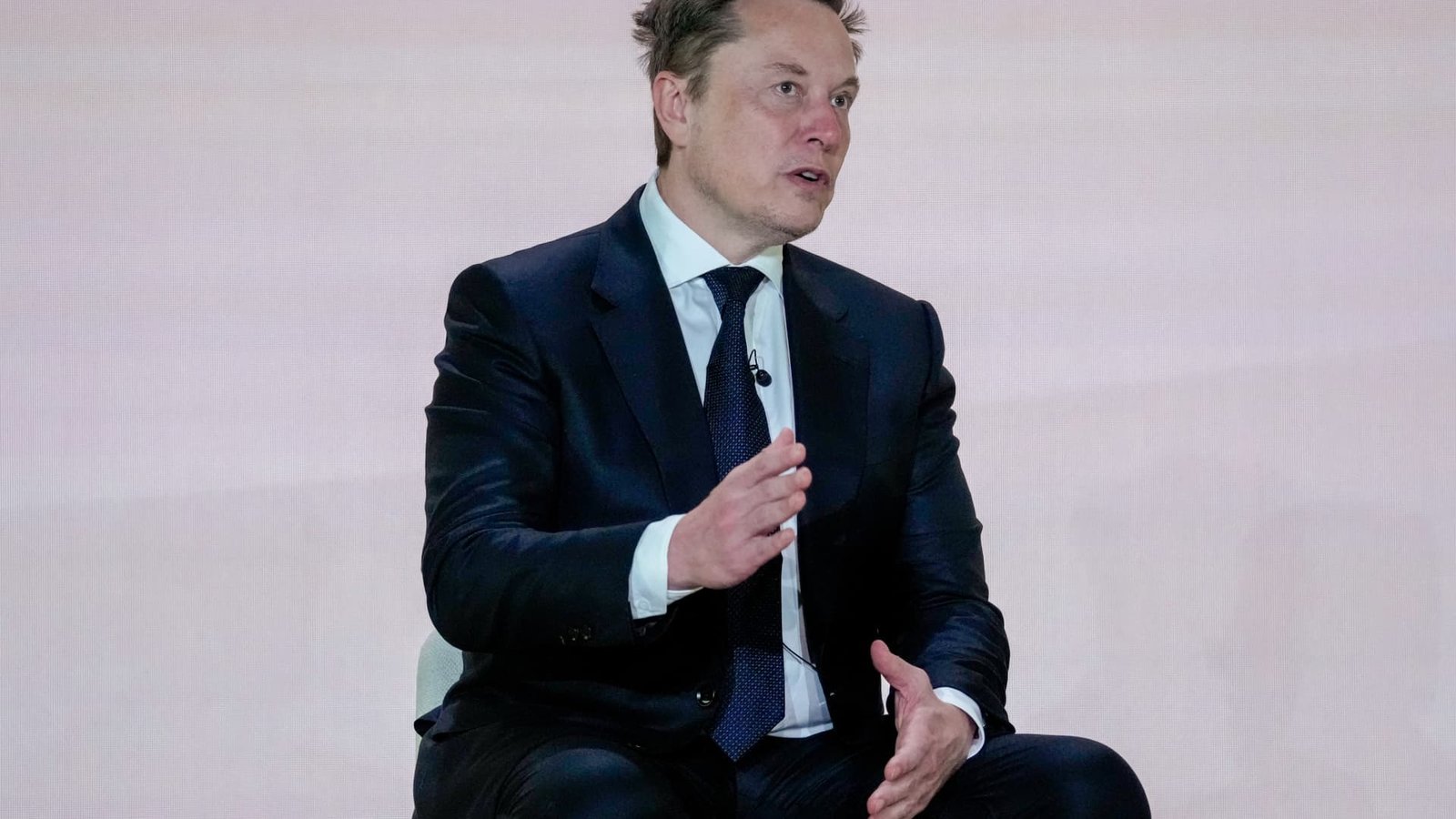
Elon Musk, chief executive officer of Tesla Inc., during the launch of America.gov in Washington, DC, US, on Tuesday, Sept. 29, 2026.
Daniel Heuer | Bloomberg | Getty Images
In recent days, the White House and Elon Musk have been trading dueling narratives over the suspension of Starlink service to Ukraine in a haze of confusion. Musk posted on X that “Any limits on speed or usage are decided by the US military and ultimately POTUS,” while the President himself told reporters Monday that he didn’t know who was responsible for the Starlink slowdown.
Now The Wall Street Journal is reporting, “some U.S. officials say that Musk acted unilaterally and that Trump didn’t specifically order any retribution against Ukraine,” quoting anonymous sources. This is despite his assurance last year he “would never do such a thing.“
No matter who is right, the alleged action raises legitimate questions about the risks of doing business with the wealthiest man on the planet.
Some critics and commentators are racing to blame Musk, who has long been one of their favorite targets for ire, with critics arguing that Musk is the puppeteer behind the throne and the first to realize the government control aspirations held by many private business leaders in American history, such as William Randolph Hearst, Marc Hanna, and J.P. Morgan. The Musk portrayed by these critics resembles the 19th century railroad tycoon Cornelius Vanderbilt, who is said to have quipped, “the law? What do I care about the law? Ain’t I got the power?”
But in racing to blame Musk alone, these critics may be missing the reality of what really happened with the suspension of Starlink service to Ukraine – while still being right on the unique risks of any business dealing with Musk. And here’s why.
Musk’s priorities are his business over his politics. And his business interests are to be in full alignment with the White House, given how uniquely reliant Musk’s companies are on the federal government across multiple vectors.
Roughly one-fifth of SpaceX’s total revenues come from U.S. federal agencies directly, most prominently NASA and the Department of Defense, on top of the fact that SpaceX‘s satellites are uniquely dependent upon federal regulatory approvals.
Furthermore, all defense contractors have their foreign sales controlled by the White House and Congress to some degree – so that the Patriot missile hold is driven by the White House not by their manufacturer Raytheon; and THAAD missile and F-35 fighter sales are driven by White House and Congressional decisions, not by their maker, Lockheed Martin. And the breaking news this week that Musk is considering merging Tesla and SpaceX into a single “Elon Inc”, as some are calling it, means that he will need federal government regulatory approval for this mega-merger.
At the end of the day, Elon Musk is not the strongest man in the world – that still is Donald Trump, president of the United States.
The Elon Musk risk
This whole episode serves as a potent reminder for every business of the unique perils and risks of dealing with Musk. After all, every business leader values certainty. There is nothing more sacrosanct in business than a contract, or an agreement, to provide goods and services. But every business partner of Musk must be thinking that certainty may not be possible when dealing with the world’s wealthiest person.
Every business has to at least now consider, as standard risk management, how Musk could conceivably throttle vital Starlink service despite prior contractual agreements. For example, just recently, Musk publicly scolded the CEO of Delta in a scorching post on X when the airline did not partner with Starlink to provide Wi-Fi on Delta flights. Delta-rival United has a partnership with Starlink, but it must now consider the uncomfortable prospect Starlink could be throttled if it somehow draws Musk’s ire.
Perhaps the biggest winner from this saga may be Jeff Bezos’ Blue Origin, which just raised $10 billion in a successful fundraising round valuing it at $130 billion. Other SpaceX competitors stand to benefit as customers — ranging from foreign governments to businesses — race to diversify their supply chain risk away from the virtual monopoly Starlink has over the space marketplace right now.
Markets dislike any monopoly, but especially an unreliable one, and competitors like Blue Origin do not need to beat SpaceX on technology to take share; they need only offer what Musk cannot, which is certainty.
Thus, no matter what really transpired with Starlink’s suspension of service to Ukraine, Musk may now face customers diversifying away from total reliance on SpaceX as his ultimate reckoning.
Jeffrey Sonnenfeld is the Senior Associate Dean for Leadership Studies and Lester Crown Professor in Management Practice at the Yale School of Management, along with a CNBC contributor. He is the New York Times bestselling author of ten books, including most recently, Trump’s Ten Commandments (Worth Books/Simon & Schuster), and the upcoming When Machines Act: The Promise and Peril of Our Agentic AI Future (MIT Press/Penguin Random House).
Steven Tian is research director at the Yale Chief Executive Leadership Institute.
About The Author