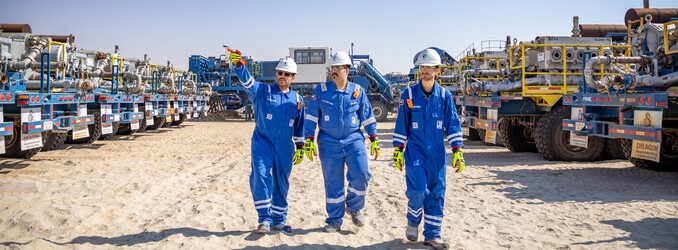
(WO) — ADNOC is applying lessons learned from two decades of U.S. shale development to advance its Diyab unconventional gas play from appraisal into early development, company executives said during URTeC 2026.
Speaking during a special session titled “Engineering the Future of UAE Unconventionals: Lessons from ADNOC’s Diyab Journey,” executives outlined how advances in subsurface understanding, drilling and completions technology, and operational efficiency are helping shape the next phase of unconventional development in the UAE.
“The journey starts at the subsurface,” said Abdullah Al Blooshi, planning engineer at ADNOC.
Al Blooshi said the company is integrating seismic, reservoir and operational data to identify sweet spots, optimize well spacing and improve landing point selection across the Diyab resource.
“We are not working in a silo. We are working to integrate data,” he said.
A key focus of the session was how the UAE’s unconventional program has adapted proven North American development practices to local conditions through the Turnwell joint venture.
Since Turnwell’s launch in 2024, the operator has drilled 125 wells and completed 85. The joint venture, formed by ADNOC Drilling, SLB and Patterson-UTI, was established to accelerate development of the UAE’s unconventional resources by combining local operational capabilities with U.S. drilling and completions expertise.
“When it came to building that ecosystem, we really did not have to reinvent the book,” said Tarik Itibrout, vice president of frac and completions for unconventional resources at ADNOC. “The rock is different than the rocks in the U.S., but fundamentally you’re still dealing with a tight reservoir.”
According to Itibrout, the development team adopted high-density completions and other unconventional practices refined in U.S. shale basins while addressing challenges unique to the UAE, including water management in a desert environment.
“One of the most important pillars of that ecosystem is obviously the water and the water management, especially when you talk about a desert environment with very scarce water resources,” Itibrout said.
The company has also focused on reducing development costs. By transitioning from ceramic-heavy proppant designs to predominantly sand-based completions, it achieved an estimated 85% reduction in proppant costs. Simplifying frac chemistry also reduced treatment costs by roughly 50%.
“We think we’re going to get to levels of cost and efficiency that are very comparable with what’s being done in the U.S. today,” Itibrout said.
Looking ahead, the focus is shifting toward optimizing development through fracture diagnostics, well-spacing evaluations and longer lateral designs, as the project transitions toward multi-well pad development.
Felipe Silva, vice president of unconventional asset development at ADNOC, said early results indicate the play is performing competitively against leading North American unconventional developments.
“Our ADNOC potential is within the range of the top U.S. players here — Marcellus, Utica, etc.,” Silva said.
“ADNOC has successfully transitioned from exploration to early development, proving viability of UAE unconventional resources. Complex UAE resources are being unlocked through tailored technologies, delivering strong productivity gains.”
As development progresses, executives said the focus is shifting from proving the resource to maximizing its long-term potential through improved reservoir understanding, optimized well designs and continued operational efficiencies.
About The Author