HOUSTON (WO) — Deepwater development has long been defined by the scale of its engineering. Panelists at the 2026 Women’s Global Leadership Conference (WGLC) said Wednesday that its future will depend just as much on people: engineers who can manage risk across a decades-long lifecycle, and leaders willing to put women in the roles that do it.
Moderated by Sacha Luces, asset development and subsurface manager, Gulf of America, at Shell, the Deepwater Development panel featured Maggie Sheridan of Murphy Oil, Otema Dzandu of Ghana National Petroleum Corp. (GNPC), Brittaney Cordas of Woodside Energy and Chen Jainsky of MODEC.
Sheridan, manager of offshore operations engineering at Murphy, said a single deepwater well can cost $100 million, a platform about $1 billion and a full development can easily push $5 billion, with reservoirs as deep as 22,000 ft. “There’s very little room for error,” she said. “Sometimes I feel like what we do in deepwater rivals NASA,” she said. “It’s not just about extraordinary engineering. It’s about long-term investments that deliver value.”
Dzandu, a reservoir engineer at GNPC, said Ghana’s three producing fields, Jubilee, TEN and Sankofa, are all offshore and all deepwater. She highlighted three challenges: access to seabed equipment, cost and flow assurance. “You can’t just swoop in there and fix a problem,” she said. “You need reliable equipment, and your backups need backups.” At Jubilee, she noted, seabed temperatures of about 40°F meet reservoir fluids at 200–300°F, creating the risk of waxes, asphaltenes and hydrates that impede production.
Cordas, senior integrated systems lead for Woodside’s Trion development offshore Mexico, walked through a project’s lifecycle, from lease access through appraisal, concept select and the final investment decision. “A lot of the game is reducing uncertainties,” she said, whether technical, commercial or execution-related. “You can spend half your career on a project before it even starts up.”
Jainsky, a project manager at MODEC, described the FPSO as a bridge between the subsea field and the energy supply chain. A typical unit is longer than three football fields, ties back to wells in nearly 3,000 m of water and stays on location for 20 years. “Today we have more than 200 FPSOs deployed around the world, so that speaks for itself as to the relevance,” she said.
Sheridan, who began her career at Prudhoe Bay, said deepwater “can be a really challenging place for entry-level engineers to cut their teeth,” because fields with only 10 to 20 wells leave little room to learn by trial. She called for rotational programs, more field experience and projects that give new engineers “some room to fail.”
Asked which skills matter most, Cordas named AI, integration and decision framing. “We need folks that have decision-framing skills,” she said, to align teams “on what are the must-haves, what are the compromises.” Sheridan warned that AI and automation risk creating “an overwhelming amount of data” without insight. “We will continue to need those engineers … who can connect the data, the process, and the people,” she said.
Luces asked panelists for one step senior leaders can take now. “By the new year, sponsor one woman for a high-visibility stretch role,” Cordas said. Jainsky added that sponsorship should go beyond advice, urging leaders to ask women what they need and remove roadblocks.
Dzandu said the opportunities ahead are broad. Areas once considered “a no-go area” are “now becoming more viable” thanks to improved subsea technology and reservoir understanding, she said, and the sweet spot for the next generation is “at the intersection of disciplines,” with professionals who “can connect all the dots.”
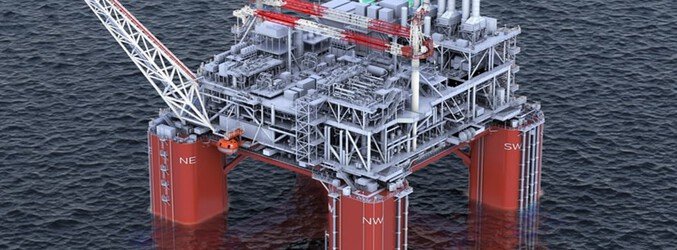
Pictured: The Trion FPU, designed for deepwater offshore Mexico. Image: Woodside Energy.
About The Author