Ripple (XRP) continues to lose momentum on Tuesday, as bears tighten their grip. The drop toward $1.00 aligns with lethargic sentiment in the broader cryptocurrency market. A daily close below that critical demand area could deepen the sell-off, narrowing XRP’s recovery potential.
XRP falters amid muted ETF activity
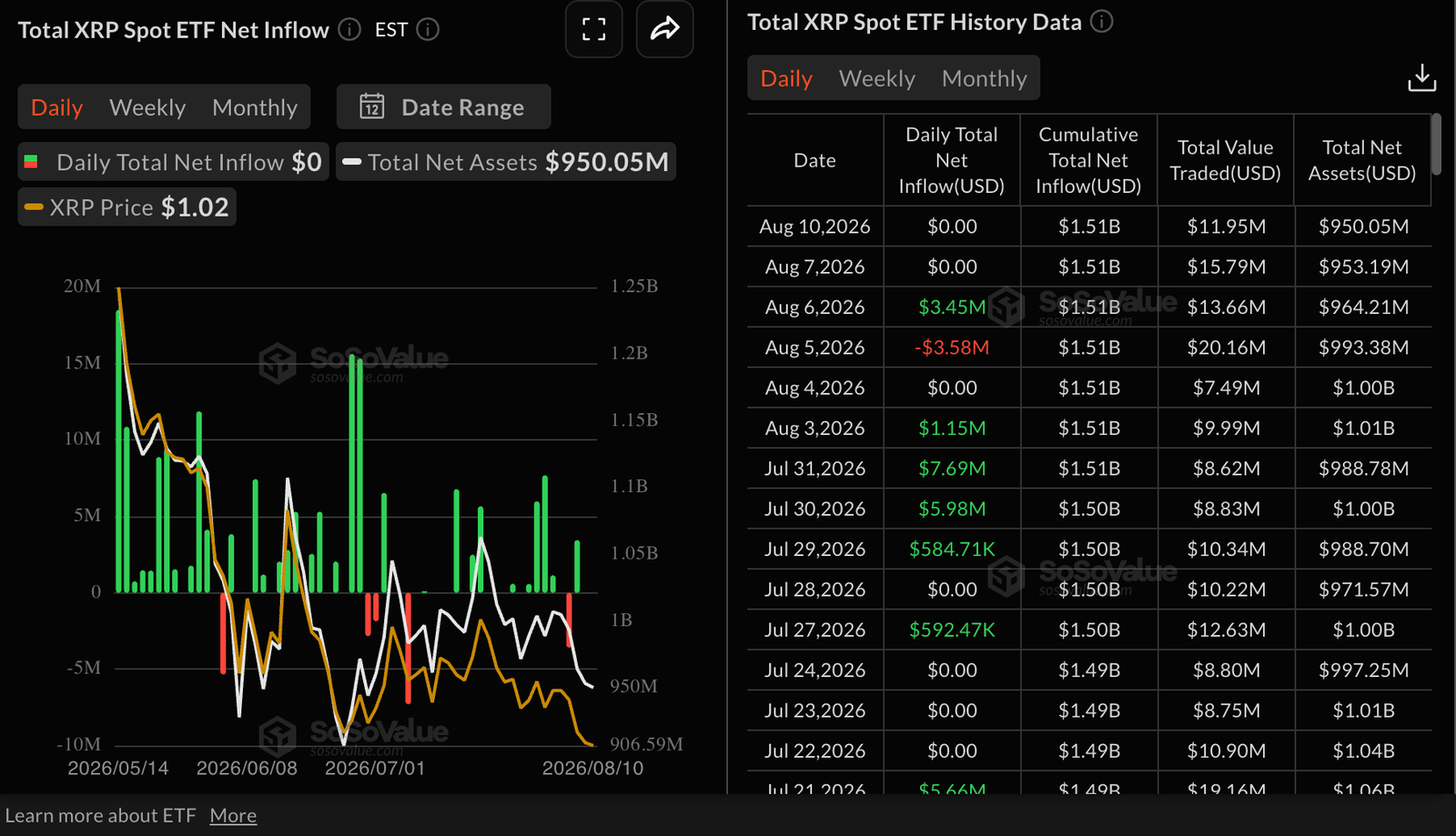
US-listed XRP spot Exchange-Traded Funds (ETFs) continue to underperform, with muted trading activity persisting through Friday and Monday. The ongoing lack of institutional participation underscores prevailing bearish sentiment across the crypto sector, diminishing prospects for a sustained recovery. However, cumulative inflows remain stable at $1.51 billion, while assets under management stand at $950 million.
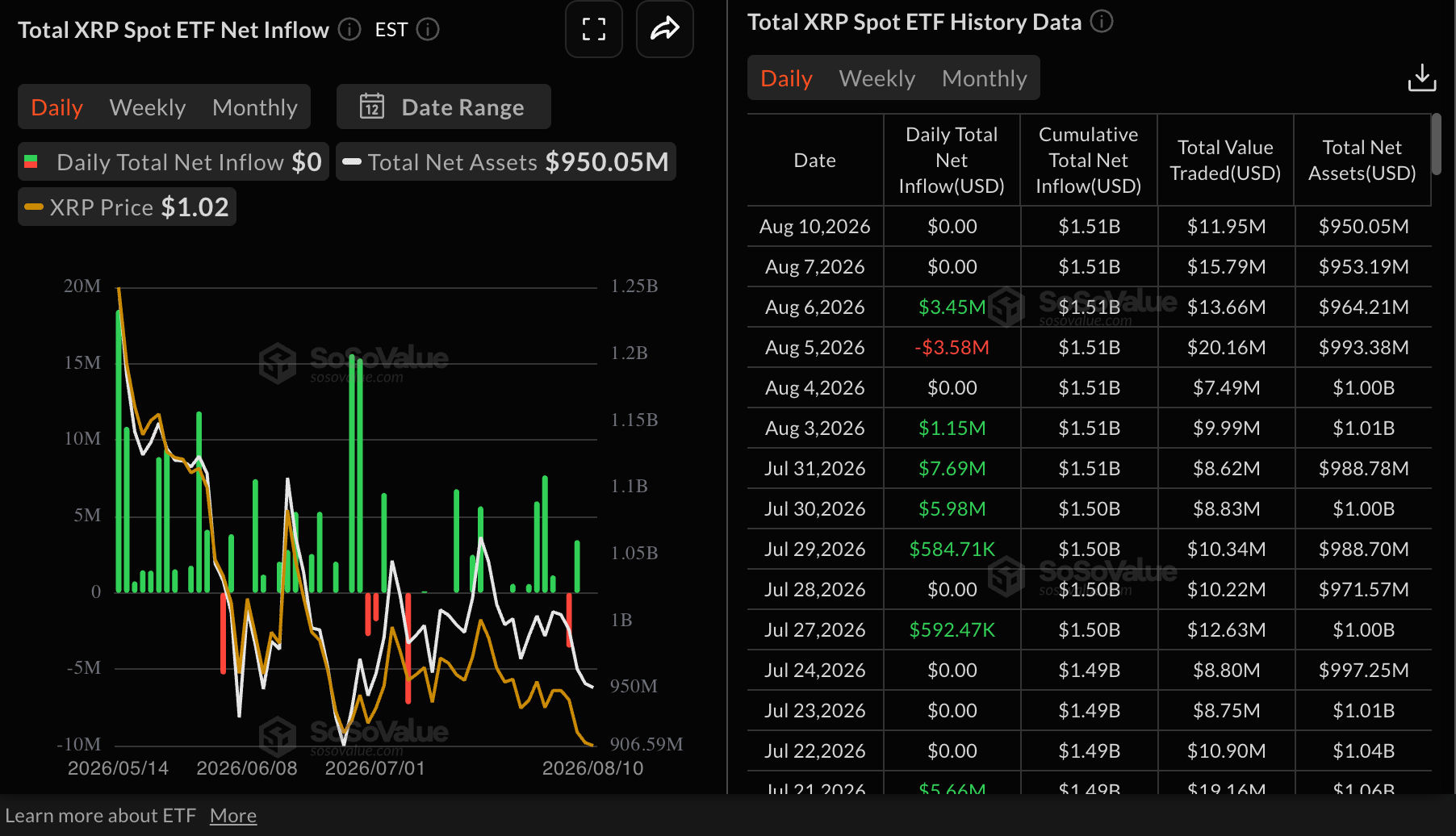
Sentiment is embedded in the Fear territory of the crypto Fear & Greed Index on Tuesday. The index holds at 29 following a marginal decline from 30 the day before. Fear sentiment implies that risk-on sentiment is subdued, primarily due to geopolitical uncertainty, inflation and the lack of catalysts to sustain recovery.
Still, activity in the derivatives market is regaining traction as reflected in the perpetual futures Open Interest (OI), rising to 2.74 billion XRP on Tuesday, from 2.62 billion XRP the previous day.
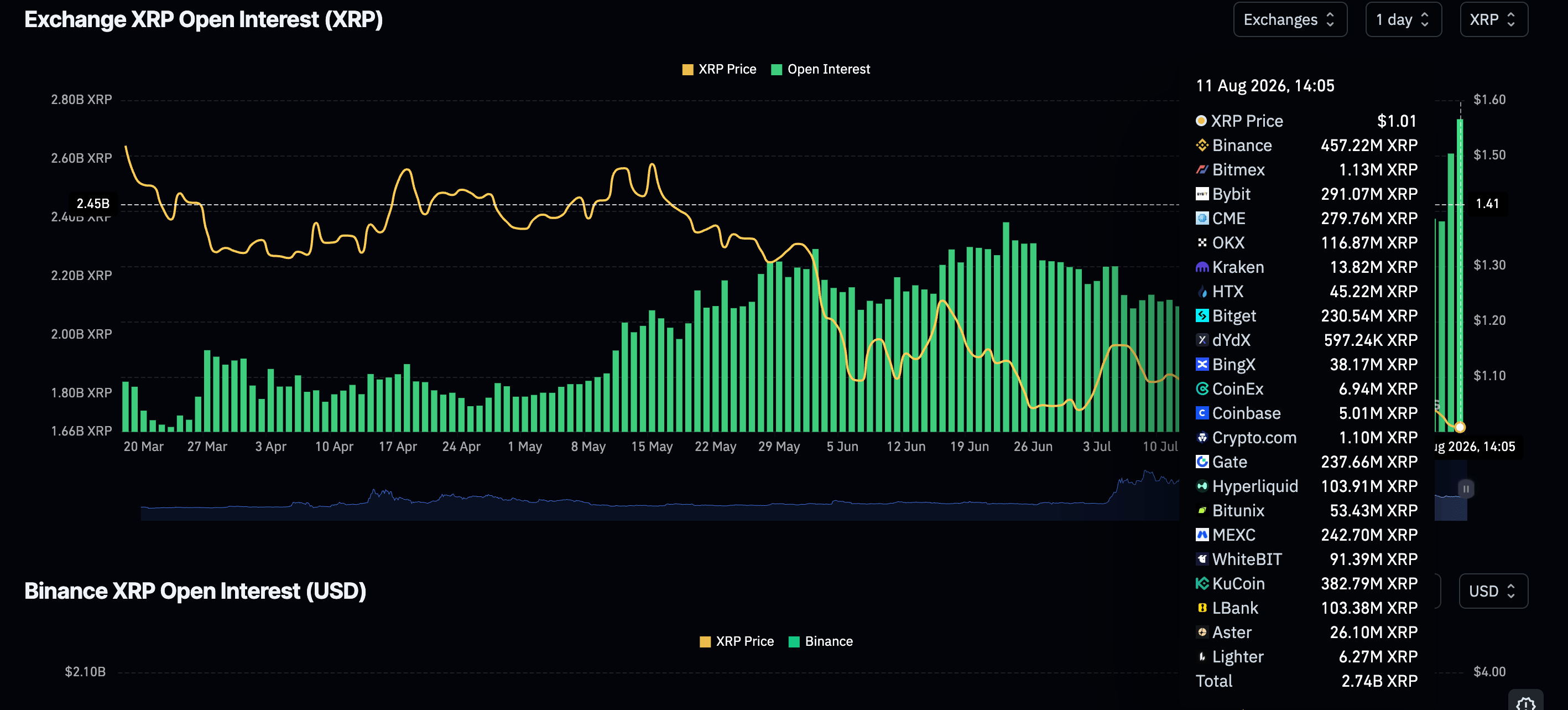
Looking back, OI averaged 2.12 billion XRP on August 5, a 23% increase. If sustained, rising demand for XRP derivatives will anchor a sustained trend reversal above the key $1.00 level.
Technical analysis: XRP at risk of falling below $1.00
XRP trades at $1.01, maintaining a bearish near-term bias as price holds decisively below the 50-day, 100-day and 200-day Moving Average Exponential (EMA) lines. The Moving Average Convergence Divergence (MACD) indicator remains below zero with a negative histogram, and the Relative Strength Index (RSI) at 35 hovers just above oversold territory, hinting at persistent selling pressure rather than an imminent recovery.
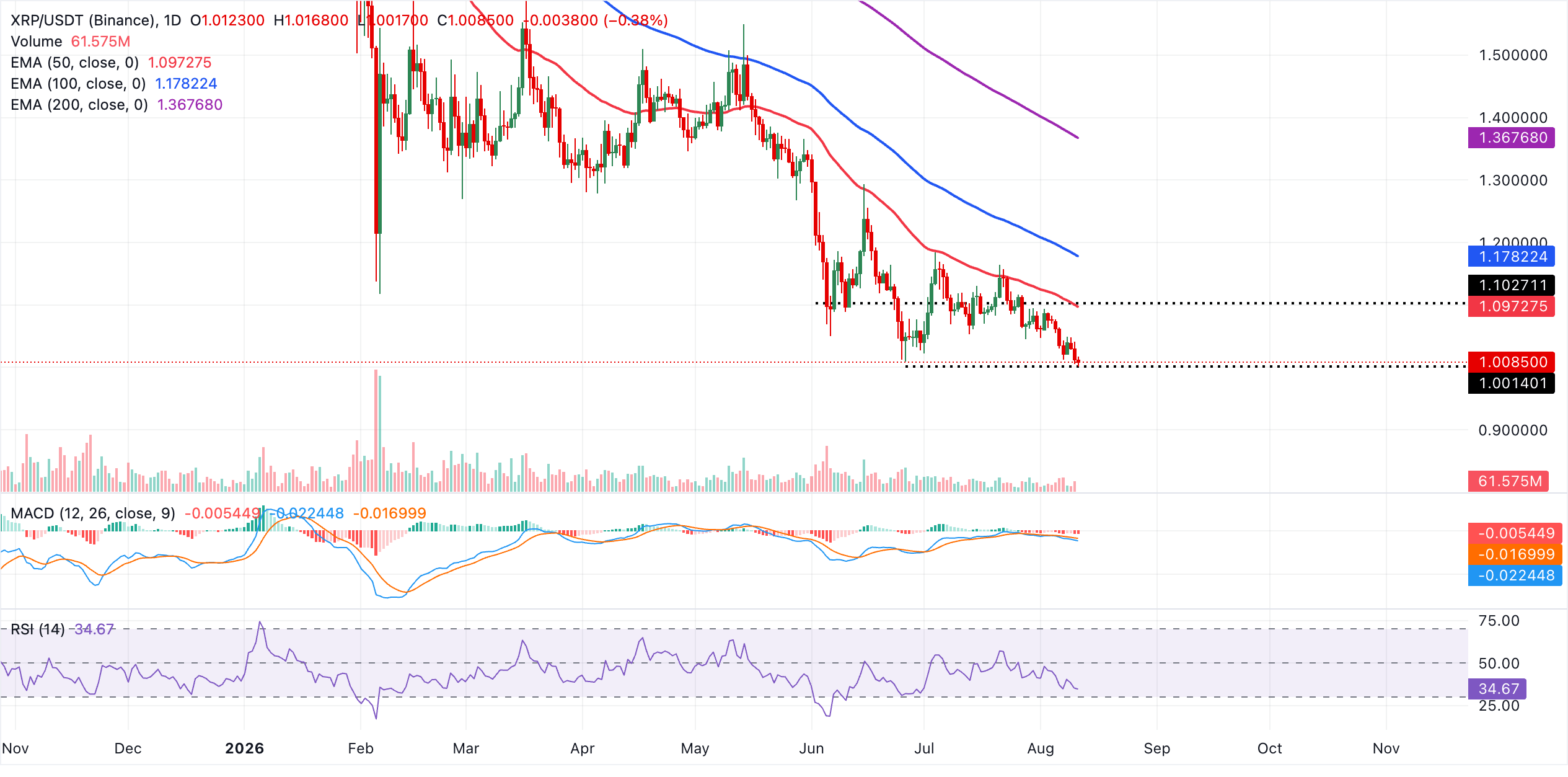
Immediate resistance lies at the 50-day EMA clustered near $1.10, followed by the 100-day EMA around $1.18 and then the 200-day EMA near $1.37, which together define a dense overhead supply zone that XRP would need to reclaim to ease the current bearish tone. The downside remains vulnerable at $1.00, and any bounce while price stays below these EMA barriers would likely be treated as a corrective move within the prevailing downtrend rather than the start of a sustained bullish phase.
(The technical analysis of this story was written with the help of an AI tool. Know more.)
Bitcoin, altcoins, stablecoins FAQs
Bitcoin is the largest cryptocurrency by market capitalization, a virtual currency designed to serve as money. This form of payment cannot be controlled by any one person, group, or entity, which eliminates the need for third-party participation during financial transactions.
Altcoins are any cryptocurrency apart from Bitcoin, but some also regard Ethereum as a non-altcoin because it is from these two cryptocurrencies that forking happens. If this is true, then Litecoin is the first altcoin, forked from the Bitcoin protocol and, therefore, an “improved” version of it.
Stablecoins are cryptocurrencies designed to have a stable price, with their value backed by a reserve of the asset it represents. To achieve this, the value of any one stablecoin is pegged to a commodity or financial instrument, such as the US Dollar (USD), with its supply regulated by an algorithm or demand. The main goal of stablecoins is to provide an on/off-ramp for investors willing to trade and invest in cryptocurrencies. Stablecoins also allow investors to store value since cryptocurrencies, in general, are subject to volatility.
Bitcoin dominance is the ratio of Bitcoin’s market capitalization to the total market capitalization of all cryptocurrencies combined. It provides a clear picture of Bitcoin’s interest among investors. A high BTC dominance typically happens before and during a bull run, in which investors resort to investing in relatively stable and high market capitalization cryptocurrency like Bitcoin. A drop in BTC dominance usually means that investors are moving their capital and/or profits to altcoins in a quest for higher returns, which usually triggers an explosion of altcoin rallies.
About The Author