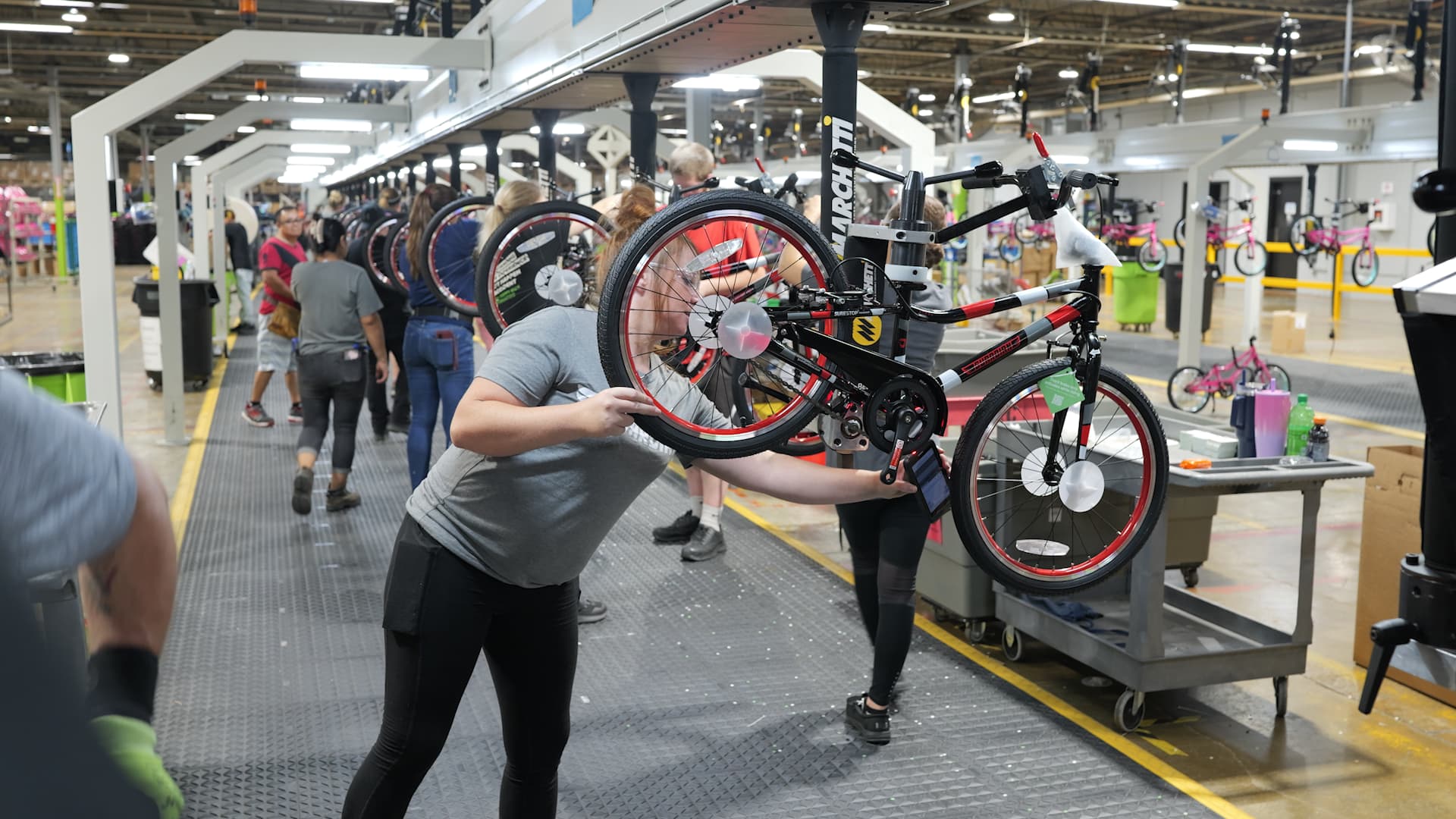
At a 540,000-square-foot facility in Seymour, Indiana, Guardian Bikes is pulling off a unique challenge: making children’s bikes in America. The company says it produces about 12,000 bikes per week, a manufacturing feat that has become increasingly uncommon in the U.S.
“All the way back to World War II era, pretty much every bike sold in the United States was made in the U.S.,” said Guardian Bikes co-founder and CEO Brian Riley. “By the time you get to the ’70s, ’80s, ’90s, it all evaporated.”
Over the last four decades, many American factories have shut down as production moved overseas in search of cheaper labor and larger supplier networks. Between 1997 and 2023 the number of U.S. manufacturing firms and plants dropped by 25% as global trade barriers fell, according to the World Resources Institute.
Now, as companies like Apple, IBM and Johnson & Johnson pledge billions towards U.S. manufacturing and politicians call for reshoring, Guardian offers a glimpse into the possibilities and difficulties of being “Made in America.”
“It wasn’t easy,” said Riley. “It even took kind of getting into losing money for a little bit.”
Guardian Bikes used to rely on a Chinese original equipment manufacturer (OEM) to build its product based on specifications provided by Guardian. But long shipping times and quality concerns prompted a pivot.
Starting in 2022, Guardian opened its own plant in the Midwest with the help of $19 million in financing from JPMorgan. Riley said the higher cost of producing domestically is offset by automation, lower inventory costs, and in some cases, tariffs.
“With the most recent tariff environment, we’re starting to get either cost parity or in some cases, the domestic parts are cheaper than what you can get out of China,” said Riley.
But building a domestic supply chain from scratch isn’t easy. Many parts, like bicycle chains and reflectors, are no longer made in the U.S. at scale.
Experts say finding input suppliers is one of many challenges companies face in bringing manufacturing back to the U.S. Meanwhile, countries like China and Vietnam have become manufacturing powerhouses, investing billions more in factories and training.
Even with new tariffs and federal subsidies under the CHIPS Act, some economists remain skeptical of a true U.S. “manufacturing renaissance.”
“Think about how much a pair of sneakers would cost if they were made here in the United States, or a phone or any number of the items that you go to a retail store to purchase. It would be a lot more expensive,” said Colin Grabow, associate director at the Cato Institute’s Herbert A. Stiefel Center for Trade Policy Studies. “So we should all welcome the fact that goods are being produced in the most efficient ways possible, because that lowers prices for us and allows us to raise our standard of living.”
To learn more about how Guardian Bikes is pulling off “Made in America,” watch the video above.
About The Author