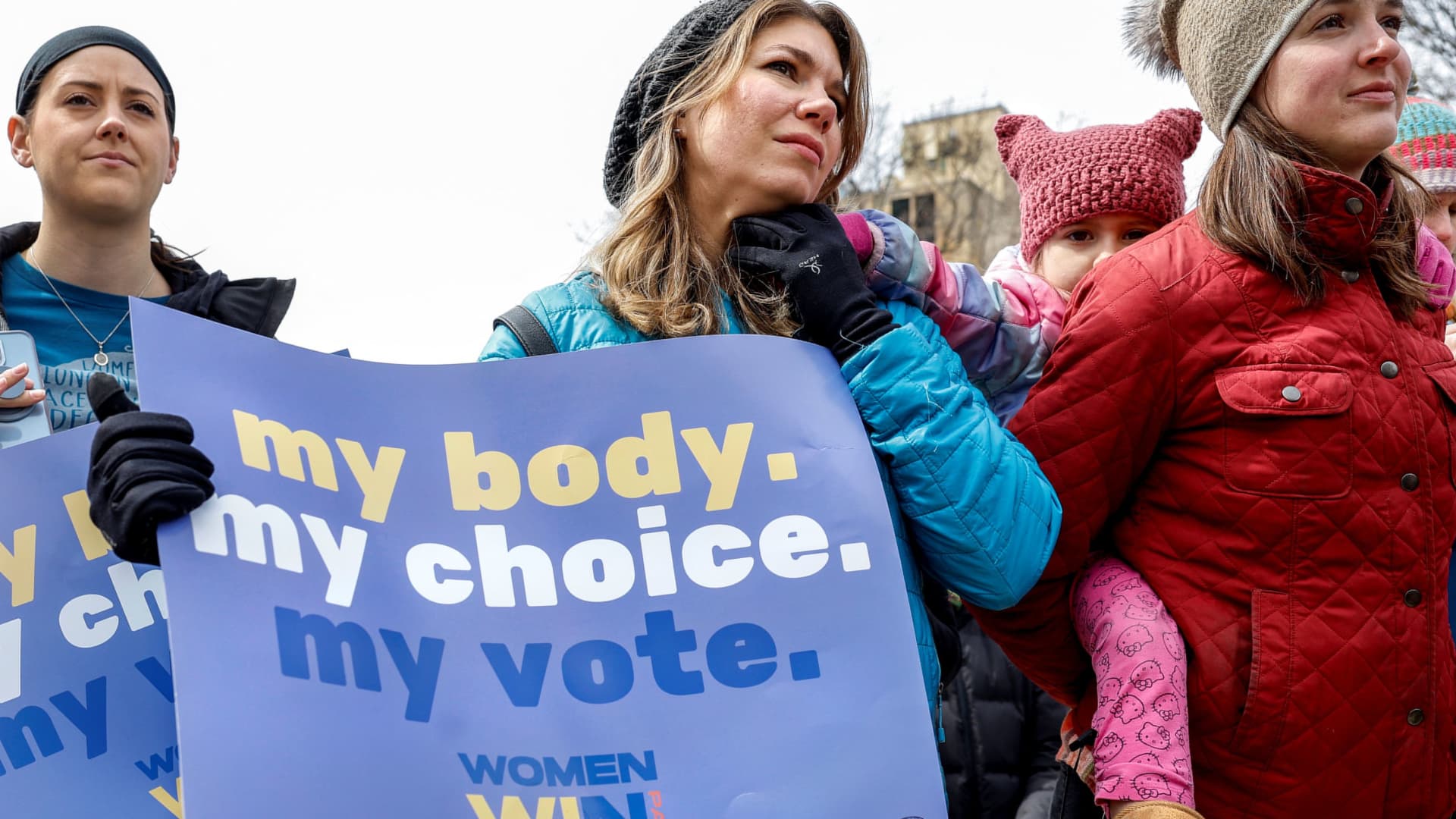
Romy Stokes, 5, and her mother Lindsey Stokes, attend the “Rally for Our Rights” ahead of the 2023 Wisconsin Supreme Court election outside the Wisconsin State Capitol in Madison, Wisconsin, U.S., April 2, 2023.
Evelyn Hockstein | Reuters
The Wisconsin Supreme Court on Wednesday formally struck down an abortion ban from 1849 that had technically retaken effect after the U.S. Supreme Court overturned federal abortion rights.
In a 4-3decisionthat came down along ideological lines, the court’s liberal majority affirmed a lower court ruling that overturned the 176-year-old ban and left in place a more recent law in Wisconsin allowing most abortions until about the 20th week of pregnancy.
“We conclude that comprehensive legislation enacted over the last 50 years regulating in detail the ‘who, what, where, when, and how’ of abortion so thoroughly covers the entire subject of abortion that it was meant as a substitute for the 19th century near-total ban on abortion,” liberal Justice Rebecca Dallet wrote in the majority opinion. “Accordingly, we hold that the legislature impliedly repealed [the 1849 ban] to abortion, and that [that law] therefore does not ban abortion in the State of Wisconsin.”
The ruling is a win for abortion rights activists in the battleground state, where Democrats had put the issue at the forefront of many elections — including two races in 2023 and 2025 that recalibrated the state Supreme Court’s ideological balance — in the years since the U.S. Supreme Court overturned Roe v. Wade.
The state’s 1849 law — enacted the year after Wisconsin was granted statehood — banned abortion in almost all cases by making performing the procedure a felony. Under the law, doctors who perform the procedure technically faced up to six years in prison and thousands of dollars in fines. The law included an exception for abortion care only to save the life of the woman, but not for her health or for rape or incest.
As was the case in many states with similar older laws, or newer so-called trigger laws, the ban technically snapped back into effect almost immediately after the U.S. Supreme Court’s decision to strike down Roe v. Wade in 2022. In short order, the decision prompted Planned Parenthood’s Wisconsin operations tosuspendabortion services in the state.
But a series of legal developments then put the question of the law’s future before the state Supreme Court.
Shortlyafter the Roe decision, Wisconsin Gov. Tony Evers and Attorney General Josh Kaul, both Democrats, filed a suit arguing that the law had been effectively deemed invalid by more recent, more lenient abortion restriction legislation in the state. Evers and Kaul said at that time, in 2022, that they wouldn’t enforce the law. Both won re-election later that year and have maintained their promise.
But a state judgein July 2023 declaredthat the 1849 law did not apply to consensual medical abortions — the judge found that the original law intended to outlaw attacks on women that were intended as attempts to kill her unborn child — prompting abortion providersto resume care in the statein September 2023.
The district attorney of conservative-leaning Sheboygan County, Joel Urmanski, backed by abortion opponents and other Republican attorneys, appealed that ruling, arguing that the 1849 ban should remain the law of the land, eventually elevating the case to the state Supreme Court.
Meanwhile, in a separate case, Planned Parenthood of Wisconsin sued in February asking the state Supreme Court to decide whether a constitutional right to abortion care exists in the state. Arguments haven’t been scheduled. But part of Wednesday’s decision could well forecast how judges decide on that case.
The decision Wednesday is the latest consequence of liberalshaving regained the majority of the technically nonpartisan courtfor the first time in 15 years in a bitter and expensive 2023 election that ended with progressive Janet Protasiewicz’s victory.
The race was largely defined by Protasiewicz’s support for abortion rights and opposition to the state’s heavily gerrymandered legislative maps. Both issues quickly came before the court following the election, and both ended with victories for the liberal parties in the cases.
The issue of abortion played a prominent role inthis year’s state Supreme Court race as well,allowing liberals to maintain their narrow majority. Susan Crawford will be sworn in next month and did not participate in Wednesday’s decision.
The issue could also animate yet another race for a seat on the high court next year. Conservative Justice Rebecca Bradley has announced she won’t run for another term, triggering what promises to be another expensive and contentious race.
State Supreme Court elections are scheduled in Wisconsin each year from 2026 to 2030.
About The Author