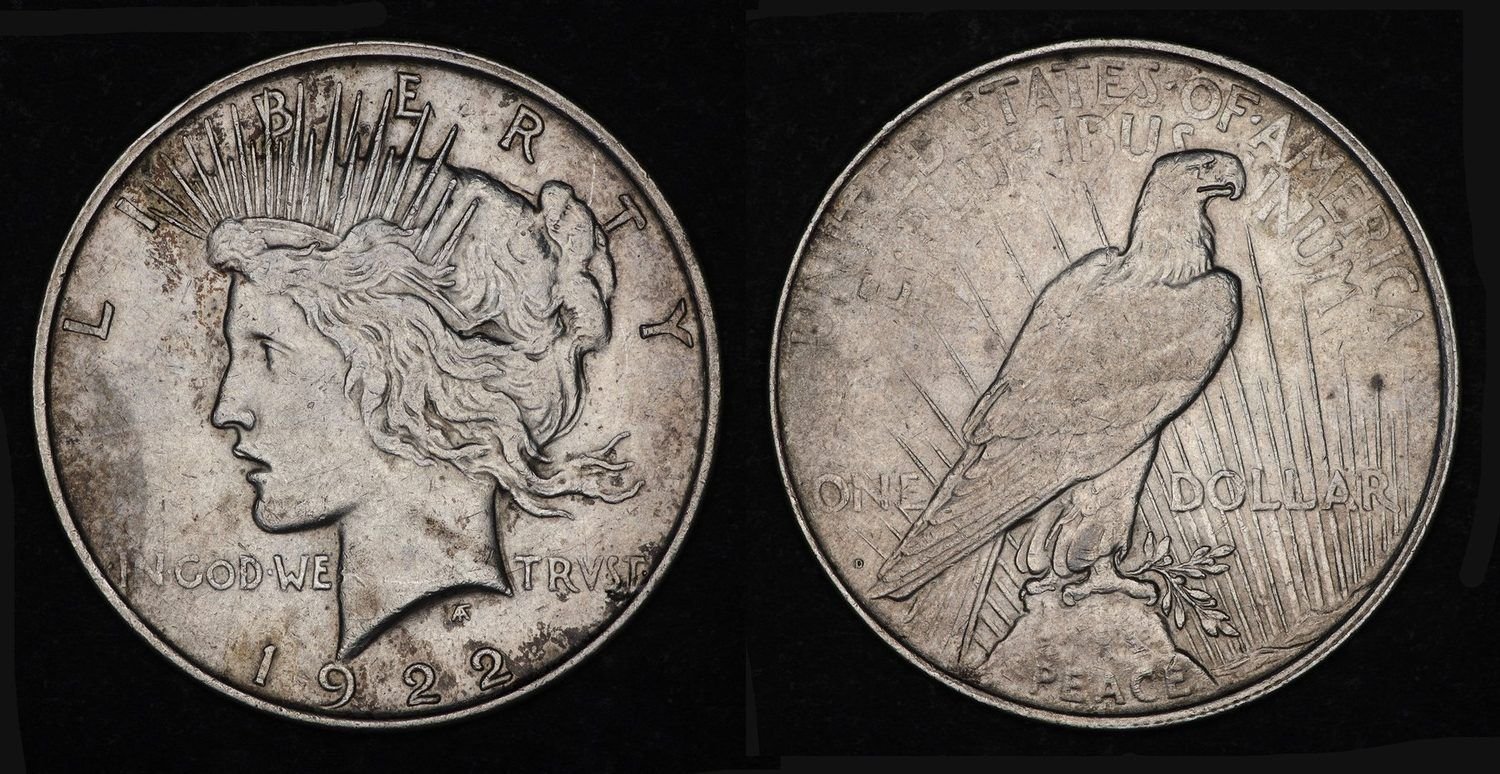
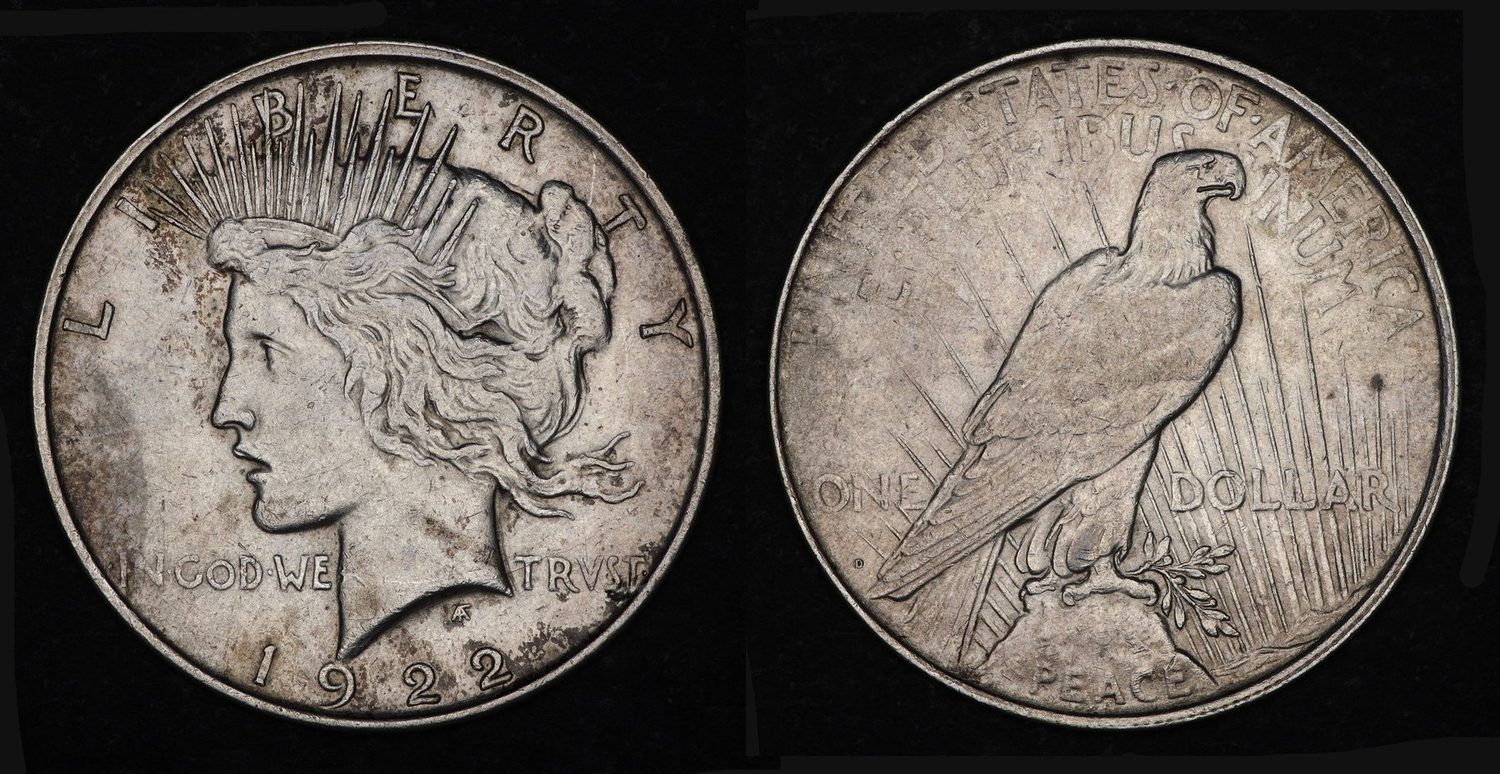
Pull a 1922 silver dollar out of a drawer and you are holding a Peace dollar, whatever else it gets called. Thousands of people search every month for the 1922 Morgan dollar and the 1922 Liberty dollar. The Morgan series ended in 1921, and the United States has never struck a coin called a Liberty dollar.
That correction is where 1922 silver dollar value begins, because the Peace dollar of 1922 was produced in quantities no American silver dollar has matched before or since. The Philadelphia Mint alone struck 51,737,000 of them, a record for the denomination that still stands.
Most are worth a little more than the silver inside them. A handful have sold for six figures. What follows is how to tell which one you have, drawn from the design fight that produced the coin and from the grading data that decides its price.
Key Takeaways
- Philadelphia struck 51,737,000 Peace dollars in 1922, the highest mintage of any United States silver dollar.
- Most circulated examples trade close to metal value: roughly $51 of silver with the spot price near $66 an ounce in September 2026.
- Grade is the dividing line. PCGS estimates 75,000 Philadelphia coins survive above MS-65, against 7,500 from Denver and just 1,000 from San Francisco.
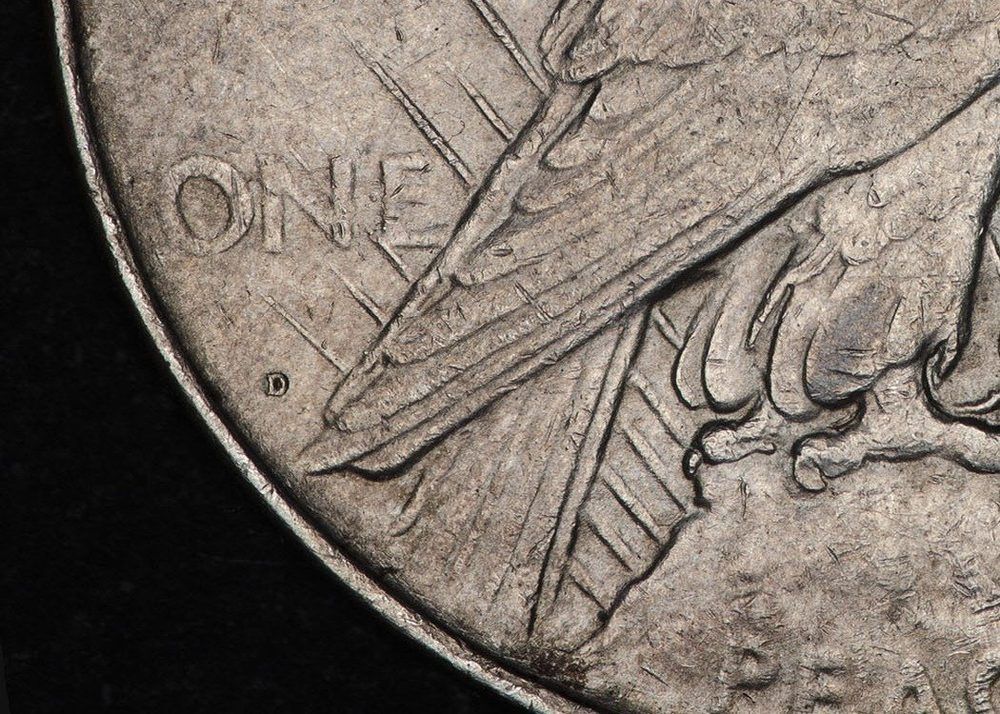
- The mint mark sits on the reverse, below the word ONE and left of the eagle’s tail.
- A 1922-D graded MS-67 sold for $90,000 in 2018. A 1922 High Relief proof brought $458,250.
The Peace Dollar’s Second Year
The Peace dollar exists because of a wartime silver deal and a lobbying campaign, and it looks the way it does because of a newspaper controversy that ended with an engraver cutting a sword off a finished die.
A Design Born From the Pittman Act
When Britain needed silver to stabilize currency in India during the First World War, Congress authorized melting Morgan silver dollars and selling the metal. The Pittman Act of 1918 required the Treasury to eventually replace every melted coin with a new silver dollar struck from domestically mined silver.
That replacement program was enormous. By June 30, 1922, the Mint had turned 86,916,979 ounces of purchased silver into 111,431,473 silver dollars, and 86,730,000 of those still carried the old Morgan design.
Numismatists led by Frank Duffield and Farran Zerbe had lobbied since 1918 for something better than a reissued Morgan: a coin marking the peace that followed the war. The Treasury announced a design competition in late 1921, and Anthony de Francisci won it. At 34 he was the youngest competitor, and he modeled Liberty on his wife, Teresa.
The Broken Sword and the Engraver’s Knife
De Francisci’s original reverse showed a broken sword beneath the eagle. When the design leaked, the New York Herald and others attacked it, arguing that a broken sword signaled defeat rather than victory.
Treasury officials ordered the sword removed days before the first strike scheduled for December 28, 1921. Chief Engraver George Morgan carved it out of the existing hub by hand and extended the olive branch to cover the change. His work was precise enough that numismatists spent more than 85 years assuming the Mint had simply cut new dies.
The 1921 coins came out in high relief and struck poorly. For 1922 the Mint lowered the relief, and production went from a trickle to a flood.
Philadelphia (no mint mark)
Philadelphia struck 51,737,000 pieces. PCGS calls it the most common date in the entire Peace dollar series, and 1922 silver dollar value with no mint mark reflects that abundance in every circulated grade.
Denver (“D”)
Denver produced 15,063,000 coins, its highest Peace dollar output of any year. The reverse is often weak at the center because the dies were spaced too far apart, so the eagle’s high points can show original planchet marks while the fields stay frosty.
San Francisco (“S”)
San Francisco struck 17,475,000. Quality was the worst of the three: weak centers on both sides, indistinct rims, and heavy bagmarks from transport. Q. David Bowers described the typical strike as an aesthetic disaster, which is exactly why sharp examples matter so much.
Those three figures add up to 84,275,000 silver dollars in a single year, struck at a moment when the Mint’s whole purpose was converting bullion into coin as fast as its presses could run.
Historical context America in 1922
- Silver averaged 66.8 cents an ounce in the fiscal year ending June 30, 1922, with a low of 59⅛ cents and a high of 74³⁄₁₆ cents.
- The Mint ran 24-hour shifts to work through Pittman Act bullion, producing 500,000 silver dollars a day at Philadelphia, 280,000 at San Francisco, and 220,000 at Denver.
- Silver certificates issued against those new dollars retired Federal Reserve bank notes, reducing the public debt and the interest on it.
- The Bank of Telluride, Colorado announced it would handle no paper money at all, paying out only gold and silver coin.
- Messenger boys in Wall Street tried to corner the 1921 Peace dollar at a premium of 25 to 50 cents over face, betting the design would be recalled. It was not.
What Determines 1922 Silver Dollar Value Today?
Nearly all of them are common. The coin’s worth in ordinary condition tracks the silver market, and the collector premium only takes over near the top of the grading scale.
Condition and Grading
Circulated 1922 dollars are among the most plentiful silver dollars in existence, and they trade accordingly. NGC’s price guide placed a circulated example at $59 to $67 as of September 2026.
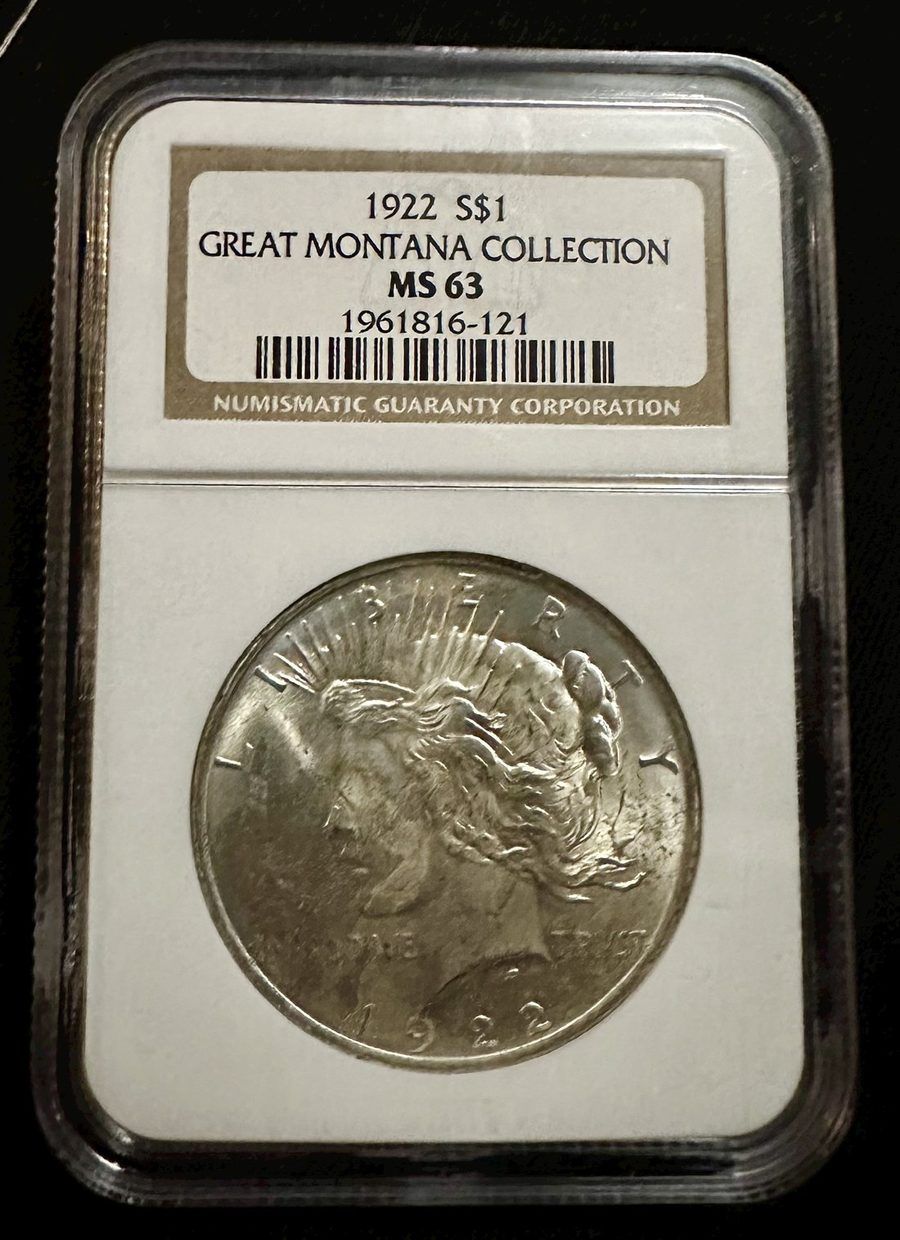
Mint State coins climb slowly at first. The great mass of surviving examples grades MS-63 and MS-64, and PCGS notes that MS-65 coins are not rare and the supply meets collector demand comfortably.
The change comes above that. In MS-66 the population drops off sharply, and in MS-67 the 1922 Philadelphia dollar becomes what PCGS calls an extreme condition rarity. Understanding how professional grading affects the value and collectibility of coins matters more here than on almost any other date, because the entire premium lives in two or three grade points.
What the Mint Mark Is Really Worth
In worn condition the mint mark barely moves the needle. All three issues are common, and 1922 D silver dollar value and 1922 S silver dollar value stay within a few dollars of Philadelphia coins in circulated grades.
In gem condition it decides everything. PCGS estimates that 75,000 Philadelphia coins survive in MS-65 or better, against 7,500 from Denver and roughly 1,000 from San Francisco.
That last figure is the one collectors chase. As of PCGS’s published assessment in August 2015, no 1922-S had ever been certified MS-67 or finer, and the finest examples known sit at MS-66 and MS-66+.
High Relief and the Varieties That Matter
The genuine rarities of 1922 come from the beginning of the year, before the relief was lowered. High relief coinage ran from January 5 to January 23, 1922, produced 35,401 business strikes, and stopped because the dies kept breaking. Essentially all of those coins were melted.
A few High Relief proofs survive, traditionally called matte proofs, and they are the first-year 1921 design carried one year further. PCGS estimates ten examples exist across all grades. No proofs of any kind were struck for the rest of the series.
Among ordinary 1922 coins, collectors look for die breaks and doubling: the die break in the reverse field that leaves a raised blob beneath the eagle, and the “ear ring” variety where a die crack arcs across Liberty’s ear. Some specimens also exist with the reverse rotated about 100 degrees from normal.
Silver Content and Melt Value
Each 1922 dollar weighs 26.73 grams at .900 fine, which works out to 0.7734 troy ounces of silver. With silver near $66 an ounce in September 2026, that is roughly $51 of metal.
This is the floor under 1922 silver dollar value today, and for most examples it is very close to the ceiling as well. When people report that their coin is “worth about $60,” they are describing the silver market rather than the coin.
Notable Auction Records
| Grade / Variety | Price Realized | Auction House | Sale Date |
|---|---|---|---|
| 1922 High Relief, matte proof, PR-67 (finest known) | $458,250 | Goldbergs | June 2014 |
| 1922 High Relief, matte proof, PR-66 | $329,000 | Heritage Auctions | January 2014 |
| 1922-D, MS-67 | $90,000 | Stack’s Bowers | August 2018 |
| 1922-D, MS-67 | $39,950 | Heritage Auctions | August 2015 |
| 1922, MS-67 | $35,250 | Stack’s Bowers | August 2014 |
| 1922, MS-67 | $11,163 | Heritage Auctions | August 2015 |
Two of those coins have a story attached. In February 1922, with newspapers still attacking the design and rumors circulating that the coin would be pulled, Director of the Mint Raymond T. Baker went on the record to end the speculation: there was no foundation, he said, for the report that Peace dollars would be withdrawn.
Baker kept examples for himself. They passed to his daughter, Yvonne Ranger, and from there into the market. The MS-67 that sold for $35,250 at Stack’s Bowers came out of that family holding, and so did the finest 1922 High Relief proof in existence, the $458,250 coin at the top of the table.
The man who publicly defended the Peace dollar against its critics owned the best ones that survive.
How to Assess Your 1922 Silver Dollar
Identification takes a few minutes and a good light. The steps below move from the easiest checks to the ones worth paying for.
Checking Key Features and the Mint Mark
- The specifications. An authentic coin measures 38.1mm across, weighs 26.73 grams, and has a reeded edge. A kitchen scale accurate to a tenth of a gram settles most questions on its own.
- The mint mark. Turn the coin over and look below the word ONE, just left of the eagle’s tail feathers. A “D” means Denver, an “S” means San Francisco, and no letter at all means Philadelphia. It should be sharp and cleanly placed.
- The strike. Look at Liberty’s hair above and behind her ear, then at the eagle’s breast and the high points of its wing. Sharp detail in both places is uncommon on Denver and San Francisco coins and adds real money when it appears.
- The surfaces. Tilt the coin under a single light source and look for the rotating cartwheel of original luster. Heavy bagmarks across Liberty’s cheek and the open fields are the usual reason an otherwise nice coin grades lower than its owner expects.
- The relief. Compare the design’s height against the flat, low-relief look of any other 1922 dollar. High relief coins are dramatically deeper, and finding one unattributed would be extraordinary.
Spotting Counterfeits and Common Fakes
Peace dollars are a frequent counterfeit target, and the tells are mostly physical. Fakes commonly miss the weight, since matching both the dimensions and the density of .900 silver is difficult and expensive.
Genuine coins ring with a clear sustained tone when balanced on a fingertip and tapped; base-metal copies produce a short dull thud. Lettering on counterfeits often looks soft or rounded where authentic coins are crisp, and the luster can appear greasy rather than showing the cartwheel effect.
None of these tests is conclusive alone. Together they catch the great majority of what circulates.
When Professional Appraisal Makes Sense
Certification is worth the fee when the money at stake exceeds it. That means any coin that appears to grade MS-65 or better, anything you suspect is a High Relief piece or a named variety, and anything whose authenticity you doubt after the checks above.
PCGS and NGC both authenticate and grade, and a certified holder makes a coin substantially easier to sell. For an inherited group rather than a single coin, Blanchard’s numismatists can evaluate a coin collection and identify which pieces justify the cost of grading.
What Collectors and Investors Watch
The 1922 Peace dollar occupies a useful position: common enough to be affordable, historic enough to be interesting, and silver-backed enough to have a floor. Circulated examples are a standard entry point for people getting started collecting rare coins on a budget.
The tradeoffs are real. Common-date coins move with the silver market rather than the collector market, so they behave more like bullion than like numismatic holdings. Physical coins carry storage and insurance costs. Condition rarities carry the opposite risk: they are illiquid, and the gap between MS-66 and MS-67 money is wide enough that a grading opinion can swing the value by an order of magnitude.
Counterfeits are common enough that provenance and third-party certification have become the practical dividing line between a collectible and a question mark. Blanchard sells Peace dollars graded and certified by the major services, which is the same standard any established dealer should meet. Buyers comparing options can work through Blanchard’s guide to rare and collectible coins before committing to a purchase.
Frequently Asked Questions
1. How much is a 1922 silver dollar worth today?
Most are worth close to their silver content, which is about $51 with silver near $66 an ounce in September 2026. NGC’s price guide placed circulated examples at $59 to $67 as of that month. Coins grading MS-65 and above carry genuine collector premiums, and the documented auction records for top-grade examples run from about $11,000 into six figures.
2. Where is the mint mark on a 1922 silver dollar?
On the reverse, below the word ONE and to the left of the eagle’s tail feathers. A “D” indicates the Denver Mint and an “S” indicates San Francisco. Philadelphia coins carry no mint mark at all, which is normal rather than an error, and they are the most common of the three.
3. What makes a 1922 Peace dollar rare?
Condition and relief, not date. With more than 84 million struck across three mints, no 1922 dollar is rare in circulated grades. The scarce coins are gem Mint State survivors, particularly from San Francisco, where PCGS estimates only about 1,000 examples exist above MS-65. The genuinely rare pieces are the High Relief strikes from January 1922, nearly all of which were melted.
4. Is there such a thing as a 1922 Liberty silver dollar?
No. The Morgan dollar, which collectors sometimes call a Liberty dollar because of its Liberty head design, ended production in 1921. Every 1922 silver dollar is a Peace dollar. It also shows Liberty in profile, which is where the confusion comes from, but the two designs are entirely different coins.
5. Why does my 1922 silver dollar say “TRVST” instead of “TRUST”?
That is deliberate, not a minting error. De Francisci used Latin lettering for the motto, and classical Latin inscriptions use V where modern English uses U. Every Peace dollar from 1921 to 1935 reads IN GOD WE TRVST, so the spelling adds nothing to the coin’s value.
6. How can I tell if I have a High Relief 1922 Peace dollar?
Compare the depth of the design against an ordinary 1922 coin: high relief pieces have noticeably deeper, more sculpted detail, especially in Liberty’s hair and the eagle’s feathers. Only 35,401 were struck, in January 1922, and essentially all were melted, so an unattributed example turning up is extremely unlikely. Any candidate should go to PCGS or NGC before you act on it.
Conclusion
1922 silver dollar value comes down to three questions in order: what grade the coin is, which mint struck it, and whether it is one of the January high relief pieces. For the overwhelming majority the answer stops at the first question, and the coin is worth its silver plus a modest premium.
The exceptions are worth knowing precisely because they are so concentrated. The gap between a common MS-64 and a condition-census MS-67 is the difference between a $70 coin and a $35,000 one, and the mint mark that means almost nothing in worn condition becomes the deciding factor at the top of the scale.
Check the weight, find the mint mark, judge the strike and the surfaces, and get a professional opinion when the numbers justify it.
Ready to add a certified Peace dollar to your collection? Explore Blanchard’s inventory of rare and collectible coins to find authenticated examples with the grading and provenance that protect long-term value.
Want to read more? Subscribe to the Blanchard Newsletter and get our tales from the vault, our favorite stories from around the world and the latest tangible assets news delivered to your inbox weekly.
About The Author