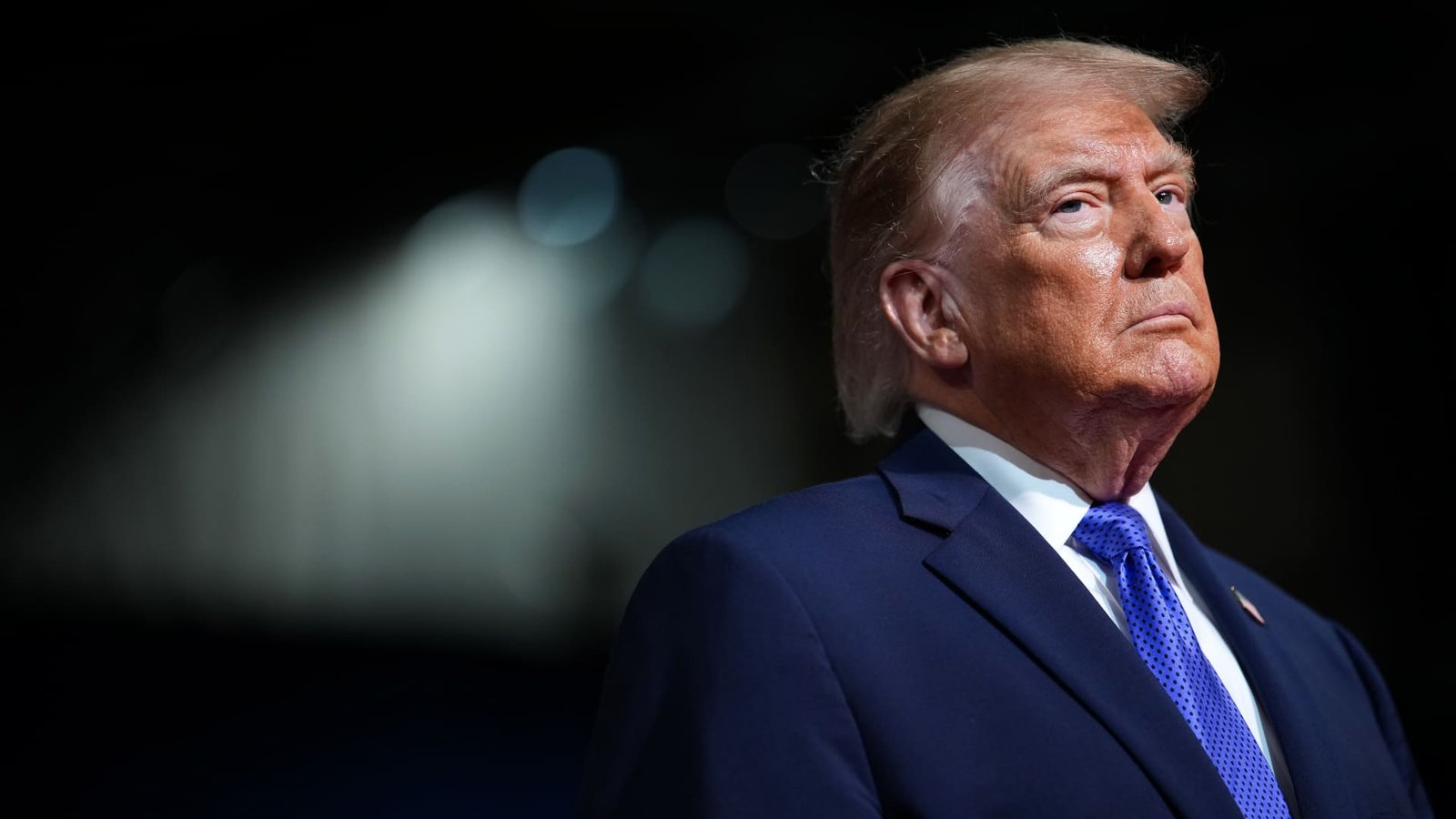
U.S. President Donald Trump arrives to deliver remarks during a campaign rally at the Rock Hill Sports and Event Center on October 29, 2026 in Rock Hill, South Carolina.
Andrew Harnik | Getty Images News | Getty Images
The stock market skyrocketed on Wednesday on the heels of a decisive sweep for Democrats in the 2026 midterm elections. But that was not necessarily the only driver of the climb.
“President Trump’s acknowledgement of the Democrats’ victory in the midterms and his expressed openness to collaborating with the opposition have helped markets to rally on hopes that contestation of the results and more adverse polarization can be avoided,” said Thomas Hempell, Generali Investments senior economist.
Trump told The New York Times and The Wall Street Journal overnight Tuesday that he accepted the results and would work with Democrats. Those headlines coincided with a rebound in stock market futures.
In the lead-up to this year’s midterms, some on Wall Street grew increasingly concerned about the prospect of Trump contesting the election results. The Department of Justice’s Alaska election lawsuit led to fears over delays with the outcome that would exacerbate the uneasiness in the market that’s typically removed once the elections conclude.
CNBC’s Fed Survey showed that among 30 fund managers, strategists and economists, 63% believe that the extended uncertainty around the balance of power created by legal challenges to the election results posed “some” market risk. That was a slight increase from 61% in September. Additionally, 14% believed it represented “significant” market risk, which was up from 7%.
Now, investors are breathing a sigh of relief over Trump’s acceptance of the results, which should “act as a break on extreme policy outcomes and bring down risk premia,” so long as the president’s decision remains, said George Saravelos, head of FX Research at Deutsche Bank.
‘An X factor’
Trump has a history of rallying markets, as well as driving them lower, with his announcements. Jay Woods of Freedom Capital Markets, who noted that the rebound in stocks overnight was partially due to the president’s “initial tone and reaction to the results,” said the focus will shift to whether Trump’s latest move will actually have staying power.
“I think Trump is going to try to do and say the right thing, but at two in the morning, he may change his mind,” the chief market strategist said. “He is an X factor.”
Woods added that he’s “encouraged” by Wednesday’s massive rally, but he noted that there are still headwinds that could plague the market over the coming weeks — such as concerns about inflationary pressures as a result of higher energy prices from the conflict in the Middle East.
“How Trump reacts to it will help us navigate those headwinds,” he said.
If Trump “continues to play nice” with Democrats, Osaic’s Philip Blancato believes the market is going to have a “very strong” end to the year.
Stocks historically tend to rally after the midterms anyway, but this time around, some were worried the solid run-up in the S&P 500 this year was going to potentially hinder those gains. After Trump’s reaction, Blancato doesn’t think the S&P 500 hitting 8,000 by year-end is totally out of the question, saying there’s “a lot predicated on him, but not completely.”
The broad market index gained more than 1% on Wednesday, with its closing price implying a roughly 4% gain to that level.
However, investors should be prepared for any future volatility if his rhetoric does not remain the same, the chief market strategist cautioned.
“The president’s always going to be a wildcard,” he said. “Let’s not let one day make a year. This is an instant reaction to this thing. There’s still plenty of things to be hashed out.”
About The Author