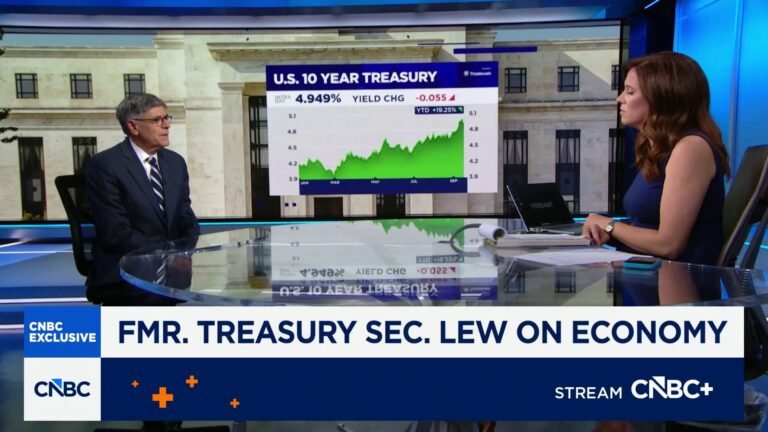
A breakout in the 10-year Treasury yield could hold back stocks if it reaches this level

A break above 5% on the 10-year Treasury yield could spell trouble for stocks – and put the artificial intelligence trade under particular pressure, according to Breakout Capital founder Ruchir Sharma. “If we do move into a new interest rate regime, where we decisively break 5% on the 10-year …, I think that will pose a problem for equity markets in general and the AI trade,” Sharma said on CNBC Thursday. Sharma, also the chief investment officer of Breakout Capital, called the 10-year Treasury “the most important asset in the world,” since it directly influences stock market valuations while setting the baseline for mortgage, auto loans and other borrowing costs across the economy. Once the 10-year yield moves above 5%, the relationship between stocks and bonds changes, Sharma said, pointing to historical data showing that the equity-bond correlation becomes positive. “For any yield above 5.25%, equity prices go down,” he said. Higher discount rate High bond yields pressure stocks by increasing the discount rate investors apply to future profits, making those earnings – and therefore the stocks – less valuable today. The 10-yr Treasury yield touched 5% earlier this week, eventually touching a 19-year high. The benchmark yield pulled back Thursday, dropping 5 basis points to 4.94%. High oil prices stemming from the Middle East war and record prices for diesel have been among the many factors driving yields higher lately. Last week, Brent crude, the global benchmark, rose above $100. Supply shocks in energy inventories are escalating inflation worries just as the Federal Reserve is trying to restore price stability. Inflation has surpassed the central bank’s 2% target for five years. The Fed raised the federal funds rate by a quarter percentage point to 3.75% to 4% Wednesday in an effort to tighten moenetary policy and quell higher prices. Policymakers signaled another hike could come later this year, with Fed Chairman Kevin Warsh saying inflation remains too stubbornly high. Complication The prospect of persistent inflation creates another complication for stocks. The Fed said it sees inflation remaining above its 2% target until 2029 , suggesting the chance that rates will have to be hiked further. Sharma said major market booms or bubbles have typically ended the same way, “when interest rates go up and monetary tightening” takes hold. Above 5%, the government’s fiscal backdrop also darkens because of the cost of servicing more than $40 trillion in debt “If the 10-year gets unhinged … that’s when you end up getting problems,” Sharma said. “The government’s balance sheet today is three times as bloated as it was in the 1990’s,” when it posed less competition for corporate borrowers in the bond market at a time when corporate issuance skyrocketed as a result of the dot-com boom. Today, mega-cap AI companies are tapping the bond market as AI infrastructure spending eatis into their free cash flows. While earnings from tech companies continue to be strong, Goldman Sachs wrote, “the combination of higher cost of capital and greater capital intensity in the tech sector has reduced the value of their future cash flows,” in a note to clients Thursday. Consequently, their forward stock valuation as measured by price-to-earnings, is close to the average of the rest of the market, Goldman said. Still, Sharma noted one important difference from past periods of market stress: corporate balance sheets are in better shape today than in the 1990’s.