- The Australian Dollar holds losses after the People’s Bank of China decided to leave its Loan Prime Rates unchanged.
- US Treasury Secretary Scott Bessent said that discussions between Washington and Beijing are progressing smoothly.
- Trump said that the US will not deploy troops to enforce a potential Ukraine peace deal.
The Australian Dollar (AUD) edges lower against the US Dollar (USD) on Wednesday, extending its losses for the third consecutive session. The AUD/USD pair remains subdued after the People’s Bank of China (PBOC) announced to leave its one- and five-year Loan Prime Rates (LPRs) unchanged at 3.00% and 3.50%, respectively.
US Treasury Secretary Scott Bessent said late Monday that the talks between the United States (US) and China are going well, adding that he expects US growth to pick up in the fourth quarter (Q4). Bessent further noted that the current arrangement with China is highly effective, as the country remains the largest contributor to tariff revenue.
The AUD/USD pair also struggles as the US Dollar (USD) extends its gains amid geopolitical developments. White House press secretary Karoline Leavitt announced on Tuesday that plans for a bilateral meeting between Russian President Vladimir Putin and Ukrainian President Volodymyr Zelenskyy are now underway, according to CNN.
Australian Dollar declines as US Dollar strengthens on Ukraine-Russia peace hopes
- The US Dollar Index (DXY), which measures the value of the US Dollar against six major currencies, is gaining ground for the third successive day and trading around 98.30 at the time of writing. Traders await the Jackson Hole Economic Policy Symposium, with Fed Chair Jerome Powell’s speech for guidance on a September policy decision.
- US President Donald Trump said on Tuesday that there won’t be American troops on the ground to help enforce a potential peace deal in Ukraine. The terms of security guarantees are still being negotiated between the US, European partners, and Ukraine.
- Ukraine’s President Volodymyr Zelenskyy late Monday emphasized the need for genuine peace and welcomed US involvement in security guarantees. Zelenskyy also confirmed major US arms purchase plans. Furthermore, US Secretary of State Marco Rubio said on Tuesday that he would work with European allies and non-European countries on security guarantees for Ukraine.
- The Trump administration has broadened its 50% tariffs on steel and aluminum imports, taking effect on August 18. Friday’s notification has included 407 new product codes in the US Harmonized Tariff Schedule. US President Donald Trump also told reporters he intends to issue further announcements on steel tariffs, along with new levies aimed at semiconductor imports.
- Recent US economic data keeps intact the dovish tone surrounding the US Federal Reserve’s (Fed) policy outlook. CME’s FedWatch tool suggests that markets are pricing in 86.5% odds of a 25-basis-point Fed rate cut in September.
- Australia’s Westpac Consumer Confidence surged 5.7% in August to 98.5, following a 0.6% increase in July. The sentiment has reached a high since February 2022, as the Reserve Bank of Australia (RBA) has delivered rate cuts totaling 75 basis points since January. Matthew Hassan, Head of Australian Macro-Forecasting, said the prolonged period of consumer pessimism may be coming to an end, although maintaining momentum could require additional easing. However, he emphasized that policymakers are under no immediate pressure to deliver further cuts.
- The Reserve Bank of Australia (RBA) delivered a 25 basis points (bps) interest rate cut on Tuesday, as widely expected, bringing the Official Cash Rate (OCR) to 3.6% from 3.85% at the August policy meeting.
Australian Dollar bears target two-month lows near 0.6400
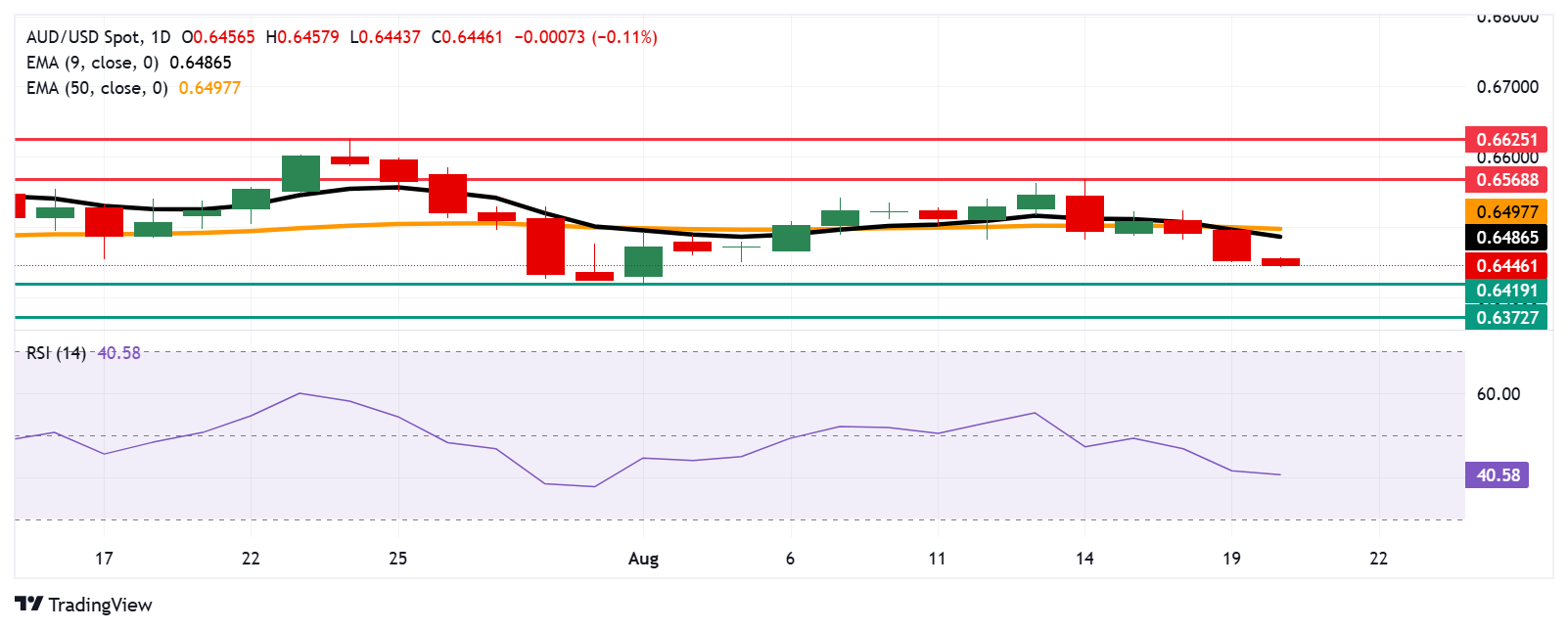
AUD/USD is trading around 0.6450 on Wednesday. The technical analysis on the daily chart indicates that short-term price momentum is weakening as the pair remains below the nine-day Exponential Moving Average (EMA). Additionally, the 14-day Relative Strength Index (RSI) is positioned below the 50 level, suggesting that market bias is bearish.
On the downside, the AUD/USD pair may explore the area around the two-month low of 0.6419, recorded on August 1, followed by the three-month low of 0.6372.
The AUD/USD pair may target the primary barrier at the nine-day EMA at 0.6486, followed by the 50-day EMA at 0.6497. A break above this crucial resistance zone could improve the short- and medium-term price momentum and support the pair to target the monthly high at 0.6568, reached on August 14, followed by the nine-month high of 0.6625, which was recorded on July 24.
AUD/USD: Daily Chart
Australian Dollar PRICE Today
The table below shows the percentage change of Australian Dollar (AUD) against listed major currencies today. Australian Dollar was the weakest against the Japanese Yen.
| USD | EUR | GBP | JPY | CAD | AUD | NZD | CHF | |
|---|---|---|---|---|---|---|---|---|
| USD | 0.10% | 0.13% | 0.04% | 0.04% | 0.28% | 1.17% | 0.07% | |
| EUR | -0.10% | 0.02% | -0.19% | -0.06% | 0.20% | 0.99% | -0.05% | |
| GBP | -0.13% | -0.02% | -0.16% | -0.08% | 0.12% | 0.88% | -0.05% | |
| JPY | -0.04% | 0.19% | 0.16% | 0.12% | 0.34% | 1.21% | 0.26% | |
| CAD | -0.04% | 0.06% | 0.08% | -0.12% | 0.26% | 1.13% | 0.03% | |
| AUD | -0.28% | -0.20% | -0.12% | -0.34% | -0.26% | 0.77% | -0.17% | |
| NZD | -1.17% | -0.99% | -0.88% | -1.21% | -1.13% | -0.77% | -1.01% | |
| CHF | -0.07% | 0.05% | 0.05% | -0.26% | -0.03% | 0.17% | 1.01% |
The heat map shows percentage changes of major currencies against each other. The base currency is picked from the left column, while the quote currency is picked from the top row. For example, if you pick the Australian Dollar from the left column and move along the horizontal line to the US Dollar, the percentage change displayed in the box will represent AUD (base)/USD (quote).
Australian Dollar FAQs
One of the most significant factors for the Australian Dollar (AUD) is the level of interest rates set by the Reserve Bank of Australia (RBA). Because Australia is a resource-rich country another key driver is the price of its biggest export, Iron Ore. The health of the Chinese economy, its largest trading partner, is a factor, as well as inflation in Australia, its growth rate and Trade Balance. Market sentiment – whether investors are taking on more risky assets (risk-on) or seeking safe-havens (risk-off) – is also a factor, with risk-on positive for AUD.
The Reserve Bank of Australia (RBA) influences the Australian Dollar (AUD) by setting the level of interest rates that Australian banks can lend to each other. This influences the level of interest rates in the economy as a whole. The main goal of the RBA is to maintain a stable inflation rate of 2-3% by adjusting interest rates up or down. Relatively high interest rates compared to other major central banks support the AUD, and the opposite for relatively low. The RBA can also use quantitative easing and tightening to influence credit conditions, with the former AUD-negative and the latter AUD-positive.
China is Australia’s largest trading partner so the health of the Chinese economy is a major influence on the value of the Australian Dollar (AUD). When the Chinese economy is doing well it purchases more raw materials, goods and services from Australia, lifting demand for the AUD, and pushing up its value. The opposite is the case when the Chinese economy is not growing as fast as expected. Positive or negative surprises in Chinese growth data, therefore, often have a direct impact on the Australian Dollar and its pairs.
Iron Ore is Australia’s largest export, accounting for $118 billion a year according to data from 2021, with China as its primary destination. The price of Iron Ore, therefore, can be a driver of the Australian Dollar. Generally, if the price of Iron Ore rises, AUD also goes up, as aggregate demand for the currency increases. The opposite is the case if the price of Iron Ore falls. Higher Iron Ore prices also tend to result in a greater likelihood of a positive Trade Balance for Australia, which is also positive of the AUD.
The Trade Balance, which is the difference between what a country earns from its exports versus what it pays for its imports, is another factor that can influence the value of the Australian Dollar. If Australia produces highly sought after exports, then its currency will gain in value purely from the surplus demand created from foreign buyers seeking to purchase its exports versus what it spends to purchase imports. Therefore, a positive net Trade Balance strengthens the AUD, with the opposite effect if the Trade Balance is negative.
About The Author