Hello, this is Priyanka Salve, writing to you from Singapore.
Welcome to the latest edition of “Inside India“— your one-stop destination for stories and developments from the world’s fastest-growing large economy.
Indian tycoon Mukesh Ambani, whose plans to launch satellite communications and dominance over the Indian telecom market have drawn the ire of Elon Musk last week, has a more pressing worry.
Jio Platforms, the company at the center of Musk’s remarks, is coming up with a record IPO issue soon, but its valuation demands have met with pushback from investors who seem unconvinced of the company’s positioning as a tech business.
Any thoughts on today’s newsletter?Share themwith the team.
The big story
Indian billionaire Mukesh Ambani’s telecom and digital services business Jio Platforms, which was called “monopolistic” by Starlink founder Elon Musk last week, has lowered its valuation ahead of its initial public offering next week.
Jio Platforms is the largest telecom operator in India with over half a million subscribers but has been positioning itself as a tech company and not just a traditional utility provider, experts told CNBC, but disagreed on whether these demands were valid.
Jio Platforms’ IPO will raise up to 302 billion rupees (nearly $3.2 billion) at a price band of 1,065 rupees to 1,119 rupees per share, its parent company Reliance Industries said in a stock filing on Wednesday. This values the company at around $108 billion—lower than the valuations of over $130 billion floated a year ago.
Jio’s enterprise valuation has shrunk to $118 billion from the $133 billion expected earlier, global brokerage Nomura said in a report on Sunday based on Bloomberg news last week that revealed the IPO pricing details.
Reliance Industries, the parent company of Jio Platforms, did not respond to CNBC’s emails seeking comments.
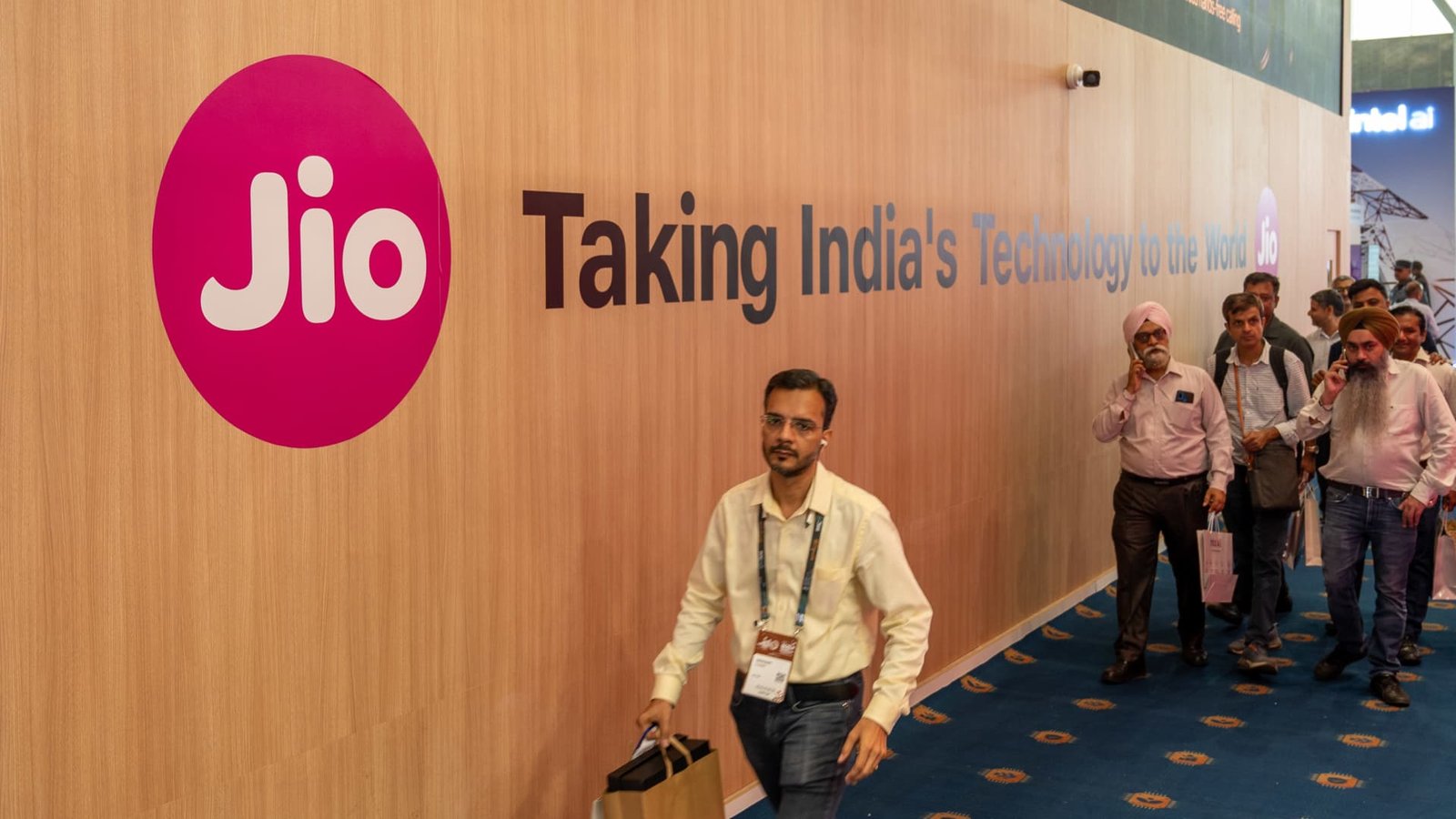
NEW DELHI, INDIA – 2026/10/09: Visitors pass by the Jio logo, (representing Reliance Jio Infocomm Limited, a telecommunications and digital services provider in India), during the 10th edition of India Mobile Congress (IMC) 2026 at Yashobhoomi India International Convention and Expo Centre.
Sopa Images | Lightrocket | Getty Images
An equity valuation of $108 billion places Jio lower than India’s second-largest telecom company Bharti Airtel, which currently trades at a market capitalization of over $117 billion, as per LSEG data.
“Following its listing, Jio will likely need to demonstrate growth to public shareholders,” the report said, adding that the era of “easy subscriber gains” is ending and tariff hikes are likely to become “the primary driver of earnings growth.”
As per the information shared in Jio Platforms’ IPO papers, the company’s ARPU was 214 rupees ($2.25) per month while that of its competitor Airtel was 257 rupees for mobile, 527 rupees for home internet and 158 rupees for digital TV services.
Based purely on average revenue per user, a key metric for telecom companies, Jio’s discount to Airtel seems justified, but Jio wants to be seen as a tech company and not just a utility player.
Tech or telecom?
Through the IPO, Jio Platforms plans to clear off its legacy telecom debt, which will free up internal cash flows for its second phase of growth, according to Neil Shah, a partner at Counterpoint Research.
Jio plans to use the funds raised by the IPO to pay off its telecom business debt of 275 billion rupees, according to its IPO papers.
The next phase of investment will involve funding the company’s “gigawatt-scale green AI infrastructure” and low-earth-orbit satellite network, Shah said, placing it in the realm of tech businesses.
He pointed out that global tech majors like Meta and Google, which hold nearly 10% and 8% stakes respectively in Jio, are not exiting their investments via the IPO—proving their willingness to wait for the next phase of growth.
During the company’s annual shareholder meeting in June, Ambani told shareholders that Jio will “demonstrate to the world that India can build technology companies of global scale, global capability, and global value.”
He highlighted that, as per the World Intellectual Property Organization, Jio Platforms’ ranking in terms of “velocity of innovation through patents” jumped to 20 from 340 a year ago.
This was also when Ambani announced Jio Platforms’ plan to enter the satellite communication space in India, an area that has drawn interest from Musk’s Starlink. Last week, Musk said that his company has spent “five years complying with every single law and requirement” of the government and blamed Ambani for the delays in the launch of Starlink.
But even as the world’s first trillionaire and India’s second-richest businessman contest to provide internet to the remote areas of India, some experts are not convinced Jio Platforms has enough to be defined as a tech company.
Jio Platforms wants tech prices, but they have “no product expertise” as of now, Anurag Singh, managing partner and founder of U.S. based Ansid Capital, told CNBC.
He added that while Indian investors may buy Jio’s tech pitch due to lack of choice, “global investors won’t.” For now, Reliance is a utility company and will need significant investment to transform into a tech player, Singh said.
Need to know
As ‘Cockroach’ protests grow over alleged voter fraud, Modi defends India as ‘mother of democracy’
Prime Minister Narendra Modi on Tuesday defended India as a “mother of democracy,” as protests demanding the resignation of Chief Election Commissioner Gyanesh Kumar over alleged voter fraud are intensifying.
India calls JD Vance’s comments about immigrants ‘deeply offensive’
India on Friday called comments by U.S. Vice President J.D. Vance about immigrants from the country “deeply offensive”. A day earlier, Vance said that foreign and local companies “cannot lay off American workers and then replace them with foreign indentured servants.”
India’s retail inflation jumps to 5.54% in September, above estimates
India’s headline inflationrose to 5.54% in September from 4.82% in August, adding pressure on the country’s central bank to further tighten monetary policy. The consumer price index print was slightly above economists’ expectations of 5.40%
The Indian billionaire investing in Trump’s refinery project is also buying more Venezuelan crude
Indian billionaire Mukesh Ambani’s Reliance Industries, which is investing in a historic U.S. oil refinery project proposed by President Donald Trump, has now emerged as the biggest buyer of Venezuelan crude outside the U.S.
Coming up
Oct. 15: India unemployment data for September
Oct. 21: Jio Platforms IPO opens
About The Author