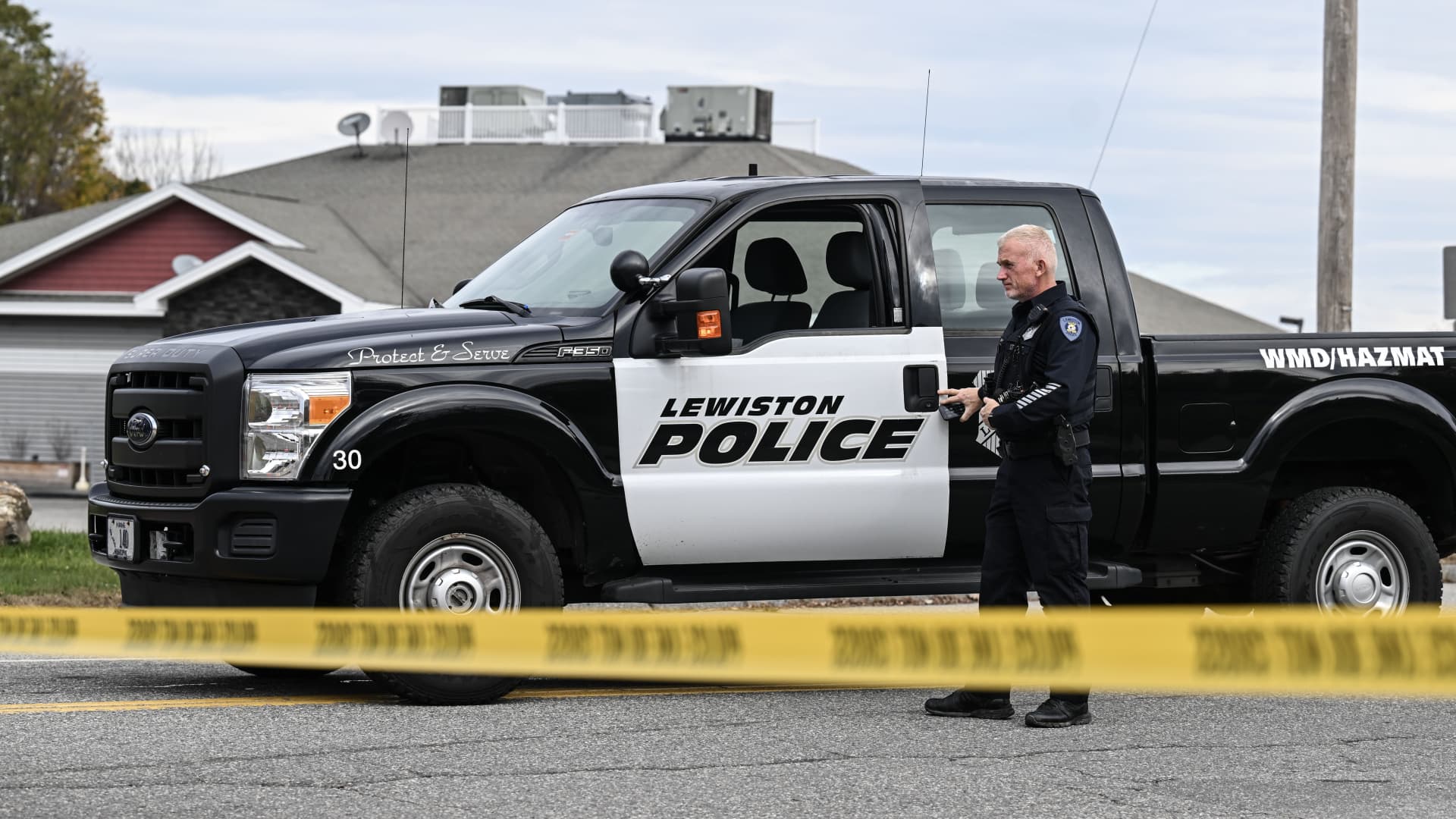
Security forces take measures at the site where at least 18 people were killed and 13 injured in a mass shooting in Maine, United States on October 26, 2023.
Fatih Atkas | Anadolu Agency | Getty Images
Families of the victims of a2023 mass shootingin Maine and dozens of survivors intend to file a negligence lawsuit Wednesday against the U.S. government,alleging the military and others failedto respond to warning signs and a threat by the gunman, who was an Army reservist.
Robert Card, 40, killed 18 people ata bowling alleyanda barin Lewiston, setting off a two-day manhunt that ended when he died by suicide, authorities said.
The approximately 100 plaintiffs are expected to name the Defense Department, the Army and Keller Army Community Hospital in West Point, New York, in the suit, which a team of four law firms is set to file in federal court in Maine.
“The Army repeatedly broke its promise to protect the community that it pledges to defend and must be held responsible,” Maine attorney Travis Brennan said in a statement.
Benjamin Gideon, another lawyer in Maine representing plaintiffs, added that “it’s hard to imagine the Army ever accepting accountability without being forced to do so in court.”
The law firms served legal notices of their intention to sue in October. The lawyers said the Army had multiple opportunities to intervene in Card’s case but did not, including as early as May 2023, when his son reported that his father’s mental health appeared to be deteriorating and his behavior was erratic.
The Justice and Defense departments and the Army could not immediately be reached for comment about the planned complaints. They previously declined to comment on the legal notices.
National Trial Law, a law firm in Texas, is working with two Maine law firms to represent the plaintiffs. The firm represented survivors and families ofthose killed in the 2017 church shooting in Sutherland Springs, Texas,committed by an Air Force service member. The federal government was found partly liable in that case, and the survivorsagreed to settlein 2023 after the Justice Department appealed.
The legal cases in Maine are similarly focused on the federal government and actions taken by military members.
Despite the apparent warning signs, a definitive motive for the rampage in Lewiston remains unclear. Card’s family has said that heclaimed to have been hearing voicesmonths before when he was fitted for high-powered hearing aids and that he hadgrown increasingly paranoid.
A month after the shootings, anindependent commissionwas formed toinvestigate itand scrutinize any lapses by the military, law enforcement andCard’s family.
The commission’s report and the military investigations shed light on possible failures.
The military’s internal report said Card’s unitfailed to follow certain proceduresafter he was involved in a shoving incident with another reservist in July 2023, leading him to be hospitalized for two weeks in a psychiatric unit at a civilian hospital. At the time, his reported symptoms included psychosis and homicidal ideations, and he had created a “hit list,” according to the military’s investigation.
The Army then prohibited Card from having access to weapons on duty.
A separateindependent report by the state commissionconcluded that while the gunman was solely responsible for his conduct, there were missteps. Leaders of Card’s unit “failed to undertake necessary steps to reduce the threat he posed to the public,” such as ignoring “strong recommendations” from his mental health providers to stay engaged with his care and ensure any weapons in his home were removed.
The commission also found that his unit “neglected to share” all the information it had about past threats with the local sheriff’s office.
In addition, the commission said, medical staff members at Keller Army Community Hospital, where Card was initially evaluated three months before the shootings, failed to file a so-called SAFE Act notice. The report is used to alert authorities when people may be dangers to themselves or others.
The military and independent commission reports also detailed how Card’s family alerted a Sagadahoc County sheriff’s sergeant about hisdeteriorating mental health. The report further said that law enforcement agencies had probable cause to initiateMaine’s “yellow flag” law, which allows them to confiscate people’s firearms if they are believed to be threats to themselves or others, but that that was never done.
Sagadahoc County Sheriff Joel Merry said after the shootings that the Army Reserve did inform his department thatCard threatenedto “shoot up” the National Guard base in Saco, Maine. Merry said he distributed a statewide alert to law enforcement agencies after deputies sent to Card’s home in Bowdoin could not find him.
Investigators also looked at whether Card’sexposure to low-level blastsas a hand grenade instructor in the military was tied to the“severe” traumatic brain injury that researchers found evidence oflast year. The military denied in its report that any brain-related injury was linked to his service.
The law firms had previously said they were focusing on the federal government and not local law enforcement because the Army had access to the most critical information about Card’s state of mind and could have helped ensure he did not have access to firearms.
Card’s unit failed to conduct a required “line of duty investigation,” which would have documented the condition of his mental state, the Army acknowledged in its internal report.
Card’sfamily told NBC Newsa year after the shootings that they supported further research of military service members’ brains. They alsolaunched a nonprofit organization, Rising Over Brokenness, to focus on mental health awareness and brain injuries among service members.
If you or someone you know is in crisis, call or text 988 or go to988lifeline.org, to reach the Suicide & Crisis Lifeline. You can also call the network, previously known as the National Suicide Prevention Lifeline, at800-273-8255or visitSpeakingOfSuicide.com/resources.
About The Author