(WO) — Strohm has completed a joint industry program with Petrobras and Shell to qualify its thermoplastic composite pipe (TCP) flowline technology for ultra-deepwater operations, clearing the way for a planned Petrobras pilot in Brazil’s pre-salt in early 2027.

The program included full-scale qualification and offshore field trials designed to demonstrate the TCP system under conditions representative of Brazil’s pre-salt fields, where high CO₂ concentrations can present corrosion challenges for conventional flexible flowlines.
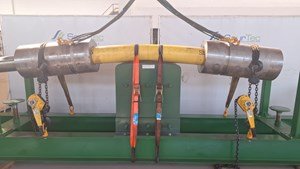
DNV qualified Strohm’s 6-in. carbon fiber-PA12 TCP for water-alternating-gas (WAG) injection service for enhanced oil recovery in accordance with DNV-ST-F119. The qualification covered the pipe, end fittings and sealing interfaces and is designed for a 30-year service life.
The program involved more than 50,000 testing hours, including material, sealing and full-scale testing. More than 40 full-scale tests were conducted across seven laboratories and certified testing facilities in Europe and Brazil.
“The project has great strategic relevance for the subsea sector in Brazil and beyond, as it decisively solves one of the major pipeline integrity challenges identified in recent years: the risk of stress corrosion cracking in environments with a high CO₂ concentration,” Strohm CEO Martin van Onna said.
Following the DNV qualification, Strohm completed offshore field trials in July 2026, including deep immersion performance tests and subsea vertical connection tests. The trials evaluated the flowline’s performance during offshore handling, installation and subsea connection.
The non-metallic TCP technology is designed to eliminate corrosion while offering lower weight and improved fatigue performance compared with steel. Strohm said the flowline can be deployed using existing installation vessels without significant changes to standard installation procedures.
Completion of the qualification and offshore trials represents the final stage ahead of Petrobras’ planned installation and operation of a pilot TCP flowline at a Brazilian pre-salt field in early 2027.
About The Author