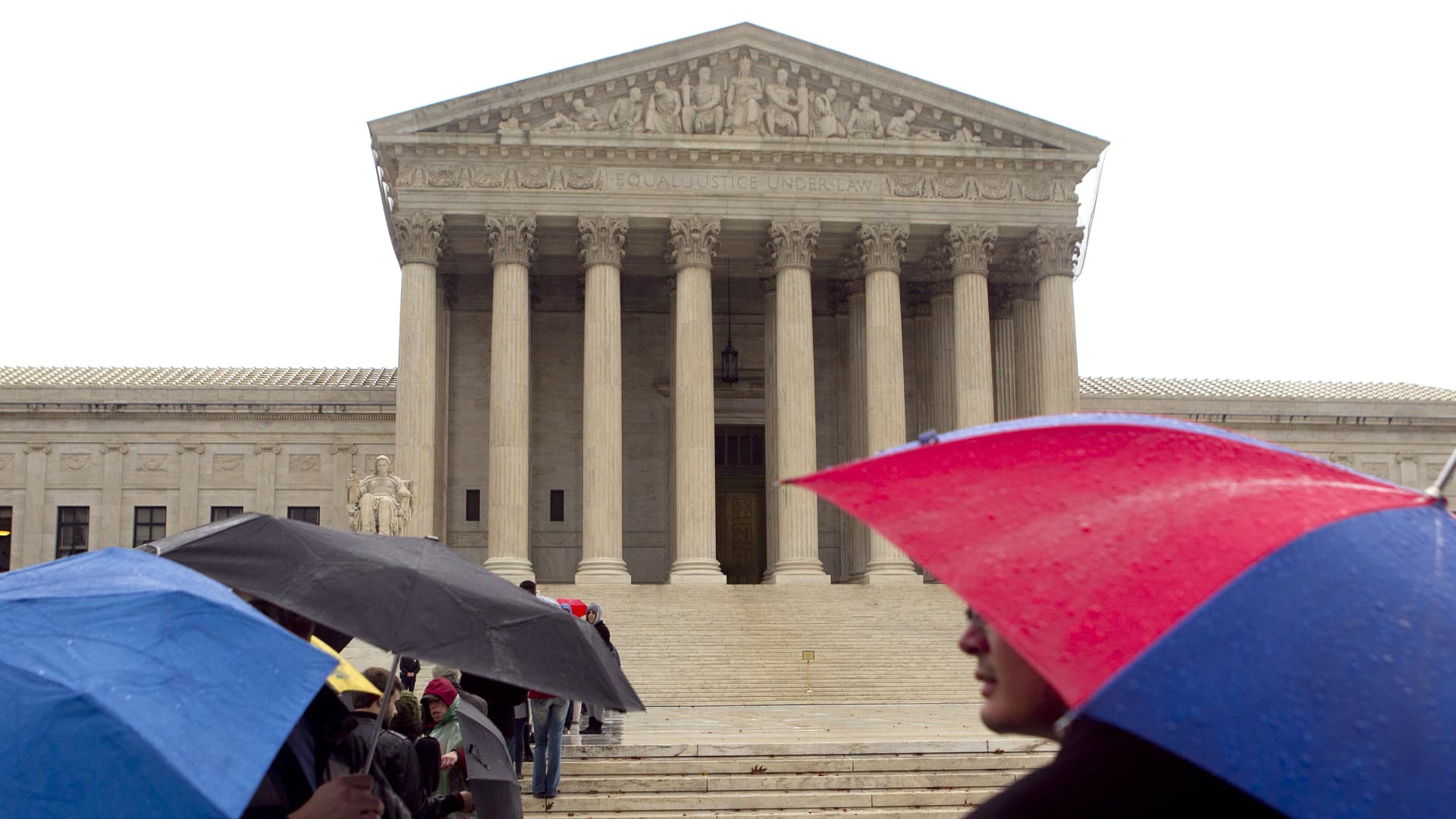
People with umbrellas line up outside the Supreme Court building in Washington, D.C., U.S. on Wednesday, Dec. 1, 2010. The U.S. Supreme Court refused this week to revive Tiffany & Co.’s bid to hold EBay Inc. accountable for sales of counterfeit goods on its auction website.
Andrew Harrer | Bloomberg | Getty Images
TheU.S.SupremeCourtagain cleared the way on Friday forDonald Trump’s administration to revoke a temporary legal protection for hundreds of thousands of Venezuelan migrants in the United States, backing a key priority of the Republican president as he pursues a policy of mass deportations.
The justices granted the administration’s request to put on hold a judge’s ruling that Homeland Security Secretary Kristi Noemlacked the authorityto end the Temporary Protected Status, or TPS, granted to the migrants under Trump’s Democratic predecessor Joe Biden while litigation proceeds.
TheSupremeCourtpreviously sided with the administration in May to lift a temporary order that San Francisco-based U.S. District Judge Edward Chen issued at an earlier stage of the case that had halted the TPS termination while the litigation played out incourt. Chen issued a final ruling on September 5, finding that Noem’s actions to terminate the program violated a federal law that governs the actions of federal agencies.
The judge also faulted Noem’s “discriminatory statements” concerning the Venezuelans, noting that her generalization of the alleged crimes of a few migrants “to the entire population of Venezuelan TPS holders who have lower rates of criminality and higher rates of college education and workforce participation than the general population is a classic form of racism.”
Chen’s ruling meant that more than 300,000 Venezuelan TPS holders would be able to remain in the country for now, even though Noem had determined that to be “contrary to the national interest,” according to the administration.
Trump has made cracking down on immigration – legal and illegal – a central plank of his second term as president, and has moved to strip certain migrants of temporary legal protections, expanding the pool of possible deportees.
The TPS program is a humanitarian designation under U.S. law for countries stricken by war, natural disaster or other catastrophes, giving recipients living in the United States deportation protection and access to work permits.
The U.S. government under Biden designated Venezuelans as eligible for TPS in 2021 and 2023. Just days before Trump returned to office in January, Biden’s administration announced an extension of the program to October 2026.
Noem, a Trump appointee, rescinded that extension and moved to end the TPS designation for a subset of Venezuelans who had benefited from the 2023 designation.
The San Francisco-based 9th U.S. CircuitCourtof Appeals declined to put Chen’s final ruling on hold, prompting criticism from the administration, which said it amounted to defiance of theSupremeCourtgiven the prior action by the justices in the case.
“This case is familiar to thecourtand involves the increasingly familiar and untenable phenomenon of lowercourts disregarding thiscourt’s orders on the emergency docket,” the Justice Department told theSupremeCourtin its filing.
Some lowercourts have expressed confusion andfrustrationin recent weeks as they attempt to followSupremeCourtemergency orders that often are issued with little or no legal reasoning presented.
“Thiscourt’s orders are binding on litigants and lowercourts. Whether those orders span one sentence or many pages, disregarding them – as the lowercourts did here – is unacceptable,” the Justice Department said.
In another case, theSupremeCourton May 30 let the administrationrevokea different type of temporary legal status for hundreds of thousands of Venezuelan, Cuban, Haitian and Nicaraguan migrants. The justices put on hold another judge’s order that had halted the administration’s move to end the immigration “parole” granted under Biden to 532,000 of these migrants while a legal challenge played out.
Immigration parole is a form of temporary permission under U.S. law to be in the country for “urgent humanitarian reasons or significant public benefit,” allowing recipients to live and work in the United States.
About The Author