

 You don’t shop for homeowner’s insurance while the roof is on fire. You buy it when the sky is clear, so it’s there when you need it. Gold can help you in the same way. Gold ownership is one of the oldest forms of financial insurance, and history suggests the best time to accumulate it is before a recession starts, not after the economy tanks. Let’s look at some history and see how gold acted during the last three recessions of this century.
What Is a Recession, and Who Decides?
First off, a recession is a period of time when the gross domestic product (GDP) of the U.S. economy shrinks instead of growing. Businesses sell less, companies cut jobs, and people spend less.
You may have heard that a recession is defined by two quarters of falling GDP in a row. That is the typical rule of thumb. However, the official call comes from the National Bureau of Economic Research (NBER), a private group of economists. Their business cycle committee looks at jobs, income, spending, and production, then decides when a recession began and ended. They usually announce it months after the recession has already started. So, by the time a recession is official, the damage to your portfolio will probably already be done.
Three Recessions This Century, Three Gold Rallies
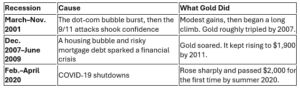
In each case, the causes of the recession were different, including a tech bubble, a housing bubble, and a pandemic. But when financial and economic crises hit, investors turn to the safety of gold.
What Happens to Stocks in a Recession?
The numbers are sobering. The S&P 500 lost about 50% of its value from 2000 to 2002 in the Dot.com market crash. The S&P 500 crashed about 57% during the 2008 Global Financial Crisis. Then, in early 2020, it lost around a third of its value in about a month.
If your retirement savings are mostly in stocks, a recession can erase years of gains in weeks or months.
How Gold Protects You
Gold doesn’t depend on company profits, sales, Federal Reserve policy or any government actions. Gold isn’t someone else’s debt or promise. It’s a tangible, physical asset that you can hold in your own hand and that has been valued for thousands of years. When confidence in stocks, banks, or the economy slides, time and time again, investors pile into the safety of gold and the price climbs.
Gold is a proven and effective portfolio diversifier. That simply means it behaves differently than other investments. So when stocks fall, gold historically climb. The critical element for investors like you is timing. Once a recession is in the headlines, gold has likely already soared. When you accumulate gold before a recession, stock market crash or a crisis hits, you are able to build your position calmly and at your own pace.
Where Are We Now?
No recession has been declared. But the conditions that can lead to one are stacking up fast. CPM Group, a respected commodities research firm, expects a recession at some point over the next two to three years. They believe gold and silver could reach new record prices as the conditions leading toward that recession develop.
Here’s a look at several pressure points that are quietly building that could create the next recession in the U.S.:
Stocks are expensive. Stock valuations are stretched, meaning prices are high compared to what companies actually earn. By one widely followed measure, they’re among the highest in history.
A narrow rally. Much of the stock market’s gains have come from a small handful of giant companies. If those stumble, there isn’t much else holding things up.
Bond market risks. Bonds are supposed to be the safe part of a portfolio, but they carry their own dangers right now.
High home prices. Housing is expensive, which leaves less room for error if the economy cools.
Record levels of debt. Governments, companies, and households are all carrying huge debt loads.
Looking back at history, recessions typically emerge from a combination of pressures, rather than one single trigger. It’s like a bridge that carries heavier traffic year after year. No single car brings it down, but eventually the load adds up. Today, the recession risks are clearly building. This uncertainty is why buying wealth insurance like gold makes sense. You don’t need to predict the storm. You only need to accept that storms happen, and that preparing early costs far less than scrambling late.
The Bottom Line
Gold rallied through all three recessions this century. Gold has a long record of holding its value when other assets don’t. If you’ve been thinking about adding physical gold to your investment portfolio, the calm before a storm is the time to do it.
About The Author